







Definition & Meaning
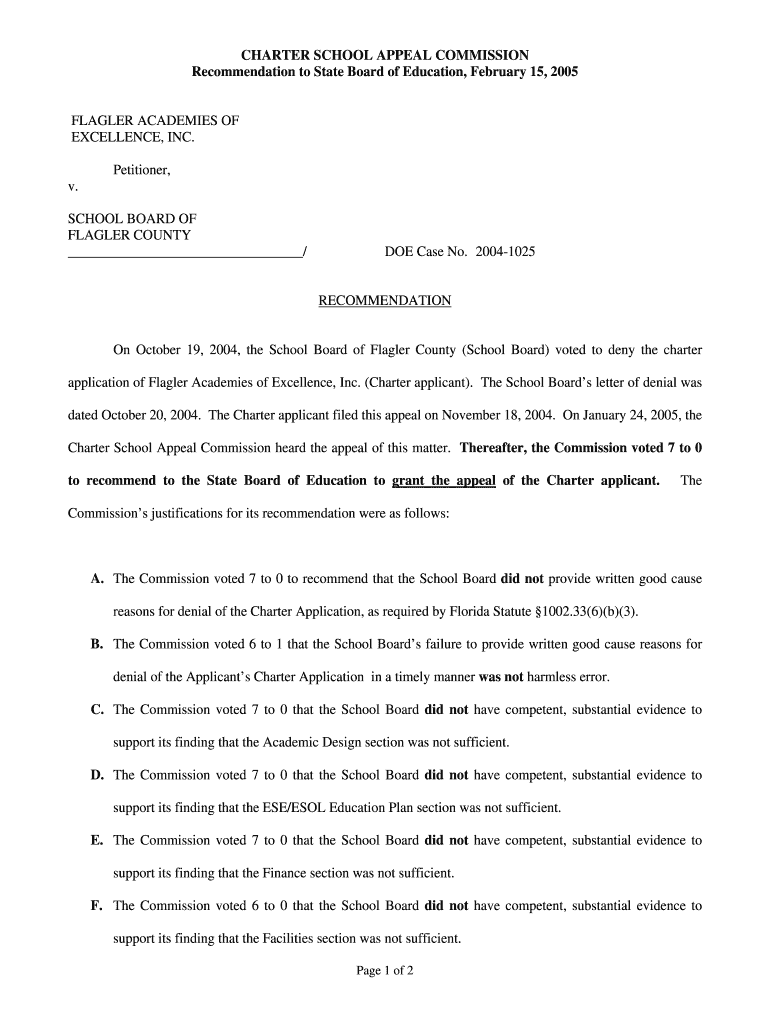
The "Recommendation to State Board of Education, February 15, 2005" is a formal document created by the Charter School Appeal Commission. Its purpose is to advise the State Board of Education on specific appeals, such as the one made by Flagler Academies of Excellence, Inc. This recommendation involves reviewing the decisions made by local education authorities, in this case, the School Board of Flagler County, to determine if adequate reasons and substantial evidence have been provided in their rulings on charter applications.
Key Elements of the Recommendation
This recommendation document includes key components that outline the basis of the Commission’s advice:
- Evaluation of Evidence: The Commission scrutinizes whether the denying school board provided substantial evidence to support its initial decision.
- Analysis of Reasons: It examines the adequacy and clarity of the written reasons given for denying a charter application.
- Voting Outcome: The document typically reflects the Commission's unanimous decision to support or refute the appeal, as observed with Flagler Academies of Excellence.
Who Typically Uses the Recommendation
The primary users of this type of recommendation include:
- Charter School Appeal Commission Members: They draft the recommendations after thorough evaluations.
- State Board of Education Members: They use these recommendations to make informed decisions on appeals.
- Charter Schools: These institutions may reference recommendations to understand the basis of support or denial for their applications.

How to Use the Recommendation
Here is a step-by-step guide on how stakeholders typically use the recommendation:
- Review the Document: Understand the rationale behind the recommendation, focusing on evidence and the reasons provided.
- Align Development Plans: Charter schools should adjust their application strategies based on the feedback and reasoning provided.
- Decision-Making: State Boards use the document to decide whether to uphold or overturn the earlier decision based on presented evidence and recommendations.
Examples of Using the Recommendation
In real-world scenarios, stakeholders might utilize the recommendation as follows:
- Charter Schools: When a charter school like Flagler Academies appeals a denial, they can use the findings in the recommendation to amend weaknesses in their application.
- State Boards: The Board may overrule a local school board’s decision if the recommendation highlights inadequate evidence for the initial denial.
Legal Use of the Recommendation
This document serves as an official piece within the appeals process, adhering to specific legal frameworks:
- ESIGN Act Compliance: Just as documents signed on DocHub are legally binding, recommendations must comply with applicable state educational statutes.
- Evidence in Legal Proceedings: It can be presented as evidence in legal challenges regarding charter school applications.
Important Terms Related to the Recommendation
Understanding the terminology used in the recommendation document is crucial:
- Charter School: A publicly funded independent school established by teachers, parents, or community groups.
- Appeal Commission: A body formed to hear and make decisions on appeals regarding educational rulings.
- Substantial Evidence: Legal concept referring to relevant evidence that a reasonable mind might accept as adequate.
State-Specific Rules for the Recommendation
Differences in state-specific educational policies may influence the recommendation process:
- State Education Laws: Each state has its set of guidelines for evaluating charter school applications, which the Commission follows when providing recommendations.
- Variation in Commission Structures: The organization and authority of appeal commissions can differ across states, impacting the decision-making process.
Steps to Complete the Recommendation
For those involved in drafting a recommendation, here are the general steps:
- Gather Information: Collect all relevant data and past rulings related to the application.
- Evidence Assessment: Analyze the evidence presented by both the applicant and the denying board.
- Draft Recommendations: Populate the document with findings and conclusions.
- Commission Vote: Conduct a vote among Commission members to finalize the recommendation.
Form Submission Methods
Although the recommendation serves a different function from common forms, its process aligns with these submission methods:
- Digital Version: Documents can be digitally created, edited, and reviewed in platforms like DocHub, ensuring streamlined collaboration.
- In-Person Review: A physical meeting may be held for discussion, although digital methods are increasingly prevalent.
Penalties for Non-Compliance
While specific penalties are less relevant to recommendations, ignoring or improperly utilizing the guidance provided can lead to:
- Legal Challenges: Schools may face legal difficulties if they disregard recommendations without valid reasons.
- Reputation Impact: Jurisdictions may suffer reputational damage or face increased scrutiny in future charter school applications.
State-by-State Differences
Each state may present unique challenges and opportunities in the recommendation process:
- Local Policies: Recommendations must comply with state-specific charter school laws.
- Appeal Pathways: Some states might offer additional appeal opportunities beyond the initial recommendation.




