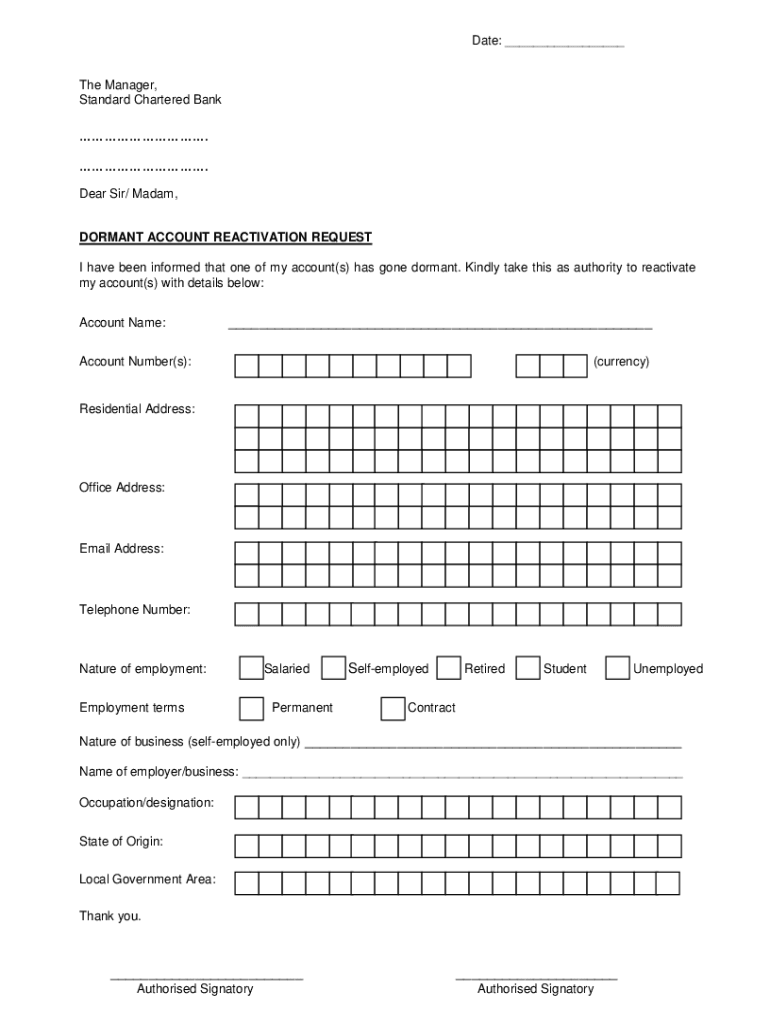







How to Use the Reactivation Form for Standard Chartered Bank
Using the reactivation form for a Standard Chartered bank account involves several essential steps. This document is vital for reactivating accounts classified as dormant. Here are specific instructions and considerations when utilizing this form.
-
Identify the Form: Ensure that the document in question is explicitly for dormant account reactivation. It should be titled prominently, often with the bank's insignia or watermark for authenticity.
-
Provide Accurate Information: Within the form, sections will request personal details, account information, and possibly employment status. Accuracy is crucial to prevent delays.
-
Gather Supporting Documentation: In addition to the form, you might need to enclose identification documents, proof of address, and additional bank-required paperwork to verify your identity and update account records.
-
Submit Through Correct Channels: Check whether the bank requires submission in person, via mail, or electronically. Each bank may have different preferences or requirements depending on the account’s nature and location.
-
Verify Transaction Methods: Ensure your transactions leading to reactivation, such as deposits or transfers, adhere to bank guidelines to successfully revive your dormant account.
Steps to Complete the Reactivation Form
The reactivation process for a Standard Chartered bank account requires careful adherence to outlined steps.
-
Contact Customer Service: Prior to filling out your form, consult with Standard Chartered's customer service. They can guide you on specific steps or additional requirements for your location.
-
Fill Out Personal Details: This includes your name, address, and contact information. Double-check spelling and numbers to avoid mistakes.
-
Include Account Information: Provide your dormant account number and any other relevant account identifiers.
-
Complete Employment Section: If applicable, include current employment status and employer information to help update the bank's records.
-
Submit Identification: Enclose copies of your official ID. This could be a passport or a government-issued ID card.
-
Sign and Date: Ensure you sign and date the document where required, confirming the accuracy of the information.
-
Submit and Confirm: Send the form and supplementary documents via the bank’s preferred method and confirm receipt if possible.
Required Documents for Reactivation
Several documents are typically required to reactivate a dormant bank account with Standard Chartered.
-
Photo Identification: A government-issued photo ID, such as a driver's license or passport, is often necessary.
-
Proof of Address: Recent utility bills or rental agreements that confirm your current address may be required.
-
Account Details: Include statements or documents that verify the dormant account's information.
-
Employment Information: Provide documentation of employment, such as pay stubs or a letter from your employer, if necessary.
Application Process and Approval Time
Understanding the timeline and process for application and approval is essential when seeking to reactivate your account.
-
Initial Review: Once your submission is complete, bank representatives will review your application, verifying all details.
-
Processing Time: Typically, processing may take a few business days to several weeks, depending on backlogged requests and the completeness of your submission.
-
Notification of Reactivation: Upon approval, you will receive notification through your preferred contact method, such as email or phone.
Who Typically Uses the Reactivation Form?
Various individuals may find themselves needing to reactivate a dormant account. Understanding who typically engages with this process can provide context.
-
Long-Term Travelers: Individuals who have spent extended periods abroad might find their accounts dormant upon return.
-
Inactive Account Holders: Consumers who haven't made a transaction in a significant amount of time could require reactivation to restore access to their funds.
-
Executors of Estates: Individuals managing financial affairs after a person’s death might need to reactivate accounts as part of estate management.


Legal Use of the Reactivation Form
Ensuring legal compliance is crucial when completing the reactivation form.
-
Verify Official Documents: Always use forms directly provided by or validated by Standard Chartered to avoid issues with legitimacy.
-
Understand Data Protection: Be mindful of submitting personal information. The bank should provide secure means of transfer to protect your details.
-
Legally Binding Outcomes: Committing false information on reactivation forms can lead to legal consequences, including potential account penalties.
Key Elements of the Reactivation Form
The reactivation form includes several key elements that must be completed accurately to avoid submission issues.
-
Personal Information: Includes name, date of birth, and social security or national insurance number.
-
Account Information: Such as account type, number, and dormant period.
-
Signature Section: Where you must affirm the details you've provided are accurate under penalty of perjury.
Submission Methods for the Reactivation Form
Understanding the nuances of form submission is integral to a successful reactivation process.
-
Online Submission: Some banks may support digital submissions through secure portals. Confirm site URLs to ensure you are on the official platform.
-
In-Branch Drop-Offs: For those who prefer in-person confirmation, bank branches often accommodate submitting reactivation forms directly.
-
Postal Submission: Mailing the form with recorded delivery ensures you have proof of submission date and receipt for records.
Eligibility Criteria for Account Reactivation
Determining eligibility is fundamental when commencing the reactivation process.
-
Account Status: Only accounts deemed dormant—but not closed or settled in full—are eligible for reactivation.
-
Legal Owner Status: You must be the account holder or possess authorization to act on their behalf, such as through a power of attorney.
Each block provides a comprehensive understanding designed to support users through the process of reactivating their Standard Chartered bank account, ensuring depth, accuracy, and utility.