
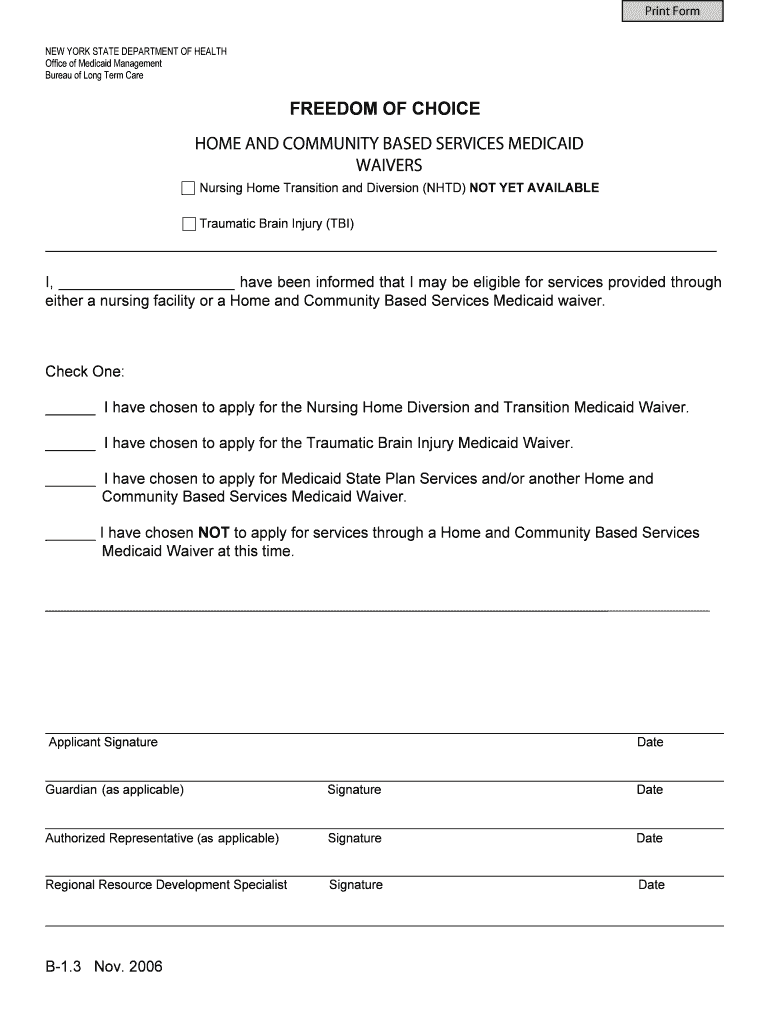







Definition and Purpose of Freedom of Choice for Home and Community Based Services Medicaid
The Freedom of Choice for Home and Community Based Services Medicaid form is a critical document provided by the New York State Department of Health. It is designed to guide eligible individuals through their options regarding Medicaid services, particularly focusing on services that offer care in non-institutional settings. Medicaid beneficiaries can use this form to decide whether they wish to receive services through nursing facilities or specific Medicaid waivers. Two such waivers include the Nursing Home Diversion and Transition Waiver and the Traumatic Brain Injury Waiver. This choice allows individuals to have greater control over their care environment, promoting autonomy and ensuring that personal preferences are respected within the Medicaid program's framework.
-
Nursing Facilities vs. Waivers: Medicaid beneficiaries often face decisions between receiving care in traditional nursing facilities or opting for home and community-based settings through specific waivers. Each setting offers different levels of care and support.
-
Empowerment Through Choice: The form places emphasis on personal empowerment, allowing beneficiaries to select the care setting that best suits their personal, medical, and emotional needs, thus fostering an environment where their values and preferences lead the care they receive.
Steps to Complete the Freedom of Choice Medicaid Form
Completing the Freedom of Choice form effectively requires careful attention to detail and compliance with the procedural steps outlined by the health department. Understanding these steps helps ensure the form is submitted correctly and efficiently.
-
Eligibility Confirmation: Before completing the form, potential applicants must confirm their eligibility for Medicaid waivers. This involves checking income, residency, and individual care needs that qualify for specific waiver programs.
-
Selection of Services: Articulate your preference for receiving care either in institutional settings or through community-based services. Indicate which waiver programs are most suitable for your particular needs, such as the Nursing Home Diversion and Transition Waiver.
-
Personal Details and Signatures: Fill out all personal details accurately, including your name, address, and Medicaid ID number. The form requires signatures from various parties, including the applicant, a guardian or authorized representative if applicable, and a regional resource development specialist.
-
Submission Process: Depending on state-specific guidelines, the completed form can be submitted via mail or in person at a designated health department office. Verify the submission address with the state health department to avoid delays.
Key Elements of the Form
Understanding and accurately completing each element of the Freedom of Choice form is crucial for efficient processing and approval. Each section requires specific information that is integral to assessing eligibility and preferences.
-
Applicant Information: Includes basic details like name, contact information, and Medicaid ID.
-
Service Selection: A critical section where beneficiaries express their choice between institutional and waiver services, highlighting the importance of aligning services with individual care needs.
-
Signature Fields: Designated spaces for the applicant, potential guardians, or representatives, ensuring legal acknowledgment of the choices indicated.
Importance of Freedom of Choice in Medicaid
The concept of freedom of choice is paramount in Medicaid services, affecting both the quality and administration of care.
-
Autonomy and Personalization: Offering choices empowers Medicaid beneficiaries to tailor their care settings, fostering an environment that respects individual autonomy and personal needs.
-
Access to Diverse Services: By choosing between home-based and institutional care, beneficiaries can access a wider range of services that might better suit their lifestyle and health needs.
Legal and Regulatory Considerations
The Freedom of Choice form is not only a practical tool but also serves as a legal document within the Medicaid system.
-
Compliance with Medicaid Policies: Proper completion and submission of this form ensure compliance with state and federal Medicaid guidelines, safeguarding beneficiaries' access to appropriate services.
-
Documentation and Record-Keeping: Maintains a legal record of an individual's choices concerning care settings, which is essential for future health planning and legal purposes.
State-Specific Guidelines and Differences
State-specific guidelines can impact how the Freedom of Choice form functions and is processed.
-
New York State Protocols: Each state's health department may have differing protocols regarding the form. In New York, the form is part of an initiative to move qualified individuals away from institutional care settings and into community-based environments.
-
Waiver Program Variations: The availability and specifics of waivers, like the Traumatic Brain Injury Waiver, may vary by state, affecting eligibility and service delivery.
Examples and Practical Scenarios
Practical scenarios can illustrate how choosing different options on the form affects service outcomes.
-
Case Study 1: An elderly individual transitioning from a hospital stay might use the form to select services through the Nursing Home Diversion Waiver, allowing for home healthcare support.
-
Case Study 2: A young adult with a traumatic brain injury may opt for community-based services under the appropriate waiver, facilitating rehabilitation in a familiar setting.
Documents and Requirements Needed for Submission
Preparing the necessary documents is an essential part of the form submission process.
-
Identification and Proof of Eligibility: Includes personal identification, proof of residency, and any documents proving eligibility for Medicaid or specific waivers.
-
Authorization Signatures: The form must include relevant signatures, which sometimes require notary services, particularly for guardians or authorized representatives.
Alternatives and Versions of the Form
Medicaid offers various forms for different needs, and individuals might encounter alternatives or updated versions through their dealings.
-
Different Waiver Options: Depending on health conditions or age, different forms may apply, each with unique requirements and benefits.
-
Revisions and Updates: Staying informed about revisions ensures that applicants use the most current and appropriate form for their circumstances.
Software and Technology Compatibility
Technological integration aids in the form completion and submission process.
-
DocHub Integration: Users can leverage document management platforms like DocHub to modify, sign, and submit forms electronically, facilitating a seamless and secure submission process.
-
Digital Accessibility: Completing forms digitally increases efficiency, allowing for modifications and electronic signatures that accelerate processing times.




