
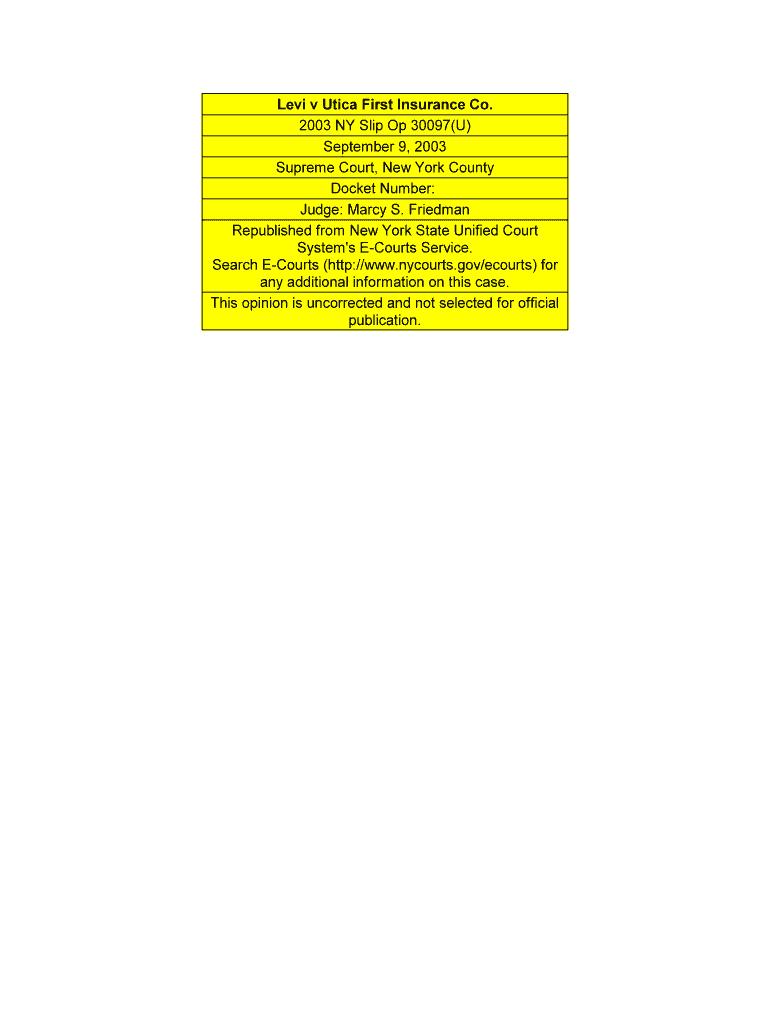







Definition and Meaning
The "Levi v. Utica First Insurance Co - New York State Unified Court System" case involves legal proceedings where plaintiffs Daniella and Ham Levi filed a lawsuit for damages after their insurance claims were denied following a fire that destroyed their home. The defendants, including Utica First Insurance Co., Morstan General Agency, and Eric Derzie, faced allegations of negligence, misrepresentation, and breach of contract. The court addressed multiple motions for dismissal and focused on various claims, determining that some should be dismissed due to a lack of privity while other claims, such as Derzie's potential liability, warranted further examination. The unresolved factual issues about the insurance application process also led the court to deny summary judgment regarding the breach of contract claim against Utica.
How to Use the Levi v. Utica First Insurance Co Form
To engage with the "Levi v. Utica First Insurance Co" form within the New York State Unified Court System, individuals involved in similar cases should carefully review the document for the processes it outlines regarding insurance disputes. This form serves both as a record and a tool for presenting and managing claims in legal contexts. Users will need to ensure they accurately document their claims, align them with specific legal precedents, and include all pertinent information relevant to their case.
Step-by-Step Use
- Review the form thoroughly to understand its components and structure.
- Compile all evidence and documentation supporting your insurance claim.
- Clearly outline the nature of the dispute, including any breach of contract or negligence claims.
- Fill out the form with detailed explanations of events, referencing relevant legal precedents.
Steps to Complete the Levi v. Utica First Insurance Co Form
Completing the form requires attention to detail and adherence to legal standards. Below is a step-by-step guide to ensure that nothing is overlooked:
-
Gather Necessary Information:
- Personal details of claimants and defendants.
- Accurate account of the incident leading to the claim.
- Evidence supporting claims made within the form.
-
Detail Legal Arguments:
- Clearly state each claim related to negligence, breach of contract, and misrepresentation.
- Attach relevant legal precedents and previous court rulings, if applicable.
-
Attach Supporting Documentation:
- Include supporting evidence such as photographs, documents, or witness statements.
- Assemble all communication records related to the insurance claim.
-
Review and Finalize:
- Double-check all entries for accuracy and completeness.
- Ensure all required fields are filled.
-
Submit the Form:
- Follow the specific submission instructions, whether electronically, by mail, or in-person.
Key Elements of the Form
This form contains several critical elements that contribute to its proper execution and legal enforceability. Understanding these components enhances the accuracy and comprehensiveness of submissions:
- Claimant Information: Includes the name, address, and roles of all parties involved.
- Incident Description: Detailed account of the incident leading to the claim.
- Allegations: Lists each allegation separately, clearly defining the basis for each claim against the defendants.
- Supporting Documents: Artifacts that substantiate claims, such as evidence of damages.
- Legal Precedents: Any previous legal decisions that support the current claims.
Legal Use of the Form
The form plays a crucial role in facilitating the legal processes within the New York State Unified Court System by formally documenting the details and arguments of a legal proceeding. Users must adhere to established legal frameworks and guidelines, ensuring that claims are presented transparently and supported by relevant evidence.
Compliance and Precautions
- Accurate Representation: Ensure that all information presented is truthful and free of exaggeration to avoid misrepresentation.
- Timeliness: File within designated legal timeframes to ensure compliance with court schedules.
Important Terms Related to the Case
Familiarity with legal terminology relevant to "Levi v. Utica First Insurance Co" enhances comprehension and usage of the form:
- Negligence: Failure to exercise reasonable care, resulting in harm or damage.
- Misrepresentation: Providing false or misleading information that affects the outcome of a decision.
- Breach of Contract: Violation of any agreed-upon terms verbally or in writing.
- Privity: Legal relationship between parties in a contract.
Examples of Using the Form
Understanding practical applications enhances comprehension of the form's real-world utility:
Scenario 1: Home Insurance Claim Denial
- A homeowner files a lawsuit against their insurer after a denied claim for fire damages. The form helps them document the incident, outline their legal arguments, and present evidence supporting their claims in court.
Scenario 2: Allegations of Misrepresentation
- An individual claims their insurer provided misleading information, affecting policy terms. This form guides the claimant through detailing the alleged misrepresentation and supporting their case with documentation.
Who Typically Uses the Form
Primarily, this form is utilized by individuals navigating legal proceedings involving insurance claims within New York State. Legal professionals, such as attorneys handling insurance disputes, also rely on this form to prepare cases, document procedural aspects, and represent clients in court effectively.


Target Audience
- Plaintiffs: Claimants seeking resolution for denied insurance claims.
- Attorneys: Legal representatives managing the litigation process.
- Courts: Judicial bodies processing and evaluating case details.
State-Specific Rules
The usage of this form follows specific regulations dictated by New York State law, ensuring that the legal process adheres to local jurisdictional requirements. Users must be conscious of these regulations to avoid procedural missteps, which could impact the outcome of their case unfavorably.
New York Considerations
- Local Precedents: Familiarity with state case law and its influence on insurance claims is crucial.
- Standard Protocols: Compliance with filing and submission protocols within New York courts to ensure legality.
These blocks offer a clear, detailed exploration into the "Levi v. Utica First Insurance Co - New York State Unified Court System" with a focus on practicality and real-world application.




