




01. Edit your canada non resident firearm declaration form online
Type text, add images, blackout confidential details, add comments, highlights and more.

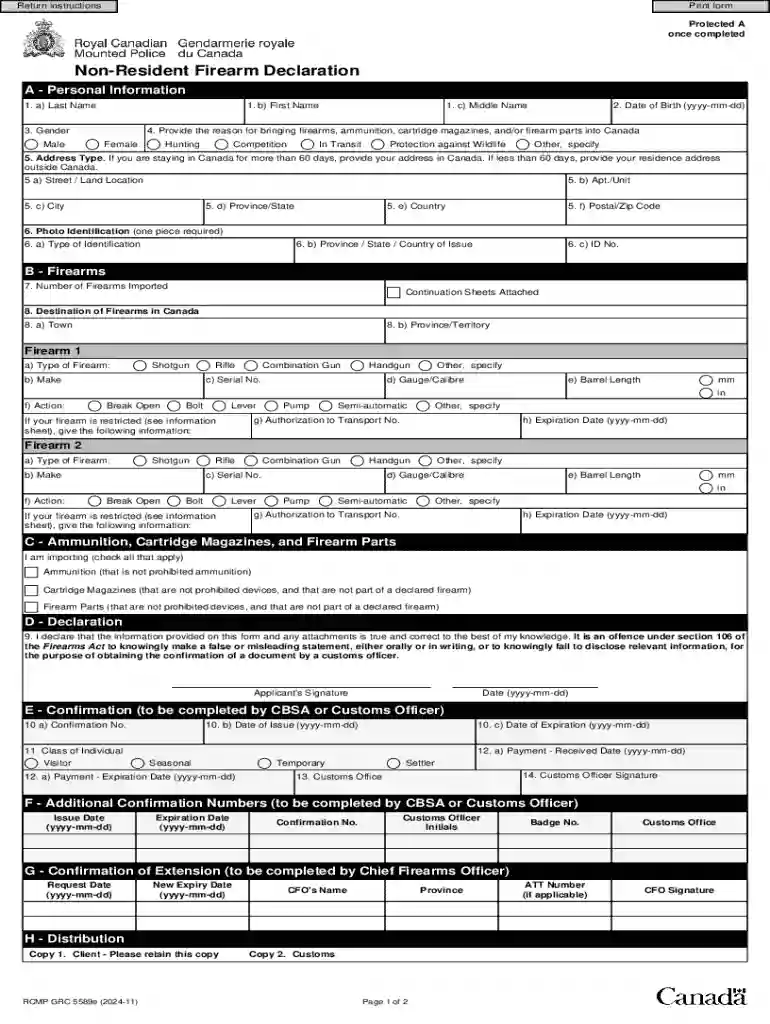
Type text, add images, blackout confidential details, add comments, highlights and more.

Draw your signature, type it, upload its image, or use your mobile device as a signature pad.

Send firearms you continuation download via email, link, or fax. You can also download it, export it or print it out.
The Canada non-resident firearm declaration form serves as an official document that allows non-residents to declare their firearms, ammunition, cartridge magazines, and firearm parts when temporarily entering Canada. Its primary purpose is to ensure that all firearms-related items brought into the country comply with Canadian laws and regulations under the Firearms Act. Non-residents must complete this form to legally possess firearms while in Canada, as it allows authorities to screen and monitor foreign travelers carrying firearms.
Providing accurate and complete information on the form is essential, as failure to do so can result in serious legal repercussions, including fines or confiscation of firearms. Additionally, the declaration promotes safety and security, helping law enforcement maintain oversight of all firearm entries.
Completing the Canada non-resident firearm declaration form involves several key steps to ensure compliance with Canadian regulations. Below is a detailed breakdown of the process.
Gather Required Information:
Access the Form:
Fill Out the Form:
Sign and Date the Form:
Submission:
Understanding specific terminology related to the Canada non-resident firearm declaration form is crucial for navigating the legal landscape of firearm usage in Canada.
An understanding of these terms assists in complying with Canadian firearm regulations, significantly contributing to a successful declaration process.
The Canada non-resident firearm declaration form consists of several critical elements necessary for legal compliance when entering the country with firearms.
Completing these sections is essential to avoid legal complications upon entering Canada. Each detail assists customs officials in making informed decisions about firearm entry.
The legal use of the Canada non-resident firearm declaration form cannot be overstated, as it serves as a critical safeguard against violations of Canadian law.
Everyone must understand their legal responsibilities under the Firearms Act. Failing to adhere to these requirements can have serious implications, reinforcing the necessity of accurately filling out and submitting the declaration form.
Understanding the typical users of the Canada non-resident firearm declaration form helps clarify who may need to complete it.


Individuals in these categories should be well-informed of regulations surrounding the type of firearms they wish to transport. Understanding the process can streamline their experience with Canadian border authorities.
Here are practical examples to illustrate the use of the Canada non-resident firearm declaration form in various scenarios.
A hunter from the United States plans a trip to Alberta for the hunting season. Before traveling, they complete the declaration form detailing their rifle, including make, model, and serial number, as well as the amount of ammunition they will be bringing. Upon arrival, they present the form to customs, allowing for a smooth entry into Canada.
A competitive shooter traveling for an event in Ontario prepares by ensuring their firearms and ammunition are declared on the form. This documentation ensures they can legally participate in the competition without violating any firearm laws.
A non-resident firearm owner visiting family in British Columbia decides to bring their firearm for personal use during their visit. They fill out the form, declaring the firearm appropriately so as to comply with Canadian customs, ensuring a hassle-free experience at the border.
These examples demonstrate the importance of accurately completing the declaration form, showcasing various legal contexts where the form is essential for lawful firearm transport.
We've got more versions of the canada non resident firearm declaration form form. Select the right canada non resident firearm declaration form version from the list and start editing it straight away!
At DocHub, your data security is our priority. We follow HIPAA, SOC2, GDPR, and other standards, so you can work on your documents with confidence.
by E Walsh Details about the firearms may be filled out by law enforcement, but the form is attached to the declaration that the respondent must DocHubRead more
Declaring firearms involves filling out some paperwork, specifically Form 5589, the Non-Resident Firearm Declaration form. There is a $25 fee, payable inRead more


