01. Edit your form online
Type text, add images, blackout confidential details, add comments, highlights and more.

Type text, add images, blackout confidential details, add comments, highlights and more.

Draw your signature, type it, upload its image, or use your mobile device as a signature pad.

Send it via email, link, or fax. You can also download it, export it or print it out.
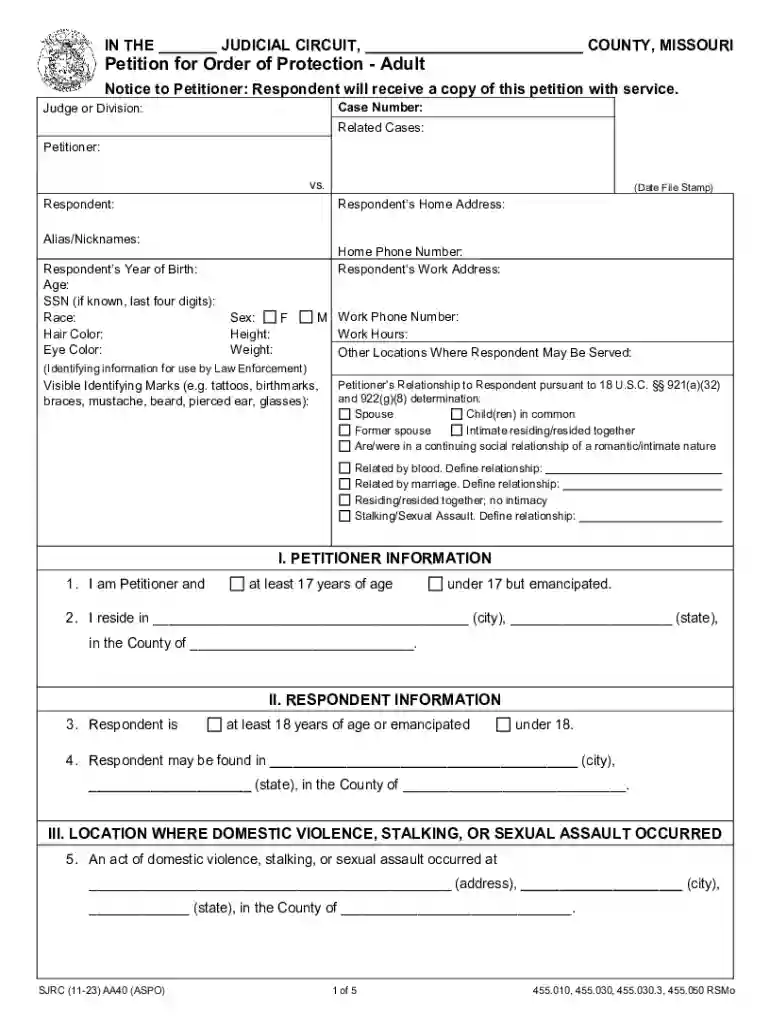
The "Petition for Order of Protection - Adult (AA40)" is a legal document used specifically in the state of Missouri by individuals seeking protection from domestic violence, stalking, or sexual assault. This form is essential for individuals who fear for their safety and require legal intervention to prevent harm. It outlines the type of protection the petitioner is requesting from the court, which may include no-contact orders or restrictions on the respondent's proximity to the petitioner.
To effectively use this form, individuals must detail the incidents that led to seeking protection, providing a narrative of events that illustrate the need for the order. Specific examples should be included to substantiate claims, such as descriptions of physical harm, stalking behavior, or threatening communications. The form also requires the petitioner to identify desired protective measures, such as custody arrangements for children or support payments if applicable.
The Petition for Order of Protection - Adult (AA40) can be obtained online through court websites or in-person at local courthouses in Missouri. Online access ensures convenience, allowing individuals to download the form directly to their computer for completion.
Completing the Petition for Order of Protection involves a step-by-step approach to ensure all necessary legal information is provided and the form is accurately filled out. This careful completion maximizes the chance of the form being accepted and acted upon by the court.
Filing a Petition for Order of Protection is critical for individuals experiencing threats of harm or assault. This legal recourse offers a sense of security and reassurance, enabling law enforcement to take necessary actions against violators. A successful petition not only protects the petitioner but also serves as a legal record of the respondent's behavior.
The Petition for Order of Protection - Adult (AA40) is used predominantly by individuals over the age of 18 who are victims of or at risk from domestic violence, stalking, or sexual assault. These individuals often include spouses, partners, family members, or acquaintances in situations where conflict or harassment has escalated to necessitate court intervention.


The effectiveness of the Petition for Order of Protection hinges on several key elements. Understanding these elements ensures the petition adequately conveys the seriousness of the situation.
In Missouri, certain state-specific rules apply to the Petition for Order of Protection. These rules govern the filing process, including deadlines, required documentation, and specific legal protections available. Adherence to these rules strengthens the validity of the petition and aids in the enforcement of protective measures.
Scenario examples provide insight into typical uses of the Petition for Order of Protection. These examples highlight the form's applicability in real-world circumstances, showcasing its role in safeguarding against threats.
We've got more versions of the Petition for Order of Protection - Adult (AA40) form. Select the right Petition for Order of Protection - Adult (AA40) version from the list and start editing it straight away!
At DocHub, your data security is our priority. We follow HIPAA, SOC2, GDPR, and other standards, so you can work on your documents with confidence.