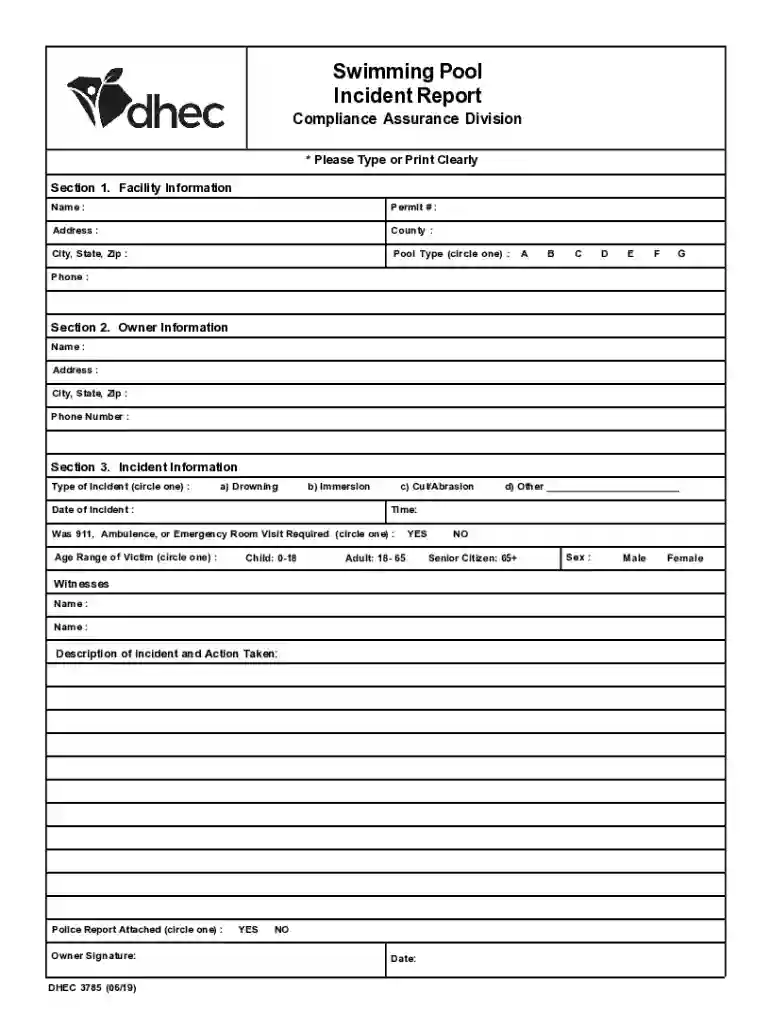
31 Incident Reporting Form page 2 2026

Get Form
31 Incident Reporting Form page 2 Preview on Page 1

Here's how it works

01. Edit your form online
Type text, add images, blackout confidential details, add comments, highlights and more.

02. Sign it in a few clicks
Draw your signature, type it, upload its image, or use your mobile device as a signature pad.

03. Share your form with others
Send it via email, link, or fax. You can also download it, export it or print it out.

Definition & Purpose of the 31 Incident Reporting Form Page 2

The 31 Incident Reporting Form page 2 is designed for detailed documentation of incidents at public swimming pools, specifically those resulting in patron injuries, emergencies, or fatalities. This form ensures that every critical detail surrounding an incident is recorded for compliance with the South Carolina Department of Health and Environmental Control (DHEC). Using this form helps pool owners and operators maintain a thorough account of all incidents, which is necessary for legal compliance and improving future safety protocols.

Key Elements of the Form

  • Incident Details: Describe the nature of the incident, including what happened, when, and where within the facility.
  • Victim Information: Collect comprehensive demographic data about the individuals involved, such as age, gender, and health conditions.
  • Response Actions: Documentation of immediate actions taken during an incident, from first aid to emergency medical services involvement.
  • Witness Statements: Include names and contact details of individuals who were present during the incident, along with their observations.
  • Facility Owner Details: Information about the pool owner or operator, ensuring that there is a point of contact for any follow-ups.

How to Use the 31 Incident Reporting Form Page 2

Step-by-Step Completion

  1. Gather Incident Information: Collect detailed accounts from witnesses and involved parties right after the incident occurs.

  2. Fill Out the Scene Information: Begin by accurately logging the date, time, and specific location within the facility where the incident took place.

  3. Include Victim Details: Fill out sections related to each victim’s personal information, including health status before the incident, to ensure thorough reporting.

  4. Document Response Actions: Note every action taken following the incident, detailing who was involved in the response and what specific steps were carried out.

  5. Obtain Signatures: Ensure that the form is signed by the person completing it and, if possible, any primary witnesses for accuracy and authenticity.


Real-World Scenarios

  • A child slipping near the pool edge, leading to an injury requiring first aid and paramedic attention.
  • An adult swimmer experiencing distress due to a health condition, necessitating an emergency response.
  • Slip and falls in locker rooms, where environmental factors such as wet floors play a role.

Who Typically Uses the Form

decoration image ratings of Dochub

Relevant Users

  • Pool Owners and Operators: Primary users responsible for the facility and the reporting of incidents as per state regulations.
  • Safety Managers: Individuals assigned to oversee the safety protocols and ensure compliance with DHEC mandates.
  • Insurance Representatives: They use the form to process claims related to incidents and verify accuracy.
  • Legal Teams: Engaged when there is a need for accountability and potential litigation following an incident.

Legal Compliance and Consequences

State-Specific Requirements

  • South Carolina DHEC Compliance: The completed form must be directly submitted to DHEC. Not submitting the required documentation can lead to fines and legal repercussions.
  • Retention Periods: Organizations must retain these forms for a specified period as per state guidelines, often several years, for audit and inspection purposes.

Penalties for Non-Compliance

  • Failure to properly report incidents using the 31 Incident Reporting Form can result in penalties, increased scrutiny from regulatory bodies, and potential legal actions against the facility.

Important Terms Related to the Form

  • Incident: Any unintended event requiring emergency intervention at a public swimming pool.
  • Victim: An individual who sustained injury or other negative health impacts due to the incident.
  • Witness: A person who observed the incident unfolding and can provide an account of it.
  • First Aid: Immediate care provided to victims prior to professional medical treatment.
  • Emergency Medical Services (EMS): Health professionals responding to the scene to provide further medical care.

Form Submission Methods

Available Options

  1. Online Submission: Some regions may offer digital submissions via official portals for quick filing.
  2. Mail: Traditional paper submissions are sent directly to the DHEC office, ensuring a documented trail.
  3. In-Person: Direct delivery to a DHEC location for immediate processing and address confirmations.

Examples of Using the Form

Common Incidents

  • Reporting slip and falls that occur due to poor maintenance or wet surfaces around the pool area.
  • Drowning incidents where the victim is rescued and requires subsequent medical evaluation.
  • Inadequate safety equipment leading to possible injury and necessitating incident documentation for corrective action.

Quick Facts

  • Mandatory Use: Required for all significant incidents at public pools.
  • Legal Requirement: Ensures compliance with state health and safety regulations.
  • Comprehensive Coverage: Captures all essential details related to pool-related incidents.
  • Protective Measure: Assists in mitigating legal liabilities through timely and accurate reporting.
be ready to get more

Complete this form in 5 minutes or less

Get form

Got questions?

We have answers to the most popular questions from our customers. If you can't find an answer to your question, please contact us.
Contact us
Incident reports can be categorized into four main types: injury, illness, near miss, and property damage. Each type serves a specific purpose and provides valuable insights into different aspects of workplace safety.
If you do not keep a copy of the online form your records must include the date and method of reporting; the date, time and place of the event; personal details of those involved; and a brief description of the nature of the event or disease.
What are the five rules of incident report writing? Timeliness: Always report the incident as soon as possible. Accuracy: Make sure all information provided is accurate and detailed. Completeness: Be thorough and provide all important details. Confidentiality: Handle sensitive and personal information carefully.
A step-by-step guide to writing a security officer report Step 1: Start with a clear and objective opening statement. Step 2: Provide a detailed account of the incident. Step 3: Describe actions taken by the officer. Step 4: Conclude with any relevant observations or recommendations.
How to Write an Incident Report: A Step-by-Step Guide (with Examples) Step 1: Provide Fundamental Information. Step 2: Take Note of Any Damages and Injuries. Step 3: Identify Affected Individual(s) Step 4: Identify Witnesses and Take Their Statements. Step 5: Take Action. Step 6: Close Your Report.

Security and compliance

At DocHub, your data security is our priority. We follow HIPAA, SOC2, GDPR, and other standards, so you can work on your documents with confidence.

Learn more
ccpa2
pci-dss
gdpr-compliance
hipaa
soc-compliance
be ready to get more

Complete this form in 5 minutes or less

Get form

People also ask

It should include: the names and positions of the people involved. the names of any witnesses. the exact location and/or address of the incident. the exact time and date of the occurrence. a detailed and clear description of what exactly happened. a description of the injuries.
What Are the Five Elements of Report Writing? Include Them for Effective Work 5 Important Elements of Report Writing Every Student Should Know. Executive Summary. An executive summary is one of the most important elements of the report writing. Introduction. Discussion. Conclusion. Recommendations.

Related links