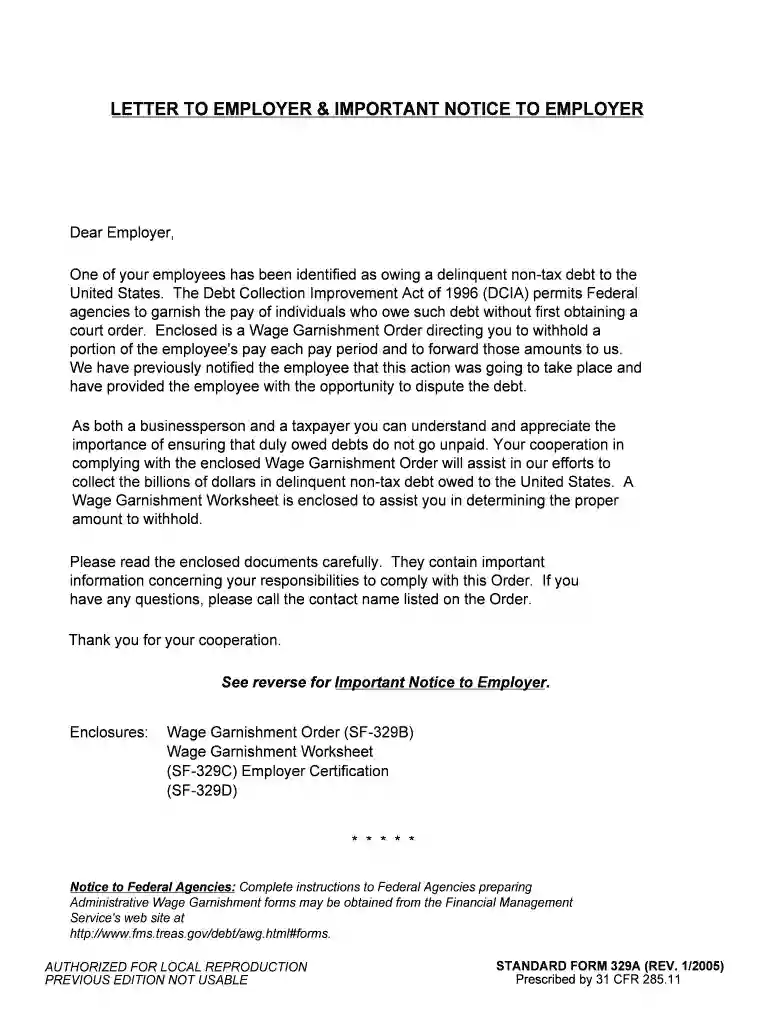
LETTER TO EMPLOYER and IMPORTANT NOTICE TO EMPLOYER 2026

Get Form
LETTER TO EMPLOYER and IMPORTANT NOTICE TO EMPLOYER Preview on Page 1

Here's how it works

01. Edit your form online
Type text, add images, blackout confidential details, add comments, highlights and more.

02. Sign it in a few clicks
Draw your signature, type it, upload its image, or use your mobile device as a signature pad.

03. Share your form with others
Send it via email, link, or fax. You can also download it, export it or print it out.

Definition & Meaning

The LETTER TO EMPLOYER and IMPORTANT NOTICE TO EMPLOYER is a formal document typically used to notify employers about specific legal or procedural obligations. This often involves situations such as wage garnishment orders, where the employer must legally withhold a portion of an employee's wages to satisfy a debt or legal judgment. The document may also provide important notices about legal requirements, definitions of disposable pay, and procedures for handling multiple withholding orders.

Key Aspects of the Definition

  • Wage Garnishment: Refers to the legal process by which an employer is required to withhold a portion of an employee's earnings to pay off the employee's debt.
  • Legal Obligations: Employers are informed about their responsibilities and the legal repercussions of failing to comply with the order.
  • Federal Law Supremacy: It often highlights the precedence of federal law over state law in these matters, ensuring uniform compliance.

How to Use the LETTER TO EMPLOYER and IMPORTANT NOTICE TO EMPLOYER

Using this document effectively requires understanding its components and following a specific protocol to ensure compliance. Employers should follow particular steps when receiving such notices to protect themselves legally and fulfill their obligations.

Step-by-Step Application

  1. Review the Notice: Upon receipt, immediately examine the document for details about the garnishment order, such as the debtor's information and the amount to be withheld.
  2. Determine Compliance Procedures: Understand how the notice interacts with your payroll system and any necessary adjustments to employee wages.
  3. Communication with Employees: If permissible, inform the affected employee about the wage garnishment order and what it entails.
  4. Execute Withholding: Begin wage withholding as instructed by the notice and ensure any withheld wages are forwarded to the appropriate legal or governing body.
  5. Record Keeping: Maintain accurate records of all communications and withholdings related to the garnishment order for legal and auditing purposes.

Practical Examples

  • Implementing wage garnishment for child support as mandated by court order.
  • Withholding earnings for overdue taxes or defaulted student loans based on federal requirements.

Key Elements of the LETTER TO EMPLOYER and IMPORTANT NOTICE TO EMPLOYER

This document comprises several critical components that necessitate careful consideration by employers.

Essential Components

  • Legal Basis: Explanation of the authority by which the garnishment is enforced, often citing specific regulations or laws.
  • Employer Obligations: Detailed instructions outlining the exact actions the employer must take to comply with the order.
  • Consequences of Non-Compliance: Clear consequences for failing to adhere to the outlined requirements, including possible legal or financial repercussions.
  • Definitions: Commonly used terms within the document are defined to ensure clarity, such as "disposable pay" and "garnishee."

Legal Use of the LETTER TO EMPLOYER and IMPORTANT NOTICE TO EMPLOYER

The letter serves as a legal instrument to enforce compliance and protect the rights of all parties involved. It is a significant component of the legal framework surrounding wage garnishments and employer responsibilities.

Compliance Considerations

  • Federal and State Laws: The document often reflects requirements that might be dictated by federal and sometimes state laws, guiding employers through the jurisdictional protocols.
  • Accountability: Precise documentation acts as a safeguard against legal actions due to alleged non-compliance.

Who Typically Uses the LETTER TO EMPLOYER and IMPORTANT NOTICE TO EMPLOYER

The primary users extend across various stakeholders directly engaged with wage-related legalities.


decoration image ratings of Dochub

Common Users

  • Employers: Entities that process payroll and are responsible for implementing wage alterations as dictated by the notice.
  • Legal and Human Resource Departments: Professionals engaged in compliance and employee management will frequently handle these documents.
  • Employees: Although not the primary recipients, they are directly impacted and often advised about the wage adjustments.
decoration image

Real-World Stakeholder Scenarios

  • Small businesses implementing wage deductions due to employee taxes owed.
  • Corporations using extensive HR resources to manage multiple garnishments and legal notices.

Important Terms Related to LETTER TO EMPLOYER and IMPORTANT NOTICE TO EMPLOYER

In order to fully comprehend the document and its implications, certain terms must be well-understood.

Key Definitions

  • Disposable Pay: The portion of an employee's earnings remaining after federal, state, and local taxes and other legally required deductions have been withheld.
  • Withholding Order: A legal mandate requiring an employer to withhold a portion of an employee's paycheck.
  • Garnishee: The party (employer) responsible for withholding earnings as per the garnishment order.

Steps to Complete the LETTER TO EMPLOYER and IMPORTANT NOTICE TO EMPLOYER

Completing this form involves a careful process to ensure accuracy and compliance throughout the execution.

Sequence of Actions

  1. Read Thoroughly: Begin by comprehensively understanding the document, including all legal references and obligations.
  2. Verify Details: Confirm the employee's details and debt specifics to ensure all information aligns with the notice.
  3. Integrate into Payroll: Adjust the payroll system according to the withholding requirements specified.
  4. Document and Report: Accurately record all actions taken and submit any required reporting to relevant authorities or agencies.

Penalties for Non-Compliance

The consequences for failing to respond appropriately to the letter and notice are severe, underscoring the need for strict adherence to the instructions.

Possible Penalties

  • Fines: Monetary penalties may be imposed on the employer for not complying with the garnishment order.
  • Legal Action: Employers may face lawsuits or legal proceedings, potentially impacting their business operations.
  • Increased Scrutiny: Non-compliance can lead to increased monitoring and audits by financial and legal authorities, adding operational burdens.
be ready to get more

Complete this form in 5 minutes or less

Get form

Got questions?

We have answers to the most popular questions from our customers. If you can't find an answer to your question, please contact us.
Contact us
Employers generally must begin garnishing wages as soon as they receive an order to do so from a court or agency. Employees can contest the garnishment, but employers must continue to comply with the original order until they are told otherwise by the court or agency that issued it.
[Todays date] Dear [name of manager], Please accept this as notice of my resignation from the position of [your job title] at [business or organisation name]. Since my notice period is [X weeks/months], I believe my last day will be [date]. Please let me know if that is incorrect.
Employers are typically required by law to inform employees when their wages are subject to garnishment, allowing them the opportunity to respond or challenge the order. Without proper notification, you may not have the chance to address the issue, potentially leading to unexpected deductions from your paycheck.
Wage garnishments are done when you owe money. The person you owe money to contacts your employer (OR ANY OTHER SOURCE OF PERSONAL INCOME) and financial institution to tell them that you owe them money and they want you to pay up. The employer then gives them a portion of your paycheck until the balance is paid.
Dear [Employee Name], We hope this letter finds you well. Unfortunately, we have received a wage garnishment order from [creditor name], which requires us to withhold a portion of your earnings from each paycheck until the debt is paid in full.

Security and compliance

At DocHub, your data security is our priority. We follow HIPAA, SOC2, GDPR, and other standards, so you can work on your documents with confidence.
Learn more
ccpa2
pci-dss
gdpr-compliance
hipaa
soc-compliance
be ready to get more

Complete this form in 5 minutes or less

Get form

People also ask

Creditors generally cannot garnish more than 25 percent of your disposable wages. Disposable wages are the earnings that remain after deducting all withholdings required by law, or any of your disposable wages if you make less than $380 per week. These limits do not apply to judgments for child support.
Wage Garnishment Order (SF-329B): This Wage Garnishment Order is to be completed by the Federal Agency issuing the Wage Garnishment Order, and must be included as part of the form mailed to employers.

Related links