




01. Edit your form online
Type text, add images, blackout confidential details, add comments, highlights and more.

Type text, add images, blackout confidential details, add comments, highlights and more.

Draw your signature, type it, upload its image, or use your mobile device as a signature pad.

Send it via email, link, or fax. You can also download it, export it or print it out.
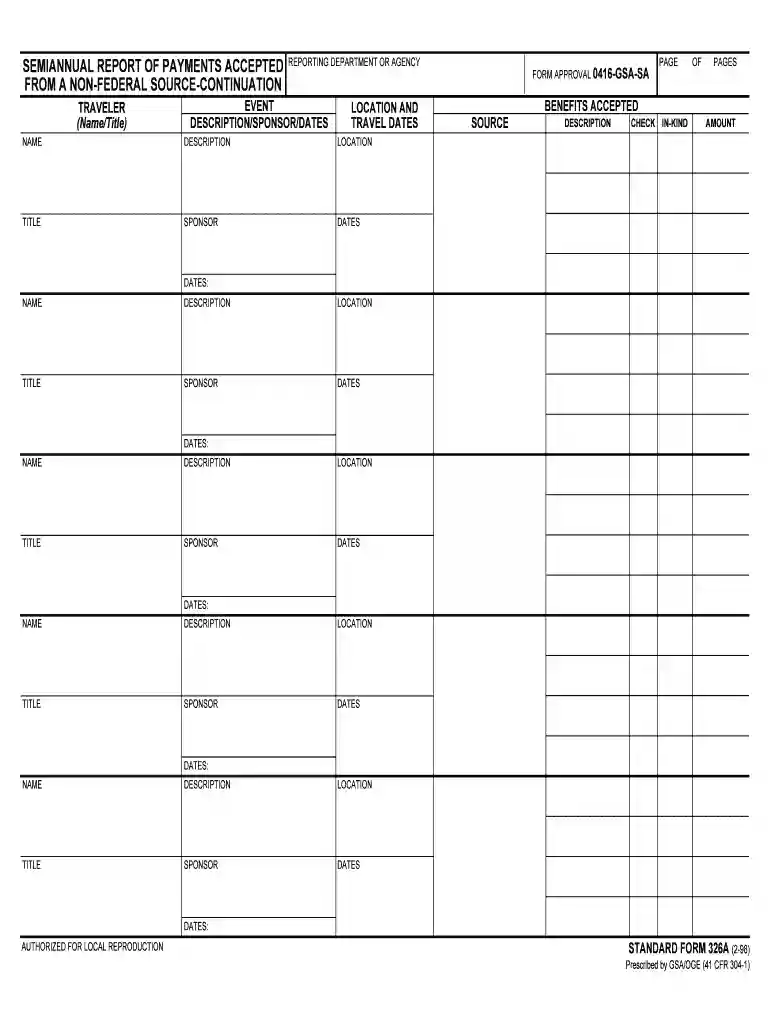
The term "FROM A NON-FEDERAL SOURCE-CONTINUATION" refers to a specific governmental form used primarily to document and report payments or benefits received by federal employees from non-federal sources. This form is an extension of reports detailing such transactions, ensuring a comprehensive record of any gifts, travel reimbursements, or other compensations provided by non-federal entities. This documentation helps maintain transparency and adherence to government ethics rules, preventing any conflicts of interest.
When using the "FROM A NON-FEDERAL SOURCE-CONTINUATION" form, the main objective is to accurately log all relevant transactions and details that are not covered in the initial report. Here’s a step-by-step guide on completing the form:
Identify Additional Transactions: Review all engagements with non-federal sources and identify any additional transactions not included in the initial report.
Detail Event Information: For every transaction, provide a clear description of the event or activity, including the purpose, date, and location.
List All Contributors: Note the names and titles of individuals or organizations contributing to the payment or benefit, ensuring all parties are accounted for.
Specify Benefits Received: Clearly list both cash and in-kind contributions, specifying the exact amount or value of benefits received.
Complete Sections for Multiple Entries: If necessary, use additional pages or forms to ensure every entry is thoroughly documented.
Review and Verify Accuracy: Double-check all entries for accuracy, as errors could lead to non-compliance issues.
To complete the "FROM A NON-FEDERAL SOURCE-CONTINUATION" form, follow these essential steps:
Gather Necessary Documentation: Collect all receipts, itineraries, and correspondence related to the non-federal benefits received.
Access the Form: Obtain the form through your agency’s administrative office or via the appropriate federal website.
Enter Personal and Event Details: Begin by filling personal details and specifics of each event associated with non-federal contributions.
Document Each Payment:
Additional Information:
Submit for Review: Before submission, ensure the form is complete and submit it to your agency's ethics office for review and record-keeping.
This form involves several key elements crucial for maintaining transparency:
Event Descriptions: Detailed narratives of each non-federally sponsored event.
Sponsor Information: Precise identification of non-federal sponsors, including their affiliations.
Dates and Locations: Accurate recording of all event-specific details, contributing to the integrity of documentation.
Contribution Types: Differentiation between cash and in-kind contributions, ensuring clear categorization.
Signatures and Approvals: Mandatory verifications by relevant authorities to legitimize the form.
To utilize the "FROM A NON-FEDERAL SOURCE-CONTINUATION" form, individuals must meet certain criteria:
Federal Employment: Primarily targeted at federal employees who receive benefits from external sources.
Receipts of Non-Federal Benefits: Eligibility depends on the receipt of payments or benefits from entities not associated with the federal government.


Failure to properly complete and submit the "FROM A NON-FEDERAL SOURCE-CONTINUATION" form can result in significant penalties:
Ethics Violations: May lead to disciplinary actions, including suspension or termination of employment.
Legal Consequences: Potential for fines or legal repercussions if found deliberately concealing or misrepresenting information.
This form is commonly used by:
Federal Employees: Individuals in government roles who engage in activities funded by non-federal sources.
Ethics Officers: Personnel tasked with maintaining ethical standards within federal agencies.

The legal framework surrounding this form ensures transparency and accountability:
Compliance with Ethics Standards: Aligns with federal ethics guidelines, reducing the risk of conflicts of interest.
Documenting Non-Federal Engagements: Legally binding record of interactions with outside entities, required for government transparency.
Understanding deadlines is crucial to compliance:
Submission Timeline: Typically required semiannually or as dictated by specific agency guidelines.
Agency-Specific Deadlines: Vary depending on the agency’s internal processes and policies.
Maintaining a thorough and detailed approach to filling out and submitting the "FROM A NON-FEDERAL SOURCE-CONTINUATION" form is essential for federal employees to ensure compliance and transparency in their interactions with non-federal entities.
We've got more versions of the FROM A NON-FEDERAL SOURCE-CONTINUATION form. Select the right FROM A NON-FEDERAL SOURCE-CONTINUATION version from the list and start editing it straight away!
| Versions | Form popularity | Fillable & printable |
|---|---|---|
| 1998 | 4.8 Satisfied (121 Votes) |
At DocHub, your data security is our priority. We follow HIPAA, SOC2, GDPR, and other standards, so you can work on your documents with confidence.

OLEM review includes OSRTI for non-federal facilities and. Locations and characterizations of continuing releases or sources (TI eval. Transport, and Fate
In cases of continued inability or unwillingness of a non-federal entity to have an audit conducted in accordance with this part, Federal agencies or passRead more


