01. Edit your form online
Type text, add images, blackout confidential details, add comments, highlights and more.

Type text, add images, blackout confidential details, add comments, highlights and more.

Draw your signature, type it, upload its image, or use your mobile device as a signature pad.

Send it via email, link, or fax. You can also download it, export it or print it out.
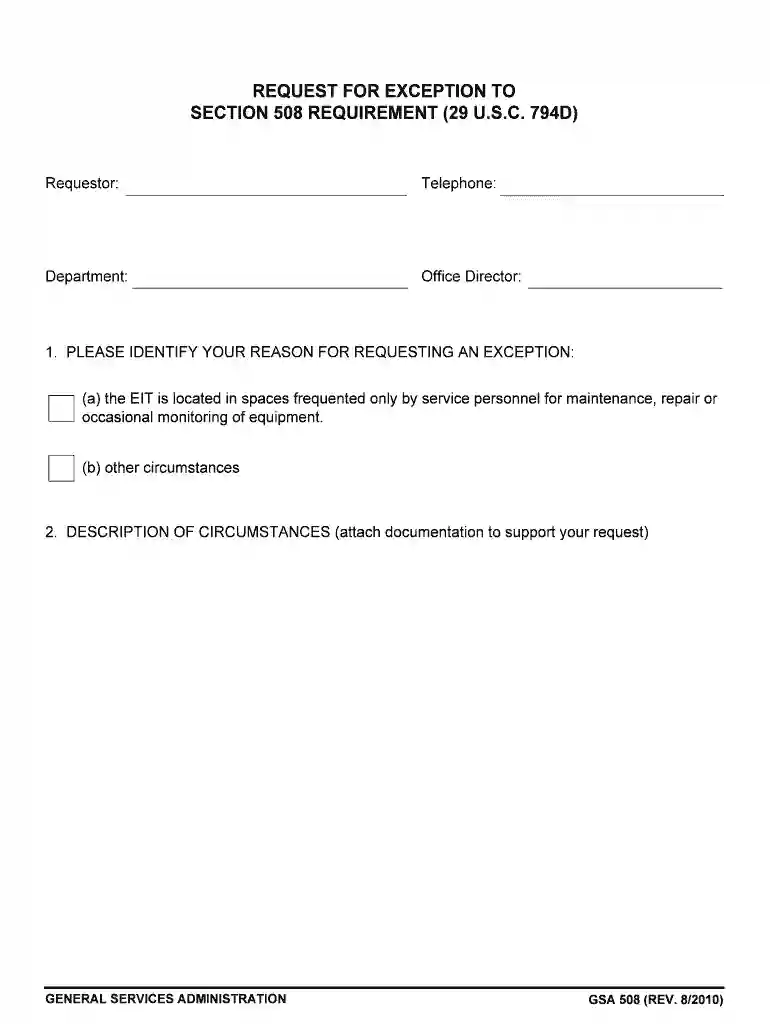
The IT Accessibility Laws and Policies under Section 508 are part of the Rehabilitation Act of 1973, designed to ensure that electronic and information technology (EIT) developed, procured, maintained, or used by the federal government is accessible to people with disabilities. This law mandates that all federal agencies and contractors must provide accessible EIT, ensuring that individuals with disabilities have equal access to government services and information. The General Services Administration (GSA) provides governance and oversight for compliance with these standards, reviewing requests for exceptions and providing guidelines for legal adherence.
To comply with Section 508, organizations must follow a detailed step-by-step process. First, assess the current technology systems to identify areas where accessibility improvements are needed. This involves conducting audits to ensure adherence to the Web Content Accessibility Guidelines (WCAG). Next, implement corrective actions based on audit findings, such as modifying software, training personnel, or updating hardware. Once changes are in place, organizations should perform a secondary review to ensure all modifications meet compliance standards. Finally, establish ongoing monitoring systems to maintain compliance, involving regular audits and updates as technology evolves.
Ensuring compliance with IT Accessibility Laws and Policies under Section 508 is crucial for several reasons. Primarily, it provides equal access to individuals with disabilities, fostering inclusivity and equality. This compliance avoids potential legal ramifications from non-compliance and enhances the organization's public image by demonstrating a commitment to diversity. Additionally, accessible technology improves overall usability, benefiting all users, not just those with disabilities. It ensures the organization remains eligible for government contracts, which often require adherence to Section 508 standards as a condition of contract procurement.
The primary users of IT Accessibility Laws and Policies under Section 508 are federal government agencies and their contractors. These entities must ensure their electronic and information technology systems are compliant. However, private-sector companies that aim to partner with government agencies or provide technology solutions to them also need to comply with these standards. Additionally, IT professionals, accessibility experts, and legal advisors often interact with Section 508 regulations to guide organizations towards compliance and manage accessibility audits and improvements within the entity.


The core elements of Section 508 focus on ensuring that all digital and technological resources are accessible. This includes compatibility with screen readers, accessible navigation, and alternative text for images. The law also mandates that multimedia content like videos or audio must include captions or transcripts to accommodate those with hearing impairments. Further, all software programs must be operable using a keyboard interface, ensuring accessibility for individuals who cannot use a mouse. These stipulations ensure that technology has universal accessibility, allowing everyone equal opportunities to access and benefit from the services.
Section 508's legal framework mandates compliance, with potential consequences for entities that fail to meet the standards. The framework includes a set of detailed guidelines that IT should adhere to, which are critical during the procurement process for any electronic and IT by federal agencies. Non-compliance could result in the loss of government contracts or litigation for discriminative practices. Therefore, legal advisors are often involved in ensuring that companies meet all regulatory requirements, thus safeguarding them from penalties, and upholding the spirit of the law by promoting accessibility and equality.
While Section 508 is a federal regulation, states may have their accessibility laws and standards that align with or extend beyond federal requirements. For example, California's laws might require additional standards for state government websites to ensure accessibility, which could go beyond the federal framework. States may also impose additional reporting or auditing requirements to ensure compliance. Entities operating in multiple states need to be mindful of these variations to ensure comprehensive adherence to both federal and local laws, optimizing accessibility across all jurisdictions.
Consider a federal agency implementing new software for internal operations. Under Section 508, this software must be evaluated for accessibility features ensuring compatibility with screen readers and alternative text descriptions. Successful compliance allows all employees, including those with disabilities, to work efficiently with the new system. Another example involves a contractor bidding on a federal project; they must demonstrate their technology adheres to Section 508 standards to qualify for the contract. These scenarios highlight the importance of integrating accessibility into technological development from inception to ensure compliance and foster inclusivity.
We've got more versions of the IT Accessibility Laws and PoliciesSection508 form. Select the right IT Accessibility Laws and PoliciesSection508 version from the list and start editing it straight away!
At DocHub, your data security is our priority. We follow HIPAA, SOC2, GDPR, and other standards, so you can work on your documents with confidence.