




01. Edit your form online
Type text, add images, blackout confidential details, add comments, highlights and more.

Type text, add images, blackout confidential details, add comments, highlights and more.

Draw your signature, type it, upload its image, or use your mobile device as a signature pad.

Send it via email, link, or fax. You can also download it, export it or print it out.
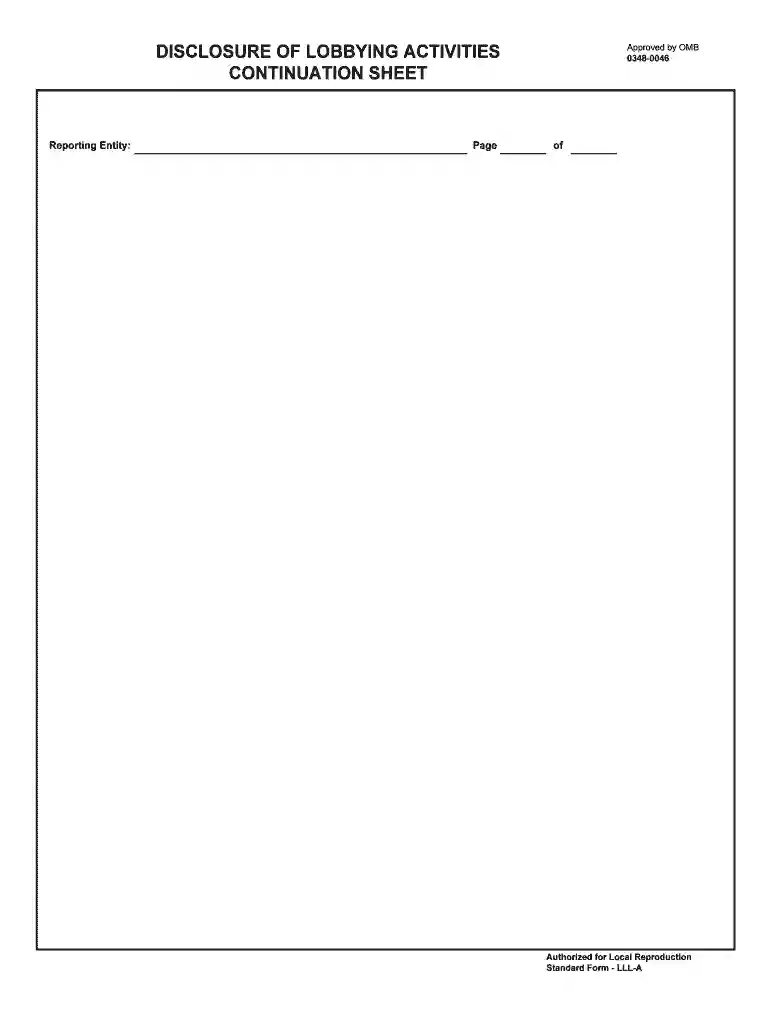
The "disclosure of lobbying activities continuation sheet - GSA" is a supplementary form utilized in the United States by entities or individuals who engage in lobbying activities. It serves as an extension to the primary lobbying disclosure form, providing additional space to detail further lobbying actions, participants, or specific legislative proposals addressed. This form is regulated by the General Services Administration (GSA) and is essential for maintaining transparency in interactions between lobbyists and government officials. The use of this continuation sheet is governed by the standards set by the Office of Management and Budget (OMB), ensuring compliance with federal reporting requirements.
When completing the continuation sheet, it is essential to provide precise and comprehensive information. Begin by identifying the primary lobbying form to which this continuation sheet is attached. List all additional lobbying activities not covered in the main document. For each entry, include detailed descriptions of the lobbying issues, the governmental bodies or officials contacted, and the date and nature of the communications. This form is designed to ensure that all lobbying efforts are fully disclosed and transparent, complying with federal requirements to provide a complete picture of lobbying activities.
The disclosure of lobbying activities continuation sheet can be easily accessed through the GSA's official website or through authorized government documentation portals. It is also available for download in PDF format, ensuring compatibility across various platforms and devices. For entities not digitally inclined, the continuation sheet can often be requested via mail or picked up at designated government offices that manage lobbying disclosures.
This streamlined process helps ensure that all lobbying disclosures are thorough and compliant with federal guidelines.
The key elements of this continuation sheet include sections for identifying additional lobbying activities, detailing specific contacts, and describing the exact nature of government interactions. It is important to fill out all fields accurately and comprehensively to comply with legal requirements. Each section facilitates the thorough reporting needed for federal transparency standards.
The legal use of this continuation sheet is to provide an obligatory supplement to primary lobbying disclosures as mandated by federal law. It is used to document extensive lobbying activities that exceed the space provided in the standard form. Legally, entities must ensure that all lobbying efforts are truthfully reported to avoid penalties and maintain compliance with the Lobbying Disclosure Act.
Non-compliance with the reporting requirements for lobbying activities raises significant legal risks, including potential fines and legal action. Penalties are imposed for failure to disclose adequately or for submitting inaccurate information. Ensuring the continuation sheet is correctly filled out is vital to sidestepping such consequences.
The continuation sheet is predominantly used by organizations, companies, and individual lobbyists actively engaging with federal government officials. These include businesses, non-profit organizations, and professional lobbyists or advocacy groups who interact with governmental bodies on policy or legislative decisions.
This comprehensive coverage ensures that all potential users are well-informed about how and why to use the continuation sheet effectively.


At DocHub, your data security is our priority. We follow HIPAA, SOC2, GDPR, and other standards, so you can work on your documents with confidence.

Disclosure of Lobbying Activities Continuation Sheet Information Form Number: SFLLLA Current Revision Date: 07/1997 Authority or Regulation: Download file [PDF
NEW Government-wide Continuing Appropriations, This policy was in place in 2024, but was then withdrawn in 2025. Government Wide Lobbying Disclosure Act of
Apr 27, 2018 Successful FOIA disclosures in some cases require legislative reforms to force the release of the desired information.


