




01. Edit your bais din maysharim online
Type text, add images, blackout confidential details, add comments, highlights and more.

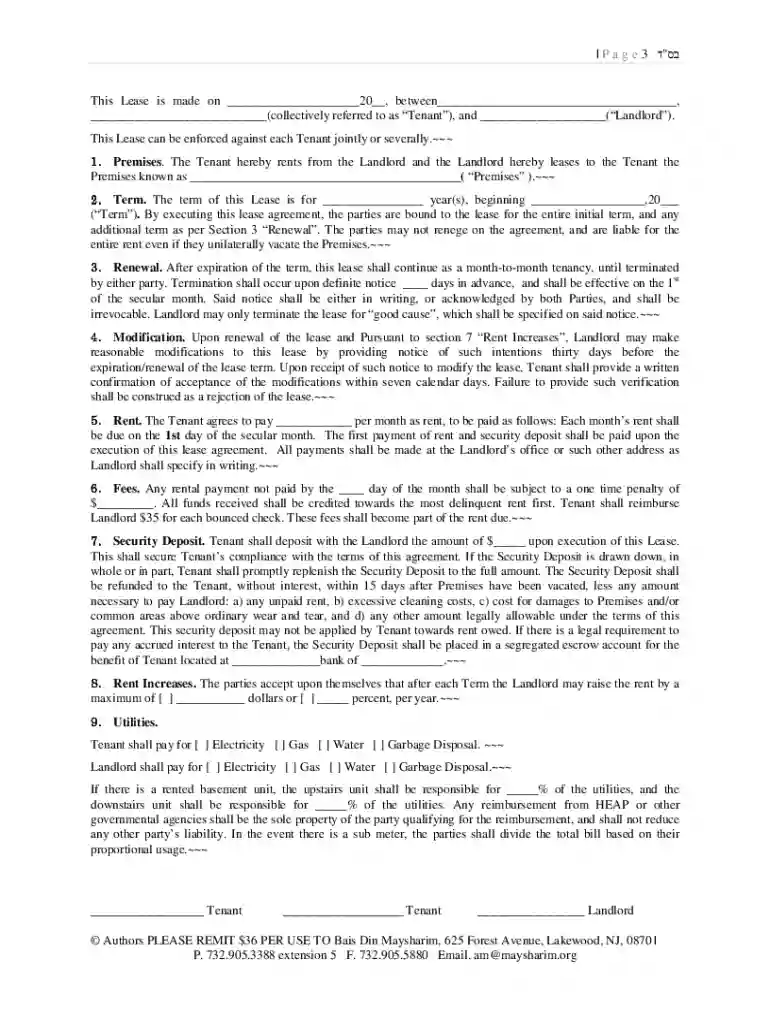
Type text, add images, blackout confidential details, add comments, highlights and more.

Draw your signature, type it, upload its image, or use your mobile device as a signature pad.

Send maysharim via email, link, or fax. You can also download it, export it or print it out.
The term "Bais Din Maysharim" refers to a Jewish court system where disputes are resolved according to Halacha, or Jewish law. This system is typically used by communities and individuals who wish to ensure that their legal matters are handled in accordance with traditional Jewish principles. A Bais Din generally comprises rabbinical judges who are well-versed in both religious texts and contemporary legal issues. The Bais Din Maysharim specifically addresses the needs of observant Jewish landlords and tenants by adjudicating cases related to residential lease agreements, among other matters.
Engaging with the Bais Din Maysharim involves several steps. Initially, both parties must agree in writing to submit their case to the Bais Din for binding arbitration. Once an agreement is reached, you can present your case, supported by any relevant documentation such as lease contracts or correspondence. The judges will review the evidence, hear arguments from both sides, and make a ruling based on Halacha. This process ensures that the outcome aligns with Jewish law while also providing a fair and impartial resolution.
Filing a case involves a series of straightforward steps, ensuring that all necessary components are addressed systematically:
The Bais Din Maysharim is primarily used by Jewish landlords and tenants looking for resolutions in rental disputes, but it is open to others who wish to settle their disputes according to Halacha. Other frequent users include businesses seeking mediation on contractual issues, marital disputes needing resolution, and community members involved in personal disagreements. The system is particularly advantageous for those who value resolving issues within the boundaries of cultural and religious practices.


Several critical elements define the functioning and effectiveness of the Bais Din Maysharim:
Under U.S. law, the Bais Din's decisions are legally binding, provided that parties have agreed to arbitration and the process complies with federal and state laws governing arbitration. This ensures that outcomes are enforceable in secular courts. Furthermore, it offers an alternative legal forum that doesn't compromise traditional beliefs, providing a dual-layer of confidence for participants looking for religiously compliant impartial adjudication.
While the basic arbitration framework remains consistent, some state variations may influence the operational aspects of the process:
Forms for initiating a case with the Bais Din Maysharim can often be submitted both digitally and in paper format. A digital submission allows for easier access, reduced paperwork, and quicker processing times. Both methods require similar information, such as personal details and a description of the dispute. Digital submissions are increasingly preferred due to their convenience and the easy tracking of submission status.
Depending on the jurisdiction and the specific requirements of the Bais Din, forms can be submitted:
Each method provides diverse benefits depending on user preference and technology comfort level, with online submissions being the increasingly dominant format.
Tools such as DocHub provide seamless solutions for filling out and signing Bais Din Maysharim forms. The platform enables users to edit documents online, add legally binding signatures, and manage documentation securely. Compatibility with cloud storage services enhances the submission and management of forms, facilitating an efficient and user-friendly experience through integration with widely used platforms such as Google Workspace.
Log in to your DocHub account and add your bais havaad lakewood to our editor using one of its upload options - from your device, cloud storage, protected URL, or your DocHub folders if you have already processed your form before. Open our editor, click the Sign key in the upper toolbar, and choose your signing method. You can upload a picture of your handwritten signature, draw it, enter your name, or use a QR code instead.
You can find the latest and most relevant version of the bais din maysharim lakewood in our DocHub forms collection. Browse it by categories or use the search field to get the exact template that suits your case. You can open this form for editing once you find it.
At DocHub, your data security is our priority. We follow HIPAA, SOC2, GDPR, and other standards, so you can work on your documents with confidence.



Dec 5, 2025 The parties Agreement to Arbitrate with Rabbi. Marburger (leader of Bais Din Maysharim in Lakewood) provided that he could renderRead more
by MA Helfand 2019 Cited by 16 Maysharim Bais Din of Lakewood; and Bais Din Tzedek UMishpat of New York). 354. Id. at 1214. 355. Brief of the United States Conference ofRead more


