Domestic Violence FormsNew Mexico Courts 2026

Get Form
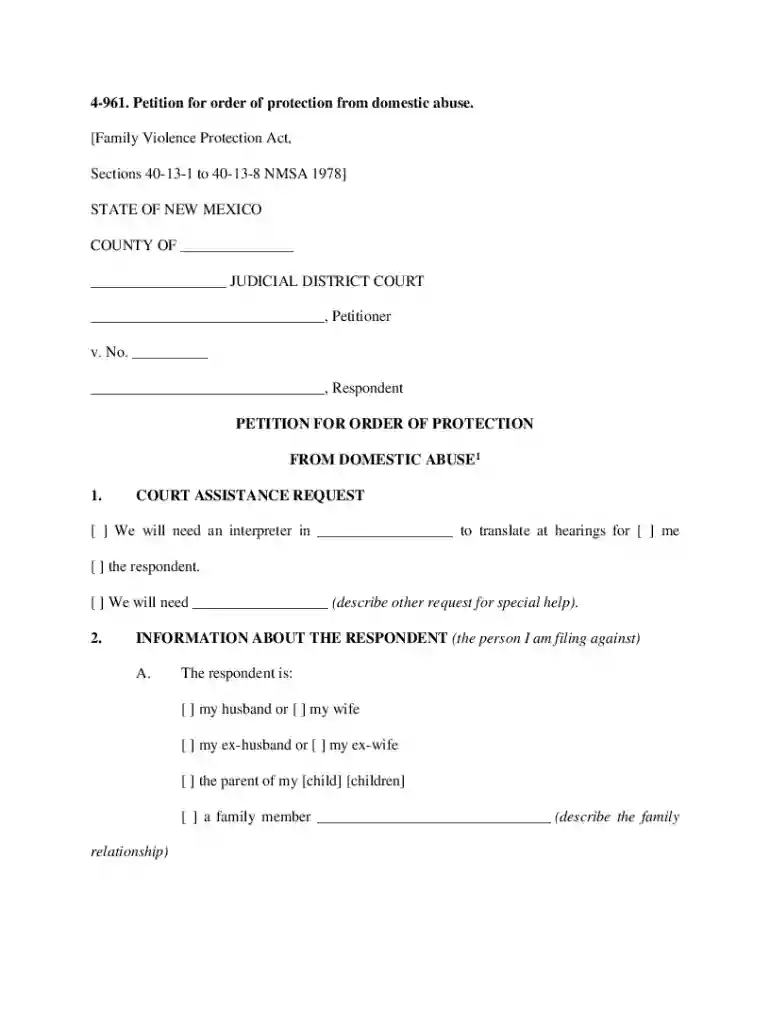
Domestic Violence FormsNew Mexico Courts Preview on Page 1

Here's how it works

01. Edit your form online
Type text, add images, blackout confidential details, add comments, highlights and more.

02. Sign it in a few clicks
Draw your signature, type it, upload its image, or use your mobile device as a signature pad.

03. Share your form with others
Send it via email, link, or fax. You can also download it, export it or print it out.

Definition & Meaning of Domestic Violence Forms in New Mexico Courts

Domestic violence forms in the New Mexico court system are legal documents used to address and manage cases of domestic abuse. These forms serve as an official means for victims to seek protection and hold abusers accountable. The forms are designed to capture vital information about the parties involved, including the petitioner, who is seeking protection, and the respondent, who is the alleged abuser. These documents are critical for initiating legal actions under the Family Violence Protection Act, providing victims with avenues for safety and legal recourse.

Detailed Explanation

Domestic violence forms are integral to the process of obtaining a protective order, which can include various measures designed to ensure the safety of the petitioner. The forms are comprehensive, detailing incidents of violence, the relationship between the parties, and any immediate threats to the petitioner or their children. Through this information, the courts can determine the necessity and scope of protective measures, ensuring they are aligned with the legal requirements and specific circumstances of each case.

How to Obtain Domestic Violence Forms from New Mexico Courts

Acquiring the domestic violence forms required by the New Mexico courts involves a straightforward process, but it may differ depending on individual circumstances.

Acquisition Methods

  1. In-Person at the Courthouse: Many individuals obtain forms directly from their local courthouse. Courthouses typically have a designated area or assistance booth for individuals seeking protective orders.
  2. Online Platforms: Various court websites and legal platforms offer downloadable versions of these forms, enabling users to complete them conveniently at home.
  3. Legal Aid Services: Organizations providing legal assistance to victims of domestic violence often supply these forms and offer guidance on completing them.

Considerations

When obtaining forms online, ensure that the platform or website used is an official or trusted source. This helps avoid any discrepancies in the information required by the courts.

Steps to Complete the Domestic Violence Forms in New Mexico Courts

Completing domestic violence forms is a meticulous process that requires accuracy and thoroughness, as the protection offered hinges on the details provided.

Detailed Completion Steps

  1. Personal Information: Begin by filling in the personal details of both the petitioner and the respondent. This includes names, addresses, and relationship status.
  2. Description of Incidents: Clearly outline the incidents of violence or threats. It is vital to include dates, locations, and detailed descriptions of each incident.
  3. Children Involved: If applicable, include details about any children involved, such as their names, ages, and the nature of their relationship to both parties.
  4. Requested Orders: Specify what protective measures are being sought, such as restraining orders or temporary custody arrangements.
  5. Signatures and Notarization: Ensure that all required signatures are obtained and that the form is notarized if required by court rules.

Tips

  • Double-check all entries for accuracy and completeness to prevent delays in processing.
  • Seek assistance from legal professionals or advocacy groups specializing in domestic violence cases to ensure the form is correctly completed.

Key Elements of Domestic Violence Forms in New Mexico Courts

Domestic violence forms contain several critical sections, each serving a specific function in the protective order process.

Essential Sections

  • Petitioner's Information: To establish the identity and qualifications of the individual requesting protection.
  • Respondent's Information: To accurately identify the individual from whom protection is sought.
  • Incident Description: A detailed account that enables the court to understand the severity and context of the allegations.
  • Children's Details: For cases involving minors, to consider their safety and welfare.
  • Orders Requested: Specific protective measures desired by the petitioner, which can influence the types of orders granted by the judge.

State-Specific Rules for Domestic Violence Forms in New Mexico Courts

The state of New Mexico has particular rules and statutes governing the use of domestic violence forms, which must be adhered to ensure legal efficacy.

Pertinent Rules

  • Family Violence Protection Act Compliance: All petitions must align with this act’s definitions and requirements.
  • Timely Filing: Forms should be filed promptly to facilitate immediate action, especially in urgent situations.
  • Evidence Requirements: Individuals may need to supply supplementary evidence, such as witness statements or medical reports, to support their petitions.

Notable Exceptions

There may be exceptions to standard procedures depending on the jurisdiction within New Mexico, so it is crucial to consult local court guidelines or legal counsel.

Examples of Using Domestic Violence Forms in New Mexico Courts

Understanding real-world applications of domestic violence forms can illustrate their practical impact on individuals seeking safety.

Case Scenarios

  • Emergency Situations: A petitioner files a form after a recent violent incident, seeking an emergency protective order to prevent further harm.
  • Ongoing Abuse: Forms are used to document a pattern of abusive behavior, leading to a hearing for a long-term restraining order.
  • Family Law Context: Domestic violence forms play a role in determining custody arrangements, ensuring children are not placed in harmful environments.

Outcome Expectations

Each case's outcome can differ, with results ranging from temporary orders to long-term protective measures, depending largely on the evidence and circumstances presented.

Legal Use of Domestic Violence Forms in New Mexico Courts

Legal recourse using these forms is a right afforded to victims under New Mexico law, ensuring their protection and the possibility of holding offenders accountable.

Judicial Process

Upon submission, forms are reviewed by a judge who determines whether to issue a protective order based on the evidence submitted. The petitioner may need to attend a hearing and provide testimony to support their claims.

Protective Orders

The legal outcomes may include various protective orders, prohibiting contact or mandating temporary custody arrangements, crafted to suit each case's needs and deemed appropriate by the court.

Important Terms Related to Domestic Violence Forms in New Mexico Courts

Understanding key terminology in domestic violence forms is crucial for properly navigating the legal process.

Terms Explained

  • Petitioner: The individual seeking a protective order.
  • Respondent: The person against whom the order is sought.
  • Restraining Order: A court order prohibiting the respondent from certain activities, typically involving contact with the petitioner.
  • Temporary Custody: Interim arrangements for care of children pending further court decisions.
  • Evidentiary Hearing: A court proceeding to examine the evidence and determine the facts of the case.

By mastering these terms, individuals can better manage the intricacies of filing and understanding domestic violence forms in New Mexico courts.

be ready to get more

Complete this form in 5 minutes or less

Get form

Got questions?

We have answers to the most popular questions from our customers. If you can't find an answer to your question, please contact us.
Contact us
If an individual kills someone while robbing a home in Mexico, theyre automatically deemed to have committed an intentional homicide. ing to Articles 315 Bis and 320 of Mexicos Federal Penal Code, committing a qualified homicide during a robbery could land you in prison for up to sixty years.
You must prove that the abuser has committed acts of domestic abuse (as defined by the law) against you or your children. You must also convince a judge that you need protection and the specific things you asked for in the petition. See the At the Hearing section for ways you can show the judge you were abused.
A domestic violence warrant is issued when there is substantial evidence that an individual has been the victim of physical, emotional, sexual, or financial abuse. It benefits the victim and promotes public safety.
This law is intended to establish coordination between the Federation, the Federal District, the Federal District and the municipalities. to prevent, punish and eradicate violence against women, as well as the principles and modalities for ensuring their access to a life free of violence which favours their development
Federal courts convicted 90% of defen- dants adjudicated for an interstate domestic violence offense. 4 in 5 defendants had a prior adult conviction. Of 47 Federal defendants sentenced for an interstate domestic violence offense between 2000 and 2002, 91% received a prison term with a median length of 60 months.

Security and compliance

At DocHub, your data security is our priority. We follow HIPAA, SOC2, GDPR, and other standards, so you can work on your documents with confidence.
Learn more
ccpa2
pci-dss
gdpr-compliance
hipaa
soc-compliance
be ready to get more

Complete this form in 5 minutes or less

Get form

People also ask

Countries Lacking Regulations Some of the countries with no defined legislation on domestic violence in Africa include the DRC, South Sudan, Republic of Congo, Ivory Coast, Chad, Swaziland, Burkina Faso, Cameroun, Morocco, Guinea, Gabon, and Eritrea among others.
If you want to withdraw your order, you would file a request for withdrawal. Only a judge can withdraw or cancel an order. If you want a final order to last longer, you may go back to court and ask a judge to extend your order by filing a request for an extension.
1 What are the penalties and sentencing laws for first-time domestic violence offenses? The specific crime of domestic violence establishes a penalty of imprisonment for six months up to four years and psychological treatment; however, a family bond also serves as an aggravation of other crimes. 5.5.

Related links