







Definition and Meaning of mJOA Score
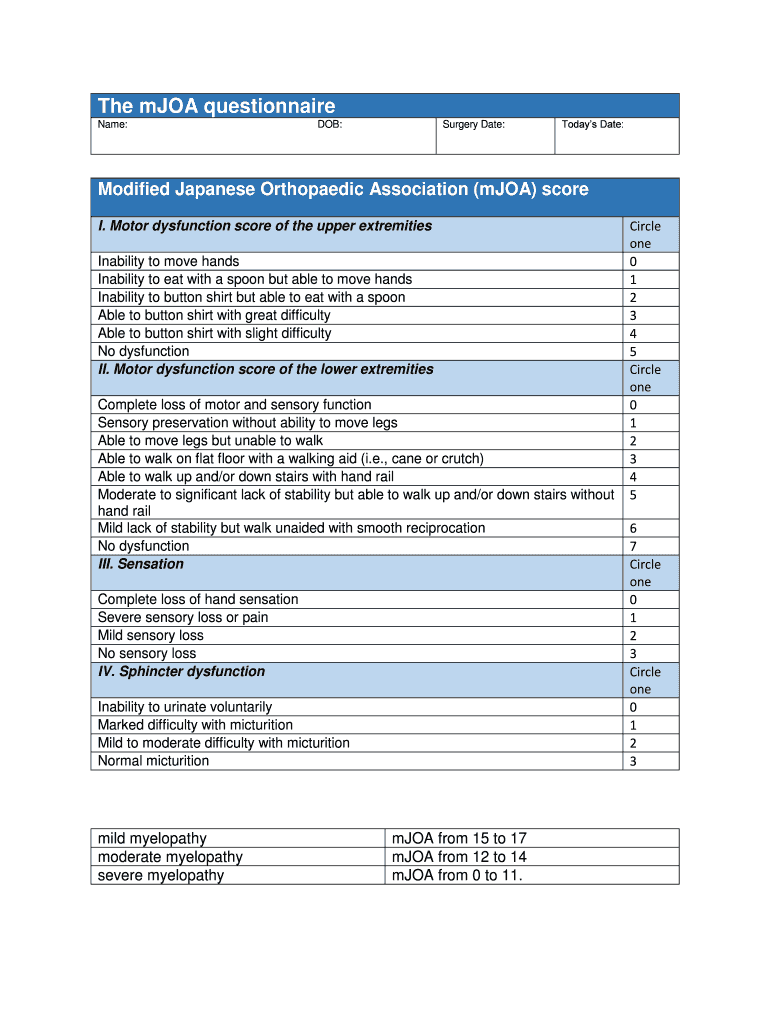
The Modified Japanese Orthopaedic Association (mJOA) score is a clinical assessment tool designed to evaluate the severity of cervical spondylotic myelopathy (CSM) in patients. It provides a standardized measure of neurological function by focusing on motor dysfunction in the arms and legs, sensory impairment, and sphincter dysfunction. This score is crucial for clinicians to assess the degree of myelopathy and guide treatment planning.
Key Components of the Score
- Motor Function in Upper Extremities: Evaluates the use and coordination of arms and hands.
- Motor Function in Lower Extremities: Assesses the strength and mobility of legs.
- Sensory Loss: Includes the assessment of reduced sensation or numbness in limbs.
- Sphincter Dysfunction: Evaluates control over bowel and bladder functions.
The total score allows healthcare providers to categorize the severity of a patient's condition, ranging from mild to severe myelopathy.
How to Use the mJOA Score
Clinic Assessment Process
- Patient Interview and History Taking: Gather detailed medical and neurological history relevant to myelopathy.
- Physical Examination: Conduct a thorough neurological exam focusing on the components of the mJOA score.
- Scoring Each Category: Use the mJOA assessment categories to score individual components such as motor and sensory functions.
- Calculating the Total Score: Sum up the individual scores to determine the overall severity of the condition.
Clinicians utilize the mJOA score to decide on potential surgical intervention or to monitor progression over time.
Steps to Complete the mJOA Score
- Prepare the Assessment Environment: Ensure a quiet, comfortable space for patient assessment.
- Review Patient History: Obtain consent and discuss any prior surgeries, injuries, or symptoms related to cervical myelopathy.
- Conduct Neurological Examination: Assess individual parameters such as hand grip, foot movement, and reflexes.
- Document Observations: Carefully note down observations for each category in the mJOA score.
- Sum and Interpret the Score: Calculate the total and interpret it according to severity guidelines.
Healthcare providers should use this assessment as a basis for diagnosis and prognosis of CSM.
Why Should You Use the mJOA Score
Clinical Significance
- Standardization: Provides a unified approach to assessing myelopathy.
- Comparative Analysis: Allows comparison across patient populations.
- Treatment Monitoring: Tracks changes over time to assess treatment efficacy.
Using the mJOA score enhances patient care by offering reliable data for decision-making processes in clinical settings.
Key Elements of the mJOA Score
- Quantitative Grading Scale: Offers a numeric scale for each component, facilitating a clear interpretation of patient condition.
- Comprehensive Coverage: Encompasses major aspects of neurological impairment.
- Focus on Functional Outcome: Directly relates to the patient's everyday function.
Healthcare professionals rely on these elements to comprehensively evaluate and monitor cervical myelopathy.
Who Typically Uses the mJOA Score


Primary Users
- Neurologists: Diagnose and develop treatment plans for neurological disorders.
- Orthopedic Surgeons: Assess surgical candidacy and outcomes.
- Rehabilitation Specialists: Design rehabilitation programs based on initial and follow-up scores.
The mJOA score particularly supports those involved in managing spinal disorders and rehabilitation.
Important Terms Related to mJOA Score
- Myelopathy: Dysfunction of the spinal cord due to compression.
- Cervical Spondylosis: Degenerative condition of the cervical spine affecting the spinal cord.
- Neurological Function: The performance of the nervous system in coordinating bodily activities.
Understanding these terms is essential for anyone involved in assessing and treating cervical spine disorders.
Legal Use of the mJOA Score
Standard Setting
- Benchmarking: Used in clinical trials and outcome studies to set standards.
- Clinical Guidelines: Incorporated in guidelines for assessing cervical myelopathy.
- Insurance Evaluation: May form part of the evidence required for insurance claims related to disability or surgery.
In the U.S., the mJOA score is often included in medical documentation to support clinical and legal processes related to patient care.




