




01. Edit your form online
Type text, add images, blackout confidential details, add comments, highlights and more.

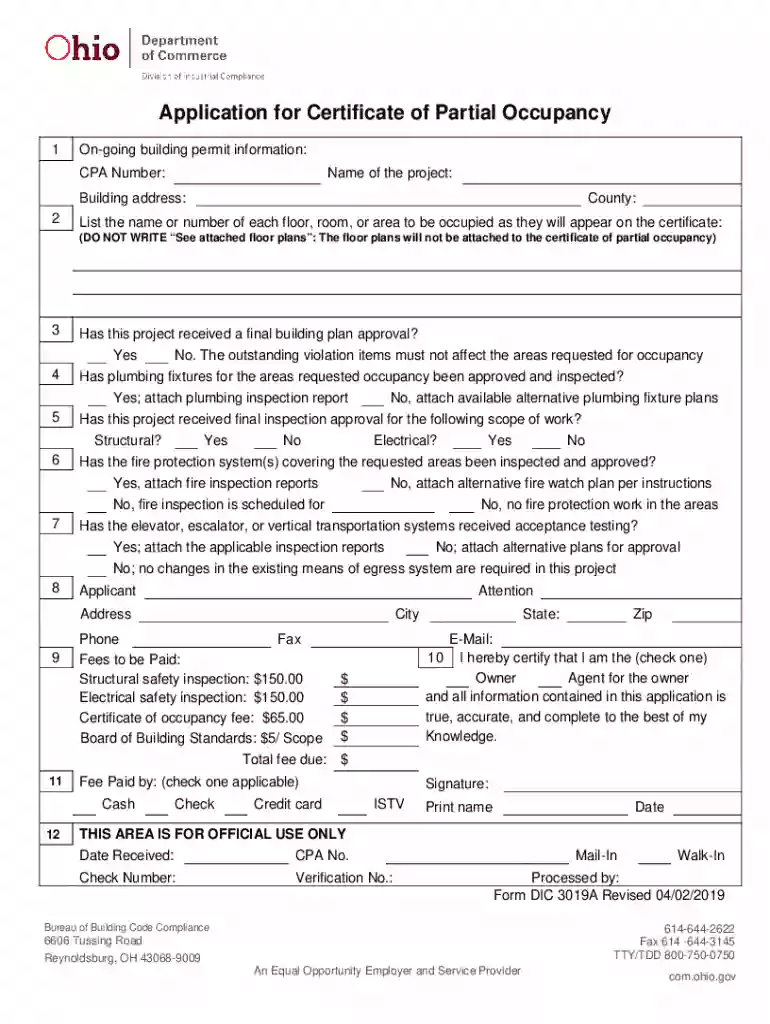
Type text, add images, blackout confidential details, add comments, highlights and more.

Draw your signature, type it, upload its image, or use your mobile device as a signature pad.

Send it via email, link, or fax. You can also download it, export it or print it out.
A Certificate of Partial Occupancy is an official document issued by a governing authority, enabling partial use of a building while certain areas are still under construction or require further inspection. Typically, it signifies that parts of the structure have met safety and compliance standards per the local building codes, providing assurance that occupancy is permissible within specific sections. This document is pivotal in scenarios such as phased housing developments or commercial spaces where immediate operational needs exist while other construction phases continue. It ensures both public safety and regulatory compliance while allowing for progressive property utilization.
To secure an application for a Certificate of Partial Occupancy, applicants must first identify the relevant local building authority. In many U.S. states, this will be the local Building Department or Permit Office. Applications are often accessible through official government websites, where they can be downloaded and completed digitally. In some regions, a visit to the physical office may be necessary to obtain paper forms. Prospective applicants should reach out in advance to confirm office hours and required documentation, ensuring a smooth application process.
Successfully completing the Certificate of Partial Occupancy application involves multiple steps:
An application for a Certificate of Partial Occupancy includes several critical components:
These elements ensure the application is comprehensive, covering all regulatory requirements prior to submission and subsequent inspection.
Submitting an application for a Certificate of Partial Occupancy necessitates a variety of supporting documents:
These documents must be current and comprehensive to facilitate the approval process.
Each U.S. state has unique requirements and interpretations of their building codes, which influence the application process for a Certificate of Partial Occupancy. Differences may include:
Ensuring an understanding of state-specific guidelines prior to application can prevent delays in approval and occupancy.
A diverse array of stakeholders may seek a Certificate of Partial Occupancy, including:
By allowing partial use, these stakeholders can generate revenue and maintain business operations without waiting for full project completion.


The duration of obtaining a Certificate of Partial Occupancy varies based on several factors:
Delays may occur if additional documentation or corrections are required, so preemptive preparation is beneficial.
Operating or occupying parts of a building without the necessary Certificate of Partial Occupancy can result in significant penalties, including:
Adhering to all regulatory requirements is crucial to avoid such negative consequences.
The legal application of a Certificate of Partial Occupancy extends to:
Achieving the certificate solidifies a legal foundation for partial occupancy, promoting safe and compliant building use.
We've got more versions of the Application for Certificate of Partial Occupancy form. Select the right Application for Certificate of Partial Occupancy version from the list and start editing it straight away!
| Versions | Form popularity | Fillable & printable |
|---|---|---|
| 2019 | 4.1 Satisfied (27 Votes) |
At DocHub, your data security is our priority. We follow HIPAA, SOC2, GDPR, and other standards, so you can work on your documents with confidence.
Sep 12, 2025 The CEOR will submit the LDP application and a set of 100%, stamped site drawings including all disciplines to the OCE electronically at ocemailRead more
Jul 4, 2026 Give your project name, building number, and the OC application number. Ask five pointed questions: current status, inspection-report date,Read more


