
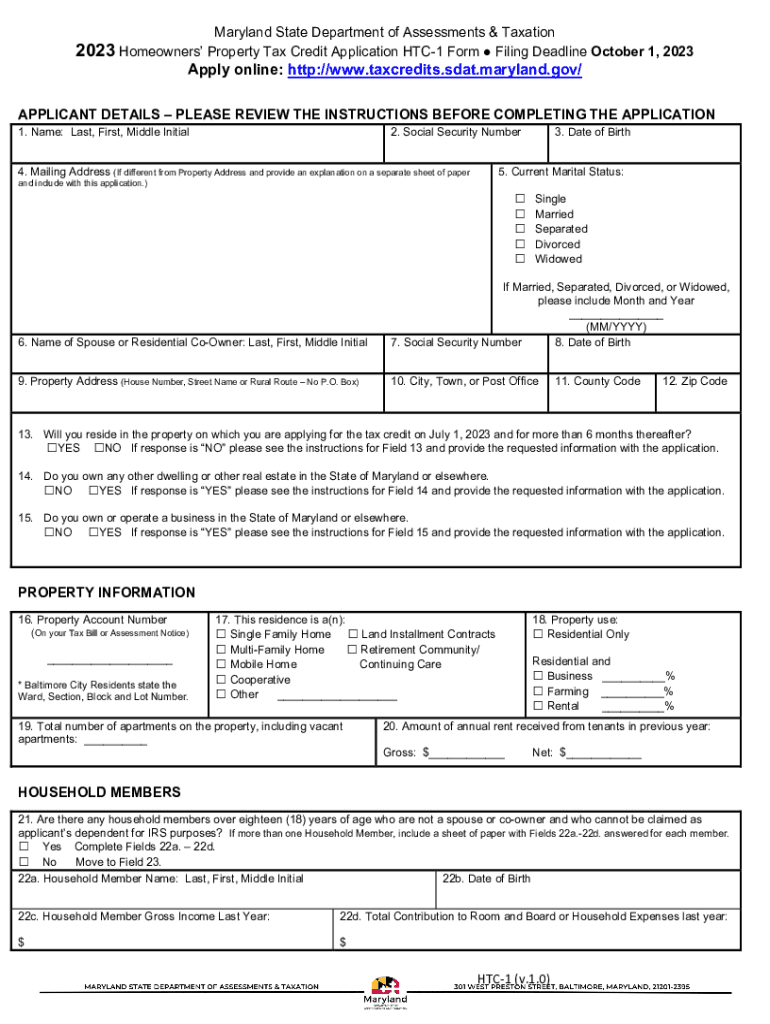







Definition and Purpose of the 2023 Homeowners' Property Tax Credit Application (HTC-1 Form)
The 2023 Homeowners' Property Tax Credit Application, commonly known as the HTC-1 Form, is a financial relief mechanism introduced by the Maryland State Department of Assessments & Taxation. This form facilitates the allocation of property tax credits to eligible homeowners based on their gross household income. Primarily, it aims to alleviate the financial burden on low to moderate-income homeowners by reducing their property tax liability.
Key Benefits
- Financial Relief: Reduces the annual property tax payable by eligible Maryland homeowners.
- Income-Based Qualification: Provides assistance proportionate to the gross household income, ensuring equitable relief.
Eligibility Criteria
- Primary Residence Requirement: The property must serve as the primary residence of the applicant.
- Income Limits: Eligibility is determined by specific income thresholds that vary annually.


How to Use the HTC-1 Form
Completing the HTC-1 Form requires a methodical approach to ensure accuracy and compliance with state regulations. Here’s how one can effectively use the form:
- Gather Necessary Documents: Collect all required personal financial records, including income statements, mortgage documents, and property assessments.
- Fill Accurate Details: Provide personal details such as name, address, property information, and income sources with precision.
- Verify Information: Double-check all entries for accuracy to prevent processing delays or application rejection.
Common Mistakes
- Incorrect Income Reporting: Misreporting income or failing to include all sources can lead to denial.
- Missing Documentation: Failure to attach required documents can delay processing.
Obtaining the HTC-1 Form
Accessing the HTC-1 Form can be done via multiple channels to accommodate different preferences:
Online
- State Department Website: Available for direct download in PDF format on the Maryland State Department of Assessments & Taxation website.
Physical Copies
- County Assessments Office: Hard copies can be requested in person or via mail from local property tax offices.
Digital Convenience
- DocHub: Streamlines the process by allowing easy editing and submission of the form digitally.
Steps to Complete the HTC-1 Form
Understanding the step-by-step process to efficiently complete the form ensures a smooth application:
- Personal Information Section: Fill in your personal and contact details.
- Property Information Section: Describe the property, including its address and value.
- Income Documentation Section: List all sources of household income and provide related documentation.
- Review and Sign: Carefully review the filled form for accuracy and sign to certify the information.
Tips for Efficiency
- Pre-Fill Sections: Using digital platforms like DocHub can automatically fill certain sections based on previous data inputs.
- Set Reminders: Keep track of deadlines to submit the form timely and avoid penalties.
Important Terms Related to the HTC-1 Form
Understanding specific terminology associated with the HTC-1 Form aids applicants in accurately interpreting requirements:
- Gross Household Income: Total income from all sources before deductions.
- Assessed Property Value: The monetary worth assigned to a home for taxation purposes.
- Tax Year: The annual period for which the tax credit is being claimed.
Filing Deadlines and Important Dates
Meeting filing deadlines is crucial for the successful acceptance of the HTC-1 Form:
Main Deadline
- October 1, 2023: The primary due date for filing the 2023 application.
Extensions and Exceptions
- Late Filing: Some circumstances allow for extensions, but late submissions generally face denial unless adequately justified.
Required Documents for HTC-1 Form Submission
The completion of the HTC-1 Form necessitates several supporting documents to verify eligibility:
Personal ID and Proof of Residency
- Government-Issued ID: Driver’s license or state ID.
- Residency Proof: Utility bills or voter registration demonstrating the primary residence.
Income Verification
- Tax Returns: Copies of the most recent federal and state tax returns.
- W-2 Forms: Documentation from employers detailing earnings.
State-Specific Rules for Maryland
Being a state-centric form, the HTC-1 has specific rules applicable to Maryland:
Maryland-Specific Criteria
- Residency Requirement: Only Maryland residents are eligible.
- State Tax Regulations: Abide by state laws dictating income and property value limits for credit qualification.




