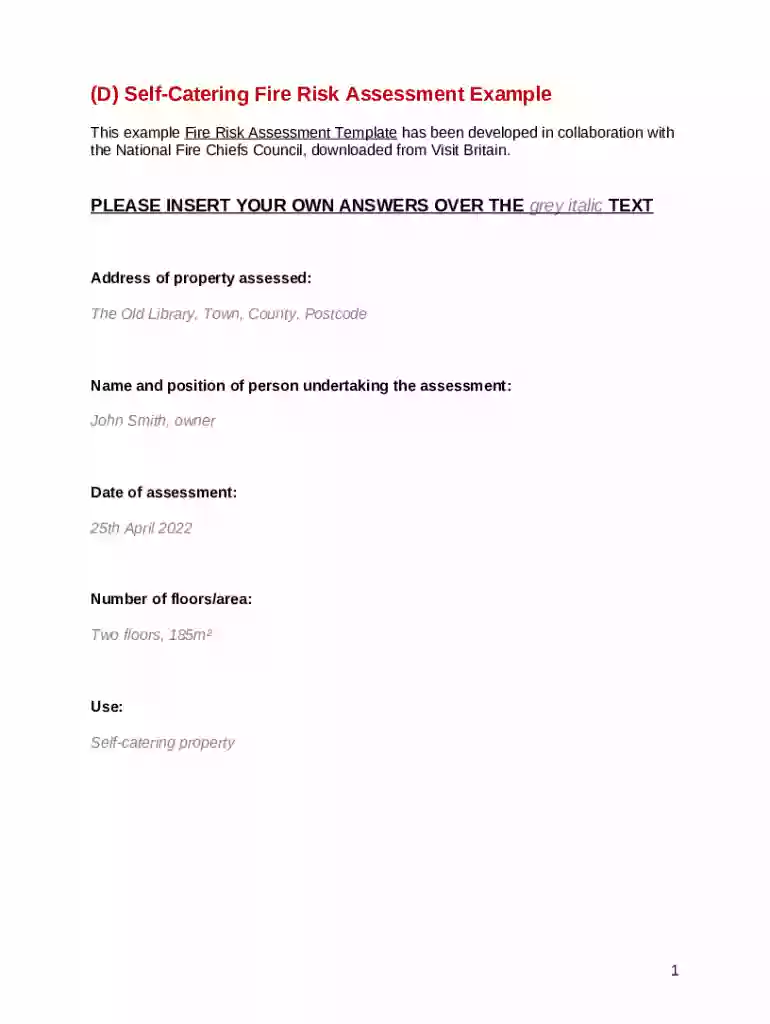
Holiday Let Cottage Fire Risk Assessment Template 2026

Get Form
uk fire risk assessment Preview on Page 1

Here's how it works

01. Edit your uk fire risk assessment online
Type text, add images, blackout confidential details, add comments, highlights and more.

02. Sign it in a few clicks
Draw your signature, type it, upload its image, or use your mobile device as a signature pad.

03. Share your form with others
Send uk fire risk assessment form via email, link, or fax. You can also download it, export it or print it out.

Key Elements of the Holiday Let Cottage Fire Risk Assessment Template

The Holiday Let Cottage Fire Risk Assessment Template includes several vital components that ensure the safety and compliance of rental properties. It provides a comprehensive framework for identifying potential fire hazards and implementing measures to reduce risks. Essential elements include:

  • Property Identification: Documents the address, type, and structural details of the holiday cottage.
  • Fire Hazard Identification: Involves spotting potential sources of fire within and around the premises, such as electrical equipment or cooking facilities.
  • Risk Assessment: Evaluates the likelihood and potential impact of identified hazards, helping to prioritize safety measures.
  • Existing Fire Safety Measures: Details existing systems in place, like fire alarms and fire extinguishers, to control or extinguish fires.
  • Means of Escape: Outlines evacuation routes and emergency exits to facilitate safe evacuation during a fire.
  • Evacuation Procedures: Provides instructions for efficient and orderly evacuation, including responsibilities of staff and guests.
  • Compliance with Regulations: Ensures that the property conforms to relevant fire safety laws and guidelines.

Steps to Complete the Holiday Let Cottage Fire Risk Assessment Template

Completing the Holiday Let Cottage Fire Risk Assessment Template requires a systematic approach to ensure thoroughness and accuracy:

  1. Gather Property Information: Collect details such as the property’s address, layout, and structural features.
  2. Identify Fire Hazards: Conduct an inspection to find potential fire sources, noting any flammable materials or faulty wiring.
  3. Risk Evaluation: Assess each hazard’s potential consequences and likelihood of occurring.
  4. Review Existing Safety Measures: Document current fire detection and suppression systems present in the cottage.
  5. Plan Escape Routes: Clearly outline emergency exits and ensure they are accessible and well-marked.
  6. Develop Evacuation Procedures: Prepare detailed procedures that include roles of staff and instructions for guests.
  7. Ensure Regulatory Compliance: Verify that all measures align with local fire safety regulations and standards.

Legal Use of the Holiday Let Cottage Fire Risk Assessment Template

Utilizing the Holiday Let Cottage Fire Risk Assessment Template carries legal implications, as it ensures compliance with fire safety regulations:

  • Regulatory Compliance: Meeting legal obligations by identifying and mitigating fire risks in accordance with local fire safety standards.
  • Documentation: Maintaining records of the assessment demonstrates due diligence and can serve as evidence in case of disputes or inspections.
  • Responsibility Assignment: Clearly defining the roles and responsibilities of staff and guests in relation to fire safety.
  • Insurance Requirements: Many insurance policies require evidence of a completed and regularly updated fire risk assessment.

Examples of Using the Holiday Let Cottage Fire Risk Assessment Template

Using this template aids in addressing fire safety effectively for various scenarios:

  • Multi-Unit Cottages: For properties with several rental units, the template helps ensure each unit has adequate fire safety measures.
  • Remote Properties: In isolated areas where emergency services have limited access, thorough risk assessments are critical for guest safety.
  • Historic Buildings: Special considerations are needed for older structures, such as maintaining the character while implementing modern fire safety measures.
  • High-Occupancy Events: During events that increase the number of occupants, extra precautions might be detailed in the assessment.

Who Typically Uses the Holiday Let Cottage Fire Risk Assessment Template

This template is widely used by various stakeholders involved in the management and operation of rental properties:


  • Property Owners and Landlords: To ensure their property is safe and compliant with necessary regulations.
  • Property Managers: Responsible for regularly updating and maintaining fire safety procedures in line with current standards.
  • Insurance Providers: Use this document to assess the risk level before issuing or renewing fire insurance policies.
  • Fire Safety Inspectors: Reference the template when conducting inspections to ensure compliance and identify potential improvements.
decoration image ratings of Dochub

Important Terms Related to the Holiday Let Cottage Fire Risk Assessment Template

Understanding key terms is crucial for the effective utilization of the assessment template:

  • Fire Hazard: Any condition or event that increases the likelihood of a fire starting.
  • Risk Assessment: The process of evaluating potential hazards and their associated risks to determine priorities in fire prevention.
  • Evacuation Route: Predefined paths that occupants should follow in case of a fire to reach safety.
  • Fire Safety Measures: Installed systems and procedures designed to prevent, detect, and control fires.
  • Regulatory Compliance: Adherence to local and national fire safety laws and guidelines protecting property occupants.

State-Specific Rules for the Holiday Let Cottage Fire Risk Assessment Template

The application of the Holiday Let Cottage Fire Risk Assessment Template might vary based on state-specific regulations:

  • State Building Codes: Differences in building codes may affect the specific requirements within the risk assessment.
  • Regional Fire Safety Laws: Each state may have unique fire safety laws dictating the measures that must be present in a rental property.
  • Inspection Frequency: Some states require more frequent inspections and updates to the fire risk assessment.
  • Special Permits: In certain states, additional permits may be needed for specific fire safety installations, such as sprinkler systems.

Versions or Alternatives to the Holiday Let Cottage Fire Risk Assessment Template

Exploring different iterations or alternatives of this template can offer flexibility:

  • Customized Assessments: Tailored versions may better suit unique properties with specific fire safety needs.
  • Digital Templates: Interactive, electronic versions allow for easy updating and sharing among stakeholders.
  • Industry-Specific Templates: Adapted forms for specific enterprises, such as those focusing on eco-friendly accommodations or historical properties.
  • Software-Based Solutions: Platforms and applications that support continuous updates, data analysis, and monitoring of fire safety compliance.
be ready to get more

Complete this form in 5 minutes or less

Get form

Got questions?

We have answers to the most popular questions from our customers. If you can't find an answer to your question, please contact us.
Contact us
Assigning a fire risk score The assessment requires the surgical team to identify the 3 key elements that are necessary for a fire to startthe fire triangle: heat fuel oxygen. nasal cannula) available ignition source (ie, electrosurgery unit, laser, or fiberoptic light source).
Broadly speaking, assessments are conducted in five key steps: Identify the fire hazards. Identify people at risk. Evaluate, remove or reduce the risks. Record your findings, prepare an emergency plan and provide training. Review and update the fire risk assessment regularly.
Types of fire risk assessment Type 1 fire risk assessment (common parts non-destructive) Type 2 fire risk assessment (common parts destructive) Type 3 fire risk assessment (common parts and flats non-destructive) Type 4 fire risk assessment (common parts and flats destructive)
The fire risk assessment should be reviewed regularly (recommended to be annually). Complete a simple line drawing of the premises and identify your fire safety provisions including escape routes, portable fire extinguishers, smoke and / or heat detectors, emergency lighting and fire alarm call points.
The approach underpinning PAS 79 is one of systematic evaluation of the factors that determine the hazard from fire, the likelihood that there will be a fire and the consequences if one were to occur.

Security and compliance

At DocHub, your data security is our priority. We follow HIPAA, SOC2, GDPR, and other standards, so you can work on your documents with confidence.

Learn more
ccpa2
pci-dss
gdpr-compliance
hipaa
soc-compliance
be ready to get more

Complete this form in 5 minutes or less

Get form

People also ask

Step 1: Identify the hazards/risky activities; Step 2: Decide who might be harmed and how; Step 3: Evaluate the risks and decide on precautions; Step 4: Record your findings in a Risk Assessment and management plan, and implement them; Step 5: Review your assessment and update if necessary.

uk fire risk assessment online