




01. Edit your bsp1 form online
Type text, add images, blackout confidential details, add comments, highlights and more.

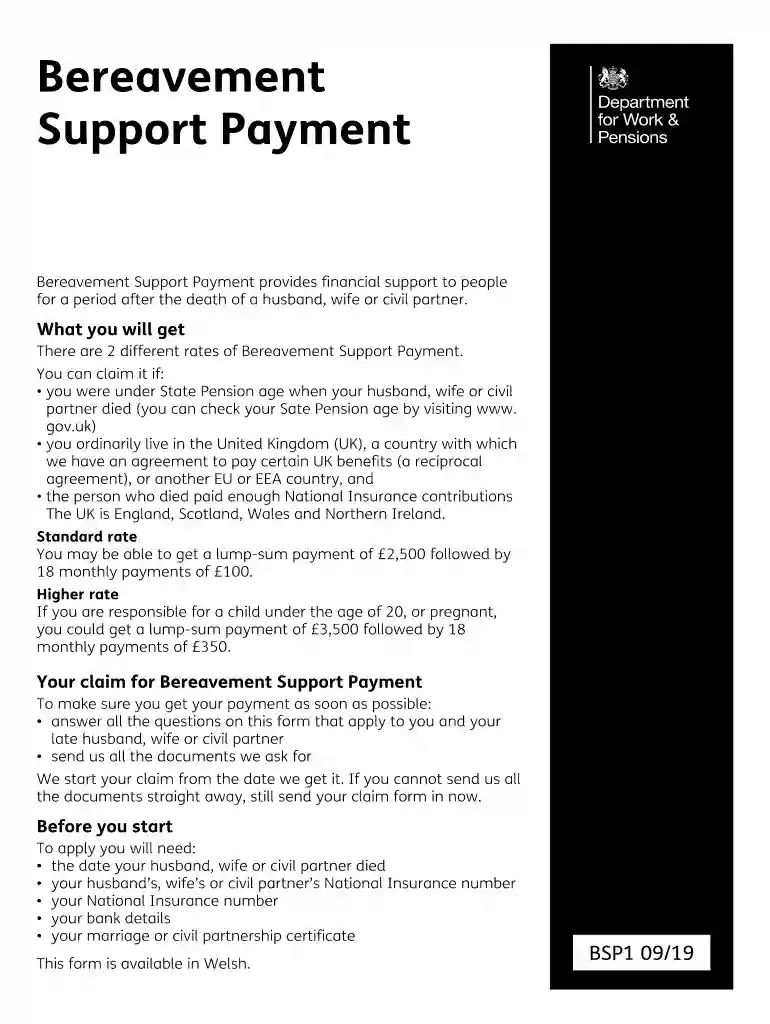
Type text, add images, blackout confidential details, add comments, highlights and more.

Draw your signature, type it, upload its image, or use your mobile device as a signature pad.

Send bsp1 via email, link, or fax. You can also download it, export it or print it out.
The BSP1 form, known primarily as the Bereavement Support Payment form, serves as a crucial tool for individuals navigating the process of applying for financial aid after the death of a spouse or civil partner. This form is integral to the application process for bereavement support payments, which aim to provide financial assistance to survivors during a difficult transitional period. The intent is to help beneficiaries cover immediate expenses and to manage the financial impact following a loss. By understanding the purpose and significance of the BSP1 form, applicants can better navigate the bureaucratic process associated with securing this type of support.
When using the BSP1 form, applicants need to accurately and thoroughly provide personal information, details about the deceased, and any relevant financial data. This form must be submitted to the appropriate governmental agency handling bereavement support. Begin by filling out personal details, including name, address, and relationship to the deceased. Ensure all sections are completed to avoid delays in processing. It's essential to follow any specific instructions included with the form, as each question is designed to assess eligibility and facilitate the processing of payments. Reviewing the form carefully before submission is advisable to prevent any errors or omissions that could affect the outcome.
Acquiring the BSP1 form can be straightforward if the proper channels are utilized. The form is typically available online through the official government websites or relevant administrative offices. It may also be requested in hard copy via mail or at local government offices dealing with social security benefits. Ensure you have access to any supporting documents that might be required alongside the form submission, as having these ready can expedite the process. It's also beneficial to consult online resources or support lines available for guidance on obtaining and completing the form.
Collect Necessary Documentation: Before beginning, gather all the necessary documents, including identification, proof of relationship to the deceased, and any existing correspondence related to their benefits.
Fill Out Personal Information: Start with detailing your name, contact information, and relationship to the decedent. Accurate data entry at this stage is crucial to ensure processing without complications.
Provide Financial Details: Include any applicable financial information that the form requests. This might involve current income, dependents, and any other monetary sources that could affect eligibility.
Double-Check Entries: Upon completion, carefully review each section to check for errors or missing data. Omissions can cause delays or rejections in processing your application.
Submit the Form: Once reviewed. Submit the form through the designated channels, whether online, by mail, or in-person, depending on the instructions provided with the form.
Track the Application: Keep a copy of your submission for reference and monitor any communications from the processing agency to follow up promptly if needed.
The BSP1 form is essential for those eligible for bereavement support payments, as it directly facilitates the provision of financial aid. By accurately completing and submitting this form, individuals can access monetary support designed to assist with financial stability after the loss of a partner or spouse. The purpose of utilizing this form is to minimize economic disruption during a period of emotional and financial transition, reducing stress and enabling a focus on adjustment and healing.
Applicant Information: This includes the personal details of the individual applying for the bereavement support payment.
Deceased Details: Information regarding the deceased individual, including their full name, date of death, and Social Security Number.
Eligibility Information: Details concerning any existing benefit claims and financial particulars affecting eligibility for support.
Declaration Statement: A signature section to confirm the authenticity and accuracy of the provided information, demonstrating compliance with legal and procedural requirements.
The BSP1 form is utilized within the framework of bereavement support legislation. Completing this form is a legal step towards claiming financial benefits intended for those who have lost a spouse or civil partner. This form supports the transparent distribution of aid and ensures that recipients meet specified criteria. The information on this form must be accurate to adhere to legal standards, and misuse or misinformation can lead to legal repercussions or denial of benefits. Understanding the legal implications is important for ensuring proper use and compliance.
To effectively complete the BSP1 form, specific documents must accompany the submission:
Proof of Identity: Government-issued identification for the applicant.
Proof of Relationship: Documentation verifying the relationship to the deceased, such as a marriage certificate.
Death Certificate: An official document proofing the death of the spouse or civil partner.
Financial Records: Any financial documentation required by the form to assess eligibility and need, including benefit statements if applicable.
Having these documents ensures that the application is processed without unnecessary delays, affirming readiness for any follow-up or verification that might be necessary.
We've got more versions of the bsp1 form form. Select the right bsp1 form version from the list and start editing it straight away!
At DocHub, your data security is our priority. We follow HIPAA, SOC2, GDPR, and other standards, so you can work on your documents with confidence.
The phosphorylated form of this protein forms a complex with SMAD4, which is important for its function in the transcription regulation. This protein is a
by R Byrne Cited by 27 Three spiropyran derivatives containing hydroxyl (BSP-1), carboxylic acid (BSP-2) and aliphatic chain (C(14)H(29)) (BSP-3) functional groups have been analysedRead more


