







Definition and Meaning
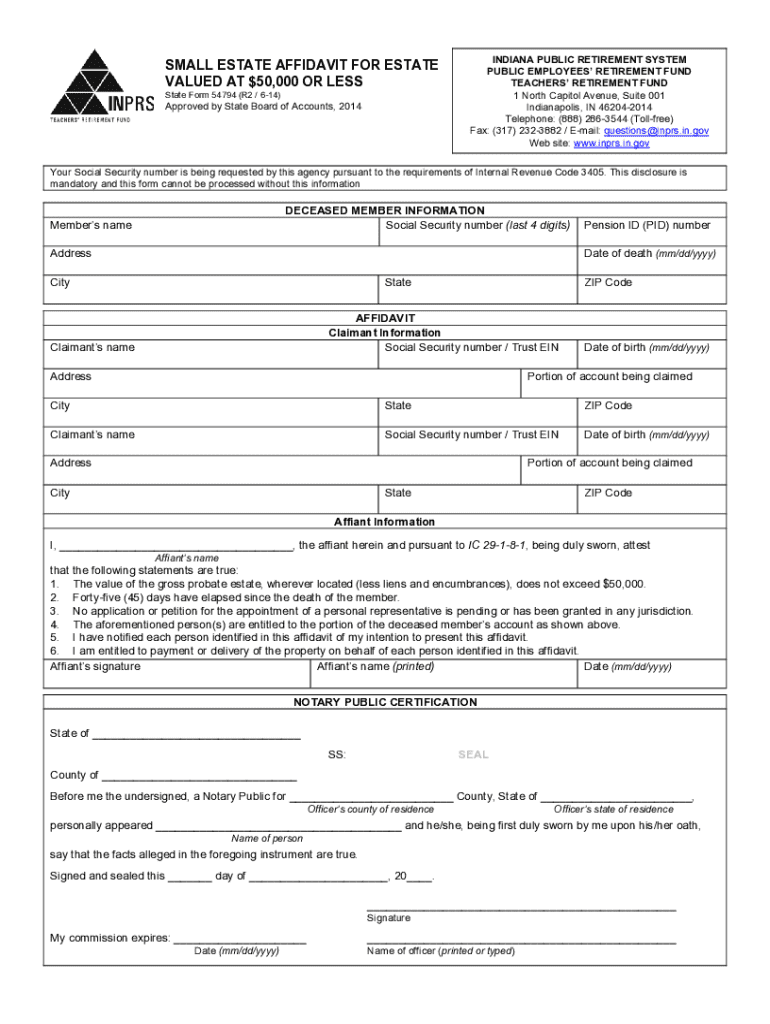
A Small Estate Affidavit in Indiana is a legal document used to simplify the process of transferring assets from a deceased person's estate without the need for formal probate. This form is applicable for estates valued at $50,000 or less and serves as a streamlined method for claimants to declare their right to specific assets. It requires the claimant to provide pertinent information about the deceased and affirm that the estate's total value fits within the small estate threshold, ensuring a quicker and more efficient distribution.
Steps to Complete the Small Estate Affidavit Indiana Forms and Templates
-
Gather Necessary Information: Collect essential details about the deceased individual, including their full name, date of death, and Social Security number.
-
Determine Eligibility: Confirm that the total value of the estate does not exceed the $50,000 threshold set by Indiana law.
-
Complete the Affidavit Form: Fill in all required sections of the affidavit, including information about the claimant and details of the estate's assets.
-
Affirmations: Certify that all provided information is true and that there is no pending application for the appointment of a personal representative.
-
Notarization: Take the completed affidavit to a notary public and have it notarized to validate the document legally.
-
Present the Affidavit: Submit the notarized affidavit to the appropriate parties holding the estate’s assets, such as banks or financial institutions, to facilitate asset transfer.
Key Elements of the Small Estate Affidavit Indiana Forms and Templates
-
Deceased's Information: The full legal name, date of death, and Social Security number of the deceased.
-
Claimant's Details: The name and contact information of the person claiming the right to inherit the assets.
-
Asset Description: A list and description of the assets within the estate, ensuring clarity about what is being claimed.
-
Declarations: Sections where the claimant declares under oath that the estate qualifies as a small estate and that there is no pending application for a personal representative.
-
Signatures: Both the claimant’s signature and a notary public's signature are required to validate the form.
Eligibility Criteria
To use the Small Estate Affidavit in Indiana, the following criteria must be met:
- The estate’s total value must not exceed $50,000.
- There cannot be an existing appointment of a personal representative through a pending probate process.
- All outstanding debts and obligations of the estate must be accounted for or acknowledged within the affidavit.
- The assets claimed must be within the jurisdiction of Indiana.


Legal Use of the Small Estate Affidavit Indiana Forms and Templates
-
Asset Transfer: The affidavit facilitates the transfer of assets such as bank accounts, stocks, bonds, and tangible personal property to rightful heirs without undergoing full probate proceedings.
-
Simplified Process: It legally allows claimants to manage and distribute small estates efficiently, reducing the costs and time associated with traditional probate.
-
Binding Document: Once notarized, this affidavit binds the claimant legally to any assertions made within, holding them accountable for inaccuracies or fraudulent claims.
State-Specific Rules for the Small Estate Affidavit Indiana Forms and Templates
-
Indiana law strictly caps the value of estates eligible for this affidavit at $50,000, a rule unique to the state.
-
Within Indiana, each county may have specific filing procedures or required documentation, emphasizing the importance of verifying local requirements.
-
Unlike some states, Indiana mandates the notarization of the affidavit, underscoring its emphasis on authenticity and legal binding.
Required Documents
-
Death Certificate: An official death certificate for the deceased is required to verify the claim.
-
Affidavit Form: The fully completed Small Estate Affidavit form with all necessary information filled.
-
Proof of Assets: Documentation substantiating the assets’ value and existence, such as bank statements or property deeds.
-
Identification: A valid ID for the claimant to confirm identity and eligibility.
Examples of Using the Small Estate Affidavit Indiana Forms and Templates
-
Bank Account Transfer: A widow uses the affidavit to claim the funds in her deceased husband's bank account, worth $30,000, without initiating probate.
-
Vehicle Ownership Transfer: A son uses the affidavit to transfer the title of his deceased father's car, valued at $12,000, into his name.
-
Personal Property Claim: Heirs use the affidavit to distribute personal belongings valued collectively at $45,000 among themselves.
By adopting a methodical approach to gather, complete, and submit the Small Estate Affidavit, claimants in Indiana can efficiently navigate asset inheritance within minor estates seamlessly.




