




01. Edit your form online
Type text, add images, blackout confidential details, add comments, highlights and more.

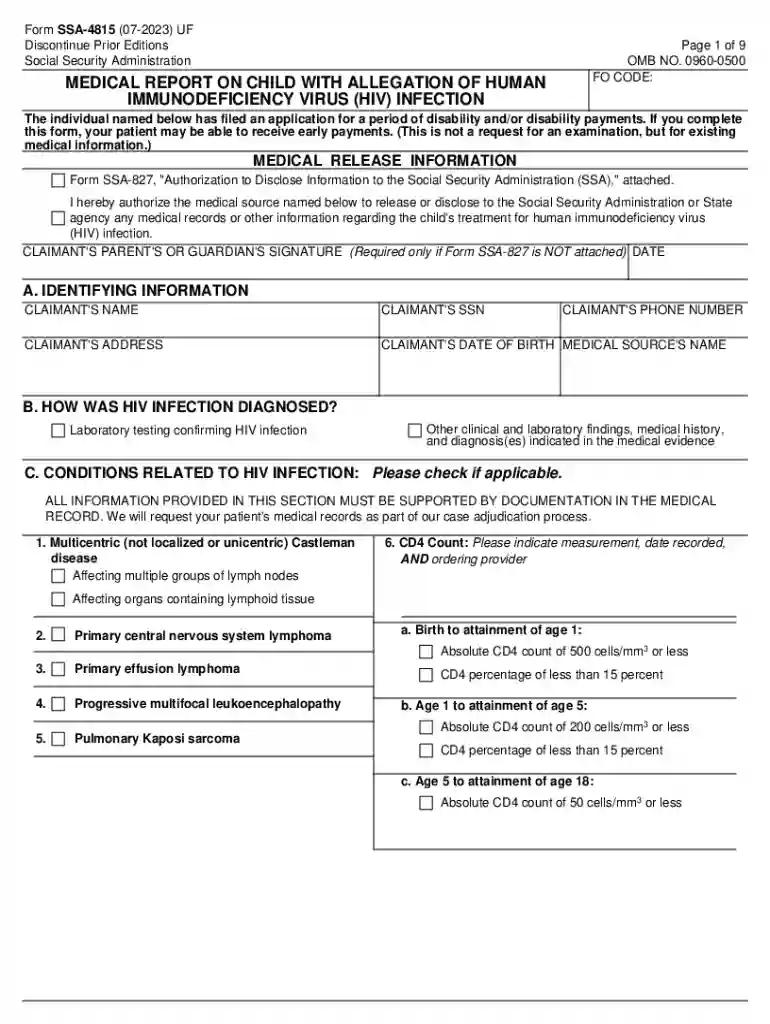
Type text, add images, blackout confidential details, add comments, highlights and more.

Draw your signature, type it, upload its image, or use your mobile device as a signature pad.

Send it via email, link, or fax. You can also download it, export it or print it out.
The Medical Report On Child With Allegation Of Human Immunodeficiency Virus (HIV) Infection, often found in its formal designation as Form SSA-4815, serves as a critical document within the Social Security Administration's framework. This form is essential for collecting comprehensive medical data relevant to allegations of HIV infection in minors. It facilitates applications for disability benefits by documenting the child's medical history, diagnostic details, and any health complications associated with the virus. In essence, the form substantiates claims, guiding appropriate benefit allocation for children affected by HIV.
Completing the Medical Report on a child alleging HIV infection necessitates careful attention to detail and thoroughness. The process involves:
Identifying Information: Accurately provide the child's full name, date of birth, and Social Security number to link the form to their unique case.
Diagnoses and Health Conditions: Medical professionals should document the primary diagnosis along with any associated conditions. Clarity in outlining the medical scenario enhances the form's effectiveness.
Complications and Treatment: Detail any complications arising from HIV infection, including the treatment regimen or interventions being employed. This section is crucial for assessing the child's current and anticipated health trajectory.
Growth Metrics and Medical History: Include relevant growth statistics such as weight, height, and developmental milestones. A comprehensive medical history provides context to the current diagnosis.
Healthcare Provider's Signature: The form must be signed by the attending healthcare provider to verify the authenticity and accuracy of the medical information presented.
These steps ensure a complete submission, supporting the child's eligibility for disability considerations effectively.
Primarily utilized by healthcare professionals, the Medical Report targets pediatricians, family doctors, and specialists involved in the diagnosis and treatment of pediatric HIV cases. These professionals gather and document the relevant medical data needed for the form. In addition, caregivers and guardians play a vital role in facilitating the completion and submission of the form, ensuring accurate personal and medical history is included.


The Medical Report has significant legal implications, particularly concerning the disbursement of Social Security benefits. It functions within a regulatory framework that respects patient confidentiality while enabling eligibility assessments for disability aid. The report must adhere to all legal requirements for data privacy and medical ethics, ensuring that the documentation is utilized solely for its intended purpose of evaluating the child's need for financial support due to health challenges.
Certain components of the Medical Report are indispensable for its completion:
Each element contributes to a comprehensive view of the child's medical situation, crucial for informed decision-making regarding benefit allocation.
Submission of the Medical Report can occur through various channels, including online, mail, or in-person delivery to local Social Security offices. The choice of method may depend on accessibility and convenience for the healthcare provider or guardian. Regardless of the method, ensuring the completeness and accuracy of all sections is vital before submission. Confirmation of receipt by the Social Security Administration should be sought to confirm that the form has been successfully filed.
Gathering pertinent documents is essential for accurately completing the Medical Report. These generally include:
These documents provide the necessary background information, validating the medical assertions made in the form.
While the Medical Report On Child With Allegation Of HIV Infection is the standard for Social Security-related disability claims for children, variations may exist depending on specific state regulations or supplementary documentation requests. It is crucial to verify that the correct and most up-to-date form or alternative documentation is being utilized to avoid processing delays or denials.
Understanding key terminology within the Medical Report is crucial for accurate completion and submission:
These terms, among others, are integral in grasping the nuanced aspects of the form and ensuring comprehensive and informed submissions.
We've got more versions of the Medical Report On Child Wtih Allegation Of Human Immunodeficiency Virus (HIV) Infection form. Select the right Medical Report On Child Wtih Allegation Of Human Immunodeficiency Virus (HIV) Infection version from the list and start editing it straight away!
At DocHub, your data security is our priority. We follow HIPAA, SOC2, GDPR, and other standards, so you can work on your documents with confidence.


