




01. Edit your fl lien online
Type text, add images, blackout confidential details, add comments, highlights and more.

Type text, add images, blackout confidential details, add comments, highlights and more.

Draw your signature, type it, upload its image, or use your mobile device as a signature pad.

Send lien form via email, link, or fax. You can also download it, export it or print it out.
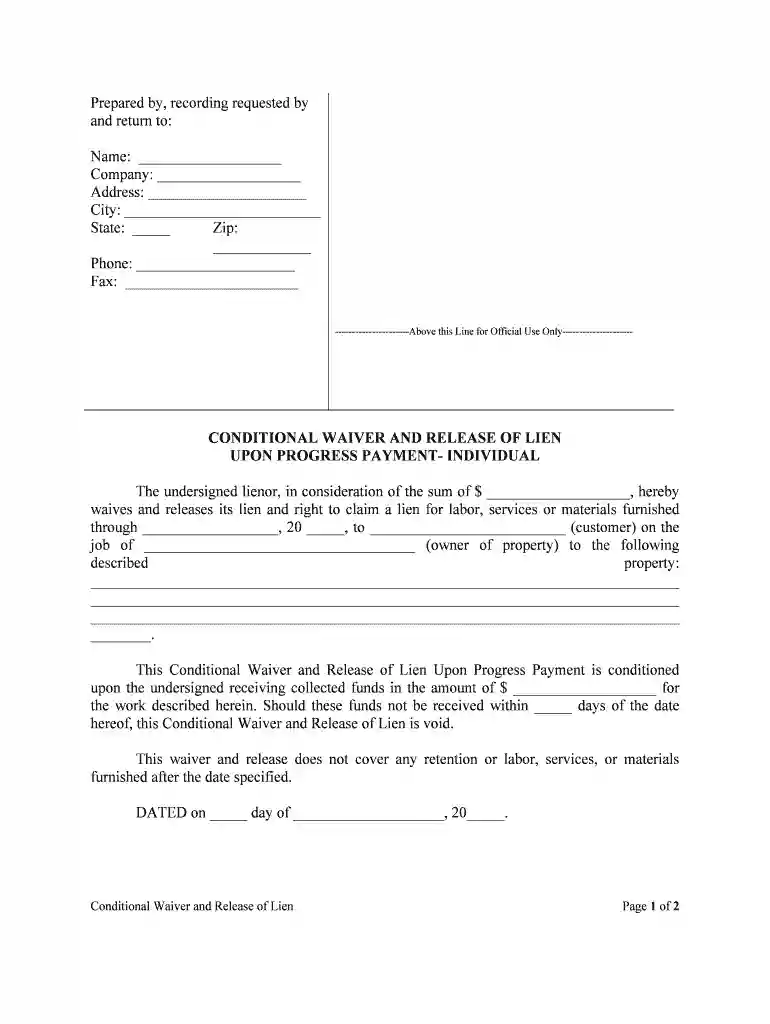
A "Florida Conditional Waiver" is a legal document used primarily in the construction industry. It allows an individual lienor to waive their lien rights upon receiving a specified payment. This type of waiver is conditional, meaning it becomes effective only once the payment is successfully processed or cleared. It is a tool used to manage liens that could be placed on properties due to outstanding payments. The waiver ensures the lienor is adequately compensated while securing the release of any claims against the property by the contractor, subcontractor, or supplier.
Understanding the components of the Florida Conditional Waiver is essential for its proper application. Key elements typically include:
These elements ensure both transparency and legality, protecting all parties involved.
Completing a Florida Conditional Waiver requires attention to detail to prevent future disputes:
Following these steps ensures the waiver's validity and enforceability.
In Florida, the use of a Conditional Waiver is governed by state lien laws, which aim to protect both property owners and lienors. It can only be applied when partial payments are agreed upon, and documentation of such payments is promptly submitted for verification. The conditional aspect guards lien rights until certain conditions — the final payment usually — are met. It is a crucial document for maintaining balance and fairness in payment practices across the construction industry.
This document is predominantly used by:


Understanding related terminology enhances clarity:
These terms are foundational to comprehending the purpose and application of the waiver.
Florida has specific requirements distinct from other states regarding waiver forms. For instance, waivers must be written in statutory language, and conditional waivers are explicitly acknowledged within Florida Statutes. A major requirement is that the waiver must correspond to actual, verified payments, otherwise, it becomes invalid. Understanding these rules not only ensures compliance but also protects against legal challenges or disputes.
Captioning examples helps illustrate practical use cases:
These scenarios highlight how effectively structured conditional waivers can facilitate smooth transactions and relationships in the construction environment.
At DocHub, your data security is our priority. We follow HIPAA, SOC2, GDPR, and other standards, so you can work on your documents with confidence.
Prior to an inmate being released by conditional release, the Commission shall determine the terms and conditions of supervision.
the committing court may order a conditional release of any defendant who has been found to be incompetent to proceed due to intellectual disability or autism,
Keystone Coal Terminal is a coal terminal at the Port of Jacksonville, Florida, United States. The terminal can handle up to 3 million short tons of coal per


