
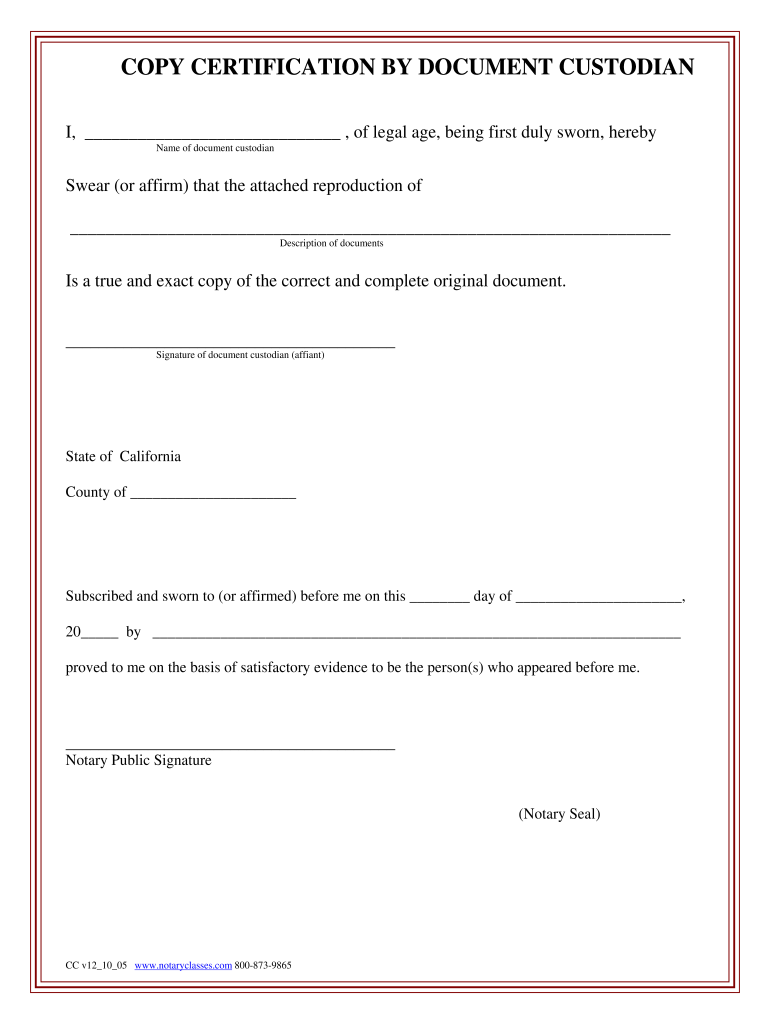







Overview of the California Copy Certification Document Custodian Form
The California Copy Certification Document Custodian Form is a vital tool for individuals and organizations requiring a verified and legally recognized assurance that a copied document is an accurate reproduction of the original. This form serves as a certification process where the document custodian, typically an individual or organization responsible for document preservation, asserts the authenticity of the copied documents.
Key Components of the Form
Understanding the essential elements is crucial for effective use of the form. Below are the critical components:
- Custodian Information: This section collects details about the custodian, including the name, position, organization, and contact information, providing clear identification.
- Document Description: Here, the type and particulars of the original document are indicated, ensuring clarity on what is being certified. This might include the title, date, and nature of the document.
- Signature Requirement: The custodian must sign the form, confirming their role and the validity of the certification. This signature is reputable and carries weight in legal contexts.
- Notary Public Verification: For added legal credibility, a notary public's acknowledgment is often included. This step reinforces the authenticity of the custodian's statement, requiring the notary to confirm the identity of the signer.
Steps to Complete the Form
Filling out the California Copy Certification Document Custodian Form requires careful attention to detail. The following steps outline the completion process:
- Gather Necessary Documents: Collect the original documents that need to be certified as copies. Ensure that all documents are clear and legible.
- Fill in Custodian Information: Enter your information accurately. This is essential as it directly identifies who is certifying the document.
- Describe the Original Document: Provide a comprehensive description of the document. This helps clarify which document the copies pertain to and facilitates tracking.
- Sign the Form: After ensuring all details are correct, sign the document to affirm your certification. Your signature should be legible, and your title or position is to be included if applicable.
- Notarization: Finally, take the completed form to a notary public for verification. The notary will witness your signature and stamp the document, making it legally binding.
Legal Considerations and Validity
The California Copy Certification Document Custodian Form must comply with relevant legal frameworks, particularly the Uniform Commercial Code and other state regulations concerning document certifications. Certified copies hold significant importance in legal proceedings, real estate transactions, and bureaucratic applications.
- Legitimacy: A properly filled and notarized form is regarded as valid evidence if ever challenged in a legal setting. As such, the accuracy of the information provided is paramount.
- Retention of Records: Following the certification, it is wise to retain both the original and certified copies in secure storage. This can assist in responding to future verifications or disputes.
Use Cases for the Certification Form
Various scenarios necessitate the use of the California Copy Certification Document Custodian Form. Below are a few common instances:
- Legal Proceedings: Lawyers and clients may need to submit certified copies of relevant documents to courts, where authenticity is crucial for admissibility.
- Business Transactions: When engaging in partnership agreements, mergers, or acquisitions, certified copies of corporate documents ensure transparency and authenticity.
- Real Estate Deals: Buyers may need certified copies of property deeds and titles, providing assurance to lenders and other stakeholders involved in the transaction.
Common Mistakes to Avoid
Accuracy is crucial when completing the form. Avoiding these common pitfalls can save time and prevent legal complications:
- Inaccurate Descriptions: Failing to provide a detailed description of the original document can lead to confusion and disputes about what is being certified.
- Omitted Signatures: Neglecting to sign the document or to have it signed by a notary may result in the certification being deemed invalid.
- Failure to Retain Copies: Not keeping a secure, accessible copy of the certification may pose challenges in future verifications or legal recalls.
By adhering to these guidelines and thoroughly completing the California Copy Certification Document Custodian Form, document custodians can ensure legality and security in their documentation processes.




