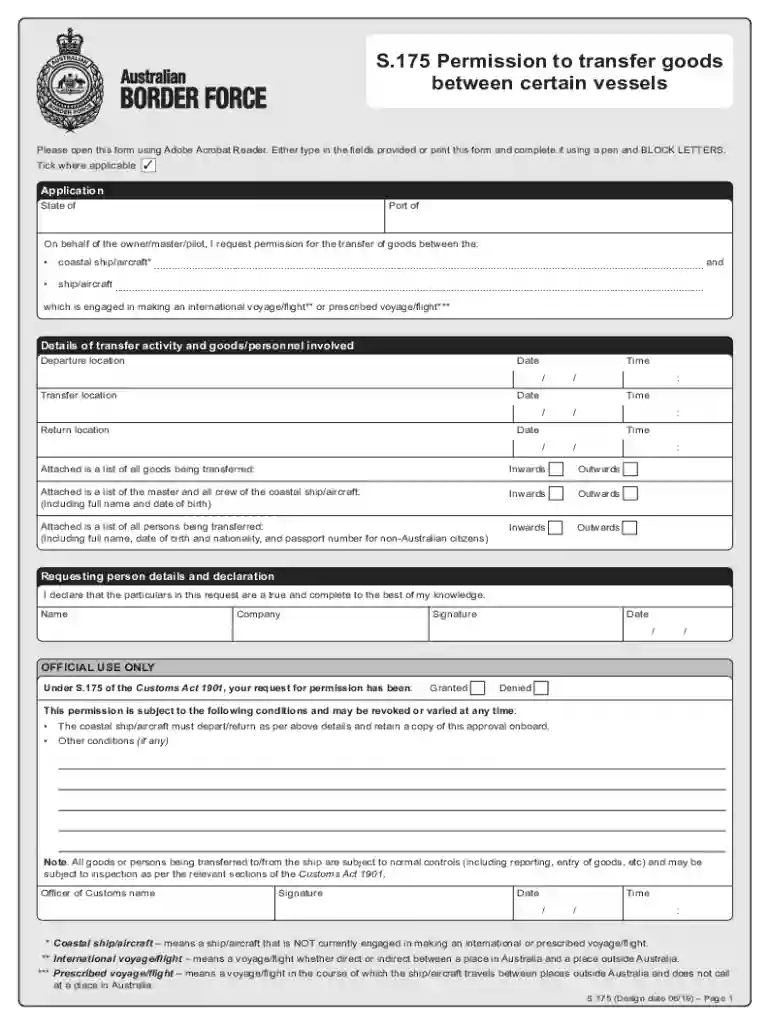
S 175 - Permission to transfer goods between certain vessels S 175 - Permission to transfer goods be 2026

Get Form
S 175 - Permission to transfer goods between certain vessels S 175 - Permission to transfer goods be Preview on Page 1

Here's how it works

01. Edit your form online
Type text, add images, blackout confidential details, add comments, highlights and more.

02. Sign it in a few clicks
Draw your signature, type it, upload its image, or use your mobile device as a signature pad.

03. Share your form with others
Send it via email, link, or fax. You can also download it, export it or print it out.

Definition & Meaning

The term "S 175 - Permission to transfer goods between certain vessels" refers to a specific authorization required for transferring goods between coastal ships or aircraft and those engaged in international or prescribed voyages. This permission aligns with the regulations of the Customs Act 1901, specifically section 175. This act mandates that certain protocols be followed to ensure goods are transferred legally and safely between vessels or flights operating in coastal or international routes.

The primary aim of this form is to regulate and monitor the movement of goods to prevent illegal importation or exportation. It ensures that all necessary customs procedures are followed, maintaining compliance with both domestic and international trade laws.

How to Use the S 175 Form

Using the S 175 form involves several critical steps. Initially, applicants must identify whether their transaction requires this specific permission. This decision depends on factors such as the nature of the goods, the type of vessels or aircraft involved, and the routes they will be taking.

  1. Identify the Need for the Form: Determine whether your transfer involves coastal and international vessels which the form regulates.
  2. Gather Necessary Information: Collect detailed information about the goods, including descriptions, quantities, and values. Also, include details about the vessels or aircraft involved in the transfer.
  3. Complete the Application: Fill out all required sections of the form accurately. Ensure there are no omissions, as missing information can delay the process.
  4. Submit to the Appropriate Authority: Once complete, submit the form to the relevant customs office for review.

Failure to submit this form when necessary can result in penalties for non-compliance.

Important Terms Related to S 175

Understanding the jargon specific to the S 175 form can help facilitate the application process. Below are some key terms:

  • Customs Act 1901: A legal framework governing the importation and exportation of goods to and from Australia, with specific sections addressing different aspects of customs.
  • Coastal Ships: Vessels that operate within the coastal waters of a country without crossing international waters.
  • International Voyages: Journeys undertaken by ships or aircraft that cross international borders.
  • Prescribed Voyages: Specific routes or journeys outlined by legislation or regulatory bodies that require additional permissions or compliance measures.

Steps to Complete the Form

Completing the S 175 form requires detailed attention to each component. Here is a step-by-step guide:

  1. Review Form Instructions: Begin by carefully reading all instructions provided for the form. This will guide you on how to fill each section accurately.

  2. Gather Required Information: Ensure all details related to the goods and journey are at hand. This includes origin, destination, description of goods, and vessel details.

  3. Fill Out Basic Information: Complete the sections requiring personal or business information. Double-check these entries for accuracy.

  4. Specify Goods and Vessel Details: Provide full descriptions of the goods being transferred and details of the vessels or aircraft involved.

  5. Attach Supporting Documentation: Include any necessary documents, such as invoices, valuations, or registration papers for vessels.

  6. Submit Form: Deliver the form to the designated customs office, either in person, by mail, or electronically if available.

Legal Use of the S 175 Form

The S 175 form serves as a legal mechanism to ensure that goods transferred between vessels meet all regulatory requirements as per the Customs Act 1901. It helps authorities maintain control over goods movement, which is crucial for preventing smuggling and ensuring that all applicable taxes and duties are paid.

Failure to legally use this form when required can lead to fines, confiscation of goods, or other legal consequences. It is crucial for businesses involved in maritime and aviation logistics to comply fully with these regulations to avoid any legal issues.

Required Documents for Submission

When submitting the S 175 form, ensure that all necessary supporting documents are included. These typically include:

  • Inventory Lists: A detailed list of all goods being transferred, including descriptions and quantities.
  • Invoices: Proof of value and origin of the goods, which aids in determining applicable duties.
  • Registration Papers: Documents verifying the registration of the involved vessels or aircraft.
  • Permits: Any additional permissions or licenses required for specific goods, like hazardous materials or restricted items.

Penalties for Non-Compliance

The penalties for failing to comply with the requirements associated with the S 175 form can be severe. These may include:

  • Fines: Monetary penalties imposed for unauthorized transfers.
  • Seizure of Goods: Confiscation of goods being transferred without proper authorization.
  • Legal Action: Potential legal proceedings against the individual or business responsible for the non-compliance.

Ensuring full compliance with the procedures and regulations related to the S 175 form is crucial to avoid these penalties.

Eligibility Criteria for the Form

Eligibility for the S 175 form is determined by the type of goods, the nature of the voyage, and the vessels or aircraft involved. The primary criteria include:

  • Type of Goods: Only specific goods require this transfer permission, typically those involving significant economic or trade impact.
  • Nature of Voyage: Determines whether the journey qualifies as international, coastal, or prescribed, requiring the form.
  • Registration of Vessels: Vessels or aircraft must be properly registered and comply with all regulatory standards.

Understanding these criteria is essential for determining the necessity of the form for specific transactions.


decoration image ratings of Dochub

See more S 175 - Permission to transfer goods between certain vessels S 175 - Permission to transfer goods be versions

We've got more versions of the S 175 - Permission to transfer goods between certain vessels S 175 - Permission to transfer goods be form. Select the right S 175 - Permission to transfer goods between certain vessels S 175 - Permission to transfer goods be version from the list and start editing it straight away!
Versions Form popularity Fillable & printable
2019 4.8 Satisfied (75 Votes)
2015 4.6 Satisfied (59 Votes)
be ready to get more

Complete this form in 5 minutes or less

Get form

Got questions?

We have answers to the most popular questions from our customers. If you can't find an answer to your question, please contact us.
Contact us
To forfeit something means to be deprived of something as a punishment for failure to adhere to specific laws. Section 97(1) (a) of the Act specifies the circumstances as to when goods are deemed liable to forfeiture.
Goods liable to forfeiture. (h) any goods in respect of which any drawback, rebate, remission or refund of duty has been unlawfully obtained.
Consignor and Consignee a consignee as the ultimate recipient of goods that have been sent from outside Australia, whether or not that person ordered or paid for the goods.
Forfeiture Order: When convicted of a serious offence that has generated proceeds, a person may be subject to a forfeiture order. This order forfeits those proceeds or property to the Crown.
special forfeited goods means: (a) forfeited goods referred to in paragraph 229(1)(a) that: (i) are narcotic goods; or. (ii) are a prohibited psychoactive substance; or. (iii) are a prohibited serious drug alternative; or.

Security and compliance

At DocHub, your data security is our priority. We follow HIPAA, SOC2, GDPR, and other standards, so you can work on your documents with confidence.

Learn more
ccpa2
pci-dss
gdpr-compliance
hipaa
soc-compliance

People also ask

(1) The following goods shall be forfeited to the Crown: (a) All goods (not being objects forfeited, or liable to forfeiture, under the Protection of Movable Cultural Heritage Act 1986 ) which are smuggled, or unlawfully imported, exported, or conveyed. (b) All prohibited imports.

Related links