




01. Edit your form online
Type text, add images, blackout confidential details, add comments, highlights and more.

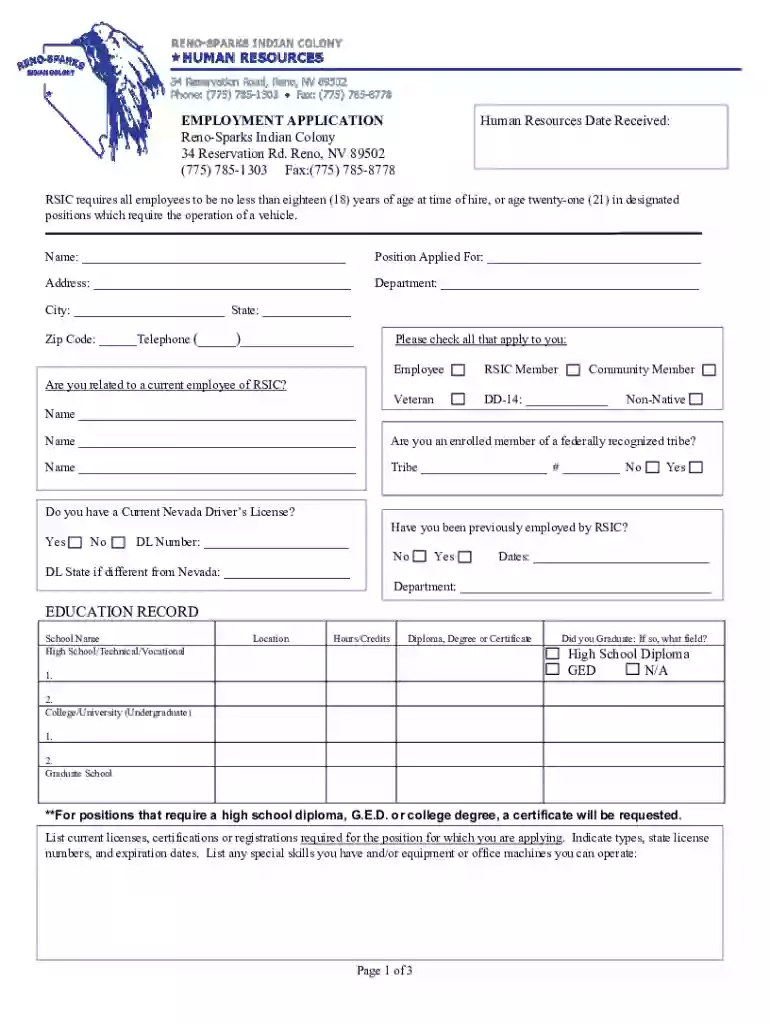
Type text, add images, blackout confidential details, add comments, highlights and more.

Draw your signature, type it, upload its image, or use your mobile device as a signature pad.

Send it via email, link, or fax. You can also download it, export it or print it out.
The Employment Application for Human Resources serves as a critical document in the hiring process. It includes several key elements that ensure it captures all necessary information from job applicants. These components are integral to evaluating qualifications and verifying credentials.
Personal Details: Applicants must provide their full name, contact information, and social security number. This section ensures that the organization can verify an applicant's identity and contact them for further information.
Education History: This part details the applicant's educational background, including institutions attended, degrees obtained, and dates of attendance. This information is crucial for assessing whether the candidate meets the educational requirements of the position.
Employment History: Applicants list previous employers, roles held, dates of employment, and responsibilities. This section provides insights into the applicant's professional experience and career progression.
Professional References: Names and contact information for professional references are required. Employers use this information to validate an applicant's past job performance and work ethic.
Acknowledgments and Signatures: This part includes applicant agreements to background checks and drug tests. It also features the applicant's signature to verify the accuracy and truthfulness of the information provided.
Completing the Employment Application requires careful attention to detail to ensure accuracy and completeness. Below are the primary steps involved:
Gather Necessary Information: Collect all personal, educational, and employment history details. Have contact information for professional references ready.
Fill in Personal Information: Start by providing personal details such as name, address, phone number, and social security number.
Detail Education History: List all relevant educational achievements, including institutions, degrees, and completion dates.
Outline Employment History: Provide a comprehensive history of previous job positions, including employers, roles, responsibilities, and time periods.
Provide References: Include contact details for references willing to speak about your professional capabilities and character.
Review and Sign: Thoroughly review the application for errors, and misstatements, and, once satisfied, sign and date the application to affirm its accuracy.
When submitting the Employment Application, certain documents might be required to support the application:
Proof of Identity: A copy of your driver's license or a government-issued ID to confirm your identity.
Educational Transcripts: Official transcripts from educational institutions may be required to verify academic achievements.
Work Experience Validations: Letters from previous employers or copies of performance evaluations might be requested.
Certification Documents: Copies of any relevant professional licenses or certifications.
Human Resources professionals use the Employment Application to guide the recruitment process, assisting in making informed hiring decisions:
Screening Applicants: Initial reviews to determine which candidates meet the basic requirements for the position.
Conducting Interviews: Using the application data to tailor interview questions that probe deeper into an applicant's experience and skills.
Reference Checks: Contact listed references to corroborate an applicant’s employment history and gauge their work ethic.
Finalizing Selection: Compiling application data to support hiring decisions and inform onboarding processes.
The Employment Application includes several legally binding components that applicants must accurately complete:
Consent for Background Checks: Authorization for potential pre-employment background investigations.
Drug Test Agreement: Consent that allows the employer to conduct drug testing as a condition for employment.
Truthful Disclosure: The applicant's signature confirms that all provided information is truthful to the best of their knowledge, which is crucial for maintaining legal integrity.
Different organizations may utilize various forms suited to specific industries or requirements:
Online Applications: Digital versions of applications that may require different information fields tailored to the company’s needs and digital processing capabilities.
Custom Forms for Specific Industries: Customized forms that include role-specific questions pertinent to industries such as healthcare or education.
To optimize workflow efficiency, Employment Applications can be managed and processed using software:
Integration with HR Software: Forms can be integrated into Human Resource Management Systems (HRMS) to streamline applicant tracking and management.
Compatibility with Document Platforms: Using platforms like DocHub, forms can be edited and annotated, enhancing the review and collaboration process among HR teams.
The processing time for employment applications can vary based on several factors:
Initial Review: Typically, this includes a preliminary screening stage that might take a few days.
Interview Scheduling: Depending on availability, scheduling may extend the time frame for application approval.
Background Checks: These can add a week or more to the process, as they require third-party involvement.
Final Decision: After interviews and checks, HR communicates decisions, which can also impact overall processing time.
By understanding and effectively managing these components, both applicants and Human Resources teams can ensure a more efficient and thorough employment application process.
We've got more versions of the EMPLOYMENT APPLICATION Human Resources Date Received form. Select the right EMPLOYMENT APPLICATION Human Resources Date Received version from the list and start editing it straight away!
At DocHub, your data security is our priority. We follow HIPAA, SOC2, GDPR, and other standards, so you can work on your documents with confidence.
May 24, 2012 Basic verification includes dates of employment, job title and reason for leaving. Some employers will verify salary. Usually obtained from HR
You can monitor the status of your application by logging into your account and going to My Applications. You can continue to apply for jobs that interest
Once the appointment form is received in Human Resources, the position will be designated as filled in the online application system and non-selected applicantsRead more


