




Definition & Meaning
The Family Educational Rights and Privacy Act (FERPA) is a federal law in the United States that ensures the privacy of student educational records. This act grants students certain rights regarding their education records and delineates how these records are accessed and released. FERPA is essential for protecting the confidentiality of student information while still allowing for necessary exchanges between educational institutions and authorized parties.
Key Aspects of FERPA
- Student Rights: Under FERPA, students have the right to inspect and review their educational records, request amendments to inaccurate or misleading information, and consent to disclosures of personally identifiable information (PII) contained in education records.
- Privacy Protections: Education records include grade reports, transcripts, class lists, student schedules, student identification codes, and other records containing personal information linked to individual students. FERPA restricts the disclosure of such information without the student's consent.
- Legal Compliance: Institutions receiving educational funds from the Department of Education must comply with FERPA regulations to avoid potential penalties.
Key Elements of the Family Educational Rights and Privacy Act
Core Components
Understanding the foundation and structure of FERPA is necessary for proper implementation. The act includes specific provisions that educational institutions must adhere to, ensuring student data protection.
- Consent for Disclosures: Generally, schools must have written permission from the student (or parent, if applicable) to release any information from a student's education record. There are specific conditions under which schools can disclose records without consent, such as to school officials with legitimate educational interests or in health and safety emergencies.
- Directory Information: Schools can disclose, without consent, “directory” information such as name, address, telephone number, date and place of birth, honors and awards, and dates of attendance. However, students can request that their directory information not be disclosed without their consent.
- Annual Notification: Schools must annually notify students of their rights under FERPA. This notification can be achieved through methods such as student handbooks, online portals, or newsletters.
Steps to Complete the Family Educational Rights and Privacy Act Waiver
Step-by-Step Process
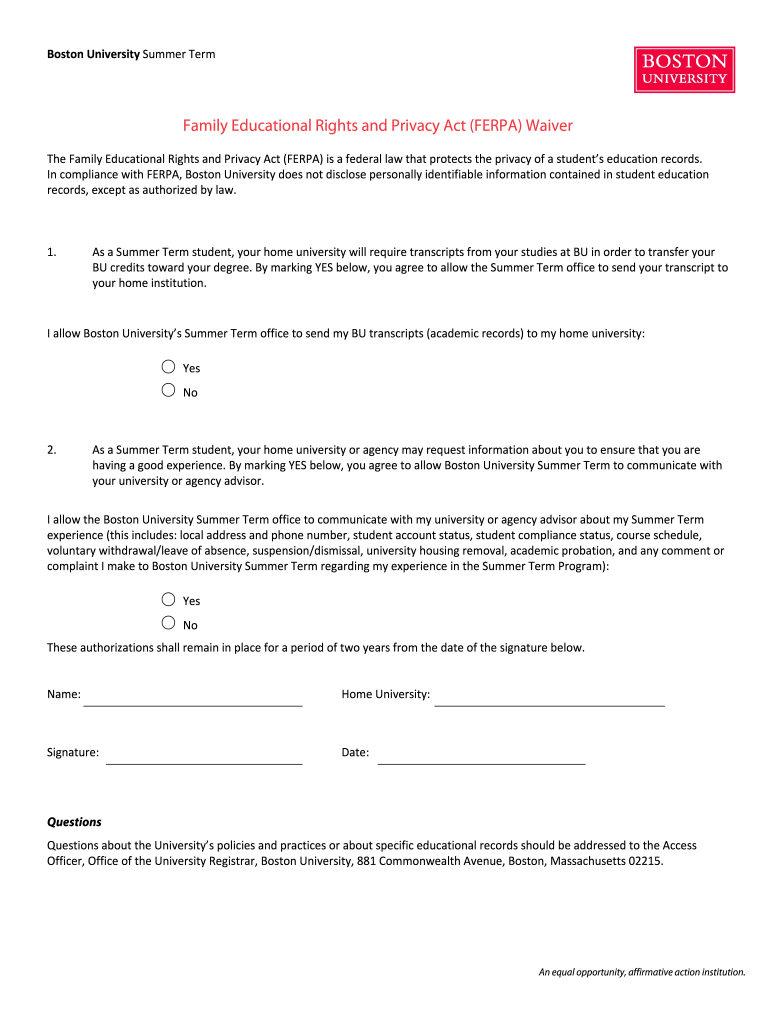
Completing a FERPA waiver allows students to authorize the release of their educational records to third parties. Here’s a step-by-step guide to its completion.
- Obtain the Waiver Form: Students can access the FERPA waiver form through their school’s registrar’s office or online portal.
- Fill in Personal Information: Enter all required personal details, including student ID, name, and contact information.
- Specify Records: Indicate which educational records you wish to authorize for release.
- Identify Recipients: List the organizations or individuals to whom the records are to be disclosed.
- Understand the Consent: Read through the consent section carefully to understand the implications of authorizing these disclosures.
- Sign and Date: Sign and date the waiver form to validate the consent.
- Submit the Form: Return the completed form to the appropriate office, typically the registrar.
How to Use the Family Educational Rights and Privacy Act
Practical Applications
FERPA is widely used across educational settings, offering flexibility while maintaining student privacy. Let’s explore some common use cases.
- Academic Advising: Enables student advisory services to access necessary records to provide personalized guidance.
- Transfer of Records: Facilitates the transfer of academic and enrollment records between institutions, like transferring transcripts for enrollment at another university.
- Parental Access: In higher education, students can waive rights to enable parents or guardians access to their educational records.
Who Typically Uses the Family Educational Rights and Privacy Act

Primary Users
FERPA serves a wide range of users within educational communities, each with distinct roles in managing and accessing educational records.
- Students: Seek to exercise rights over their educational records and monitor how their data is shared.
- Educational Institutions: Required to comply with FERPA to protect students’ records and privacy.
- Parents: Particularly in K-12 settings, exert rights on behalf of minor students concerning access to educational records.
- Administrative Staff: Handle education records, ensuring compliance with privacy standards under FERPA.
Important Terms Related to FERPA
Glossary
Familiarity with the terms associated with FERPA is crucial for proper understanding and application of the law.
- Education Record: Any records maintained by an educational institution or party acting on its behalf, which contain information directly related to a student.
- Personally Identifiable Information (PII): Information that can be used on its own or with other information to identify, contact, or locate a single person.
- Legitimate Educational Interest: A school official’s need-to-know basis when accessing students’ education records for fulfilling professional responsibilities.
Legal Use of the Family Educational Rights and Privacy Act
Compliance Guidelines
Adhering to legal requirements and understanding permissible actions under FERPA is vital for schools and individuals.
- Authorized Disclosures: Release of records permissible without consent in specific cases, such as compliance with a judicial order or lawfully issued subpoena.
- Breach Consequences: Non-compliance may lead to the withdrawal of federal funding from the Department of Education.
- Audit and Review: Institutions must account for how they collect, maintain, and disclose records, subject to audit for compliance with FERPA requirements.
State-Specific Rules for the Family Educational Rights and Privacy Act
Understanding Variations
While FERPA is a federal law, its interpretation and implementation can vary across states due to additional privacy laws.
- State Enhancements: Some states have enacted additional laws that complement FERPA, offering increased protections or expanded definitions of educational records.
- State Education Agencies: Differ in their interpretation and implementation of FERPA, influencing how educational records are managed locally.
- Consultation Requirement: Schools may require legal consultation to align state-specific rules with FERPA, ensuring comprehensive compliance.