




01. Edit your form online
Type text, add images, blackout confidential details, add comments, highlights and more.

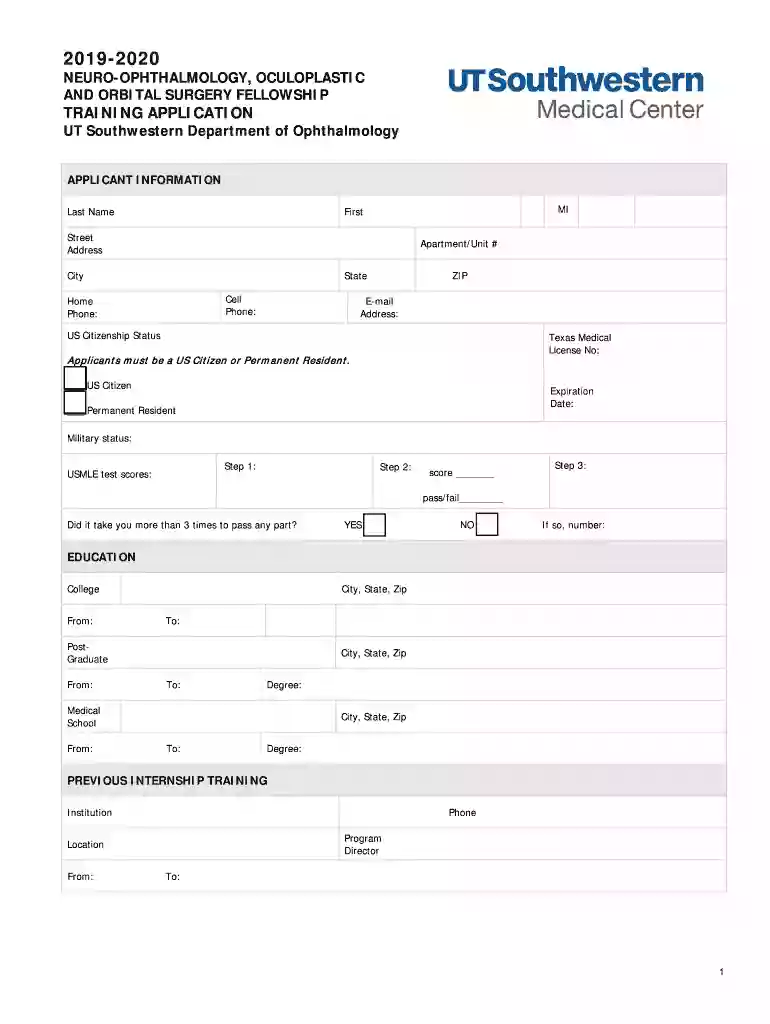
Type text, add images, blackout confidential details, add comments, highlights and more.

Draw your signature, type it, upload its image, or use your mobile device as a signature pad.

Send it via email, link, or fax. You can also download it, export it or print it out.
The Neuro-Ophthalmology, Oculoplastic form is an application used for the fellowship at the UT Southwestern Department of Ophthalmology. This form serves as a comprehensive document gathered from applicants to assess their qualifications and suitability for the fellowship program involving specialized fields within ophthalmology, focusing on neurological and reconstructive aspects.
This form adheres to legal and professional standards in the medical field. Applicants are expected to provide accurate and truthful information. Misrepresentation or falsification can lead to disqualification and potential legal actions. Compliance with privacy laws regarding the handling of applicant data is also essential.
Candidates pursuing careers in neuro-ophthalmology and oculoplastic surgery often use this form to apply for specialized fellowship training. The target users are typically medical professionals who have completed their primary ophthalmology residency and are seeking further specialization.
When submitting the Neuro-Ophthalmology, Oculoplastic form, include:
While the form pertains to a program in Texas, applicants must be aware of individual state requirements or restrictions on medical licensing and practice. Compliance with state medical boards is often necessary depending on where applicants intend to ultimately practice.
Applicants may complete the Neuro-Ophthalmology, Oculoplastic form digitally for submission via email or through an online portal, if available. Paper versions are also accepted, ensuring accessibility for individuals with varying technical capabilities. Digital versions offer the advantage of streamlined processes and easy editing, whereas paper submissions may appeal to those preferring physical copies for their records.
We've got more versions of the NEURO-OPHTHALMOLOGY, OCULOPLASTIC form. Select the right NEURO-OPHTHALMOLOGY, OCULOPLASTIC version from the list and start editing it straight away!
At DocHub, your data security is our priority. We follow HIPAA, SOC2, GDPR, and other standards, so you can work on your documents with confidence.
The neuro-ophthalmology service at New York Eye (NYEE) is fully equipped to handle visual problems triggered by neurological conditions, including brain tumors
Kami menyediakan pasaran lengkap yang mencakup berbagai jenis togel dari seluruh dunia. Dari togel 4D, 3D, hingga 2D, Anda memiliki banyak pilihan untukRead more
by JB Kerrison 1999 Cited by 3 Five things oculoplastic surgeons should know about neuro-ophthalmology. Department of Ophthalmology, Emory University School of Medicine, Atlanta, Georgia,


