




01. Edit your form online
Type text, add images, blackout confidential details, add comments, highlights and more.

Type text, add images, blackout confidential details, add comments, highlights and more.

Draw your signature, type it, upload its image, or use your mobile device as a signature pad.

Send it via email, link, or fax. You can also download it, export it or print it out.
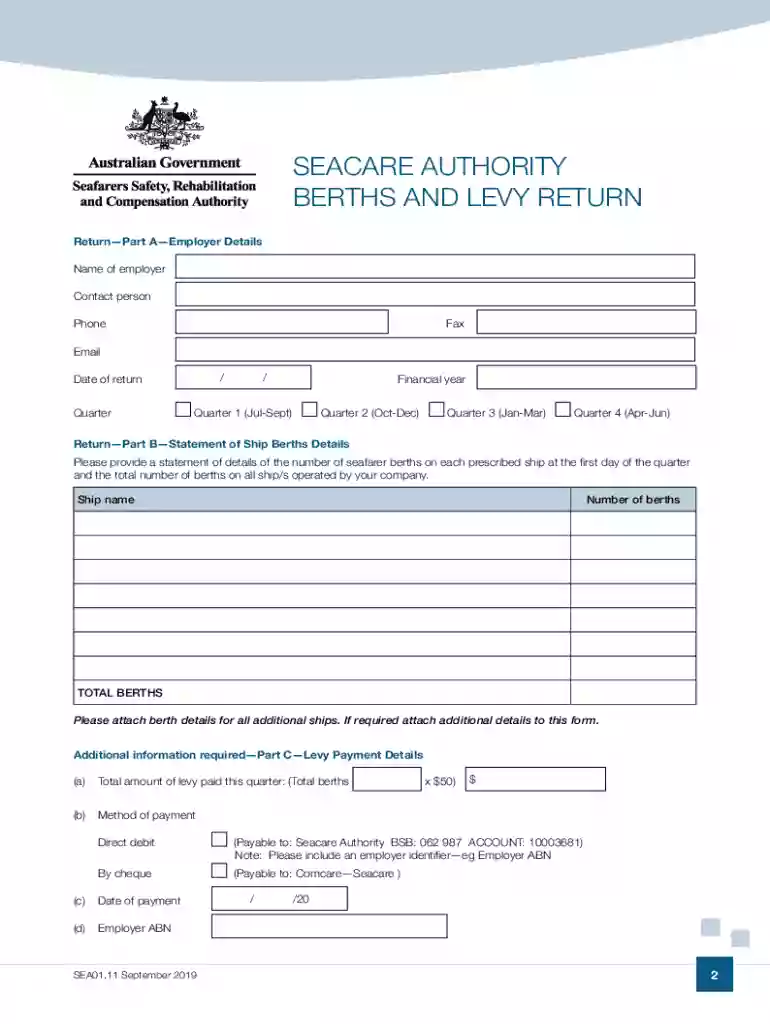
The Berths and Levy Return form is a critical document for employers under the Seafarers Rehabilitation and Compensation Levy Collection Act 1992. This form is essential for reporting ship berth information and associated levy payments. Employers are required to submit this form to the Seacare Authority within 14 days of the beginning of each quarter. Its primary purpose is to ensure compliance with legal requirements by providing detailed employer and ship information.
Employer Details: Each submission must include comprehensive details about the employer responsible for the ships and operations concerned.
Ship Berth Information: Detailed statements about the ship berths under the employer's responsibility must be reported, ensuring transparency and accuracy in data.
Levy Payment Information: Specifics of levy payments are required, ensuring funds are correctly attributed and processed according to regulations.
Employers can acquire the Berths and Levy Return form through various official channels. Ensuring timely access to the form is essential to maintain compliance with the Act's requirements.
Official Government Websites: The primary option for obtaining the form is through official government or agency websites dedicated to the Seacare Authority or maritime operations.
Direct Requests: Employers may also directly request the form from the Seacare Authority or relevant regulatory bodies dealing with maritime operations and levies.
Professional Associations: In some cases, industry associations or professional bodies may distribute the form to their member organizations.
Digital Platforms: Digital document management platforms, such as DocHub, may offer accessibility features or links to government forms for streamlined workflow integration.
Completing the Berths and Levy Return form requires attention to detail and a systematic approach to ensure all information is accurately captured.
Gather Necessary Information: Before starting the form, collect all required details about the employer, ship berths, and levy payments.
Fill Out Employer Details: Input the employer's name, address, and contact information accurately to avoid potential discrepancies.
Provide Ship Berth Statements: Enter detailed information about each ship berth, including location and operational data, as required by the form.
Detail Levy Payments: Calculate and document all related levy payments to ensure complete and accurate financial reporting.
Review and Verify: Carefully review all entered data for accuracy, verifying against source documents and financial records.
Submission Process: Ensure the form is submitted within the specified 14-day period at the start of each quarter to comply with deadlines.
The Berths and Levy Return form is primarily utilized by employers within the maritime industry responsible for ships and related operations under the jurisdiction of the Seafarers Rehabilitation and Compensation Levy Collection Act.
Maritime Corporations: Large corporations operating fleets or multiple vessels commonly require this form for compliance with levy collection statutes.
Shipping Companies: Entities directly involved in the shipping industry use this form extensively for operational and financial reporting.
Maritime Service Providers: Companies providing services such as staffing or operations management for shipping firms may also need to complete and submit this form.


Understanding the primary components of the Berths and Levy Return form helps ensure its correct completion and submission.
Employer Identification: Critical for tracking submissions and ensuring accountability, this section requires precise details about the employer.
Detailed Berth Reports: Each berth operated by the employer must be documented, including specific usage and location data, which is essential for accurate levy calculation.
Financial Reporting: Levy payments must be thoroughly detailed within the form, ensuring that all financial obligations are correctly reported and settled.
The Berths and Levy Return form serves both a legal and administrative purpose, ensuring employers comply with regulatory obligations under the Seafarers Rehabilitation and Compensation Levy Collection Act.
Regulatory Compliance: Submission of the form as specified by law demonstrates compliance with maritime levy regulations, thereby avoiding legal penalties.
Audit Trail: Proper completion and submission provide an audit trail, which is essential for potential audits or reviews by regulatory bodies.
Transparency and Accountability: By offering clear evidence of berth operations and financial transactions, the form supports transparency and accountability in the maritime industry.
Failure to submit the Berths and Levy Return form timely or accurately can result in significant consequences.
Fines and Penalties: Non-compliance may lead to monetary fines imposed by regulatory authorities, impacting the financial standing of the employer.
Legal Action: Persistent non-compliance could escalate to legal proceedings, depending on the severity and frequency of breaches.
Reputation Damage: Non-compliance might negatively affect the reputation of the business within the maritime industry, which could have broader business implications.
Employers have several options for submitting the Berths and Levy Return form, each with distinct advantages.
Online Submission: Many regulatory bodies provide an electronic submission option, allowing for efficient and timely processing.
Postal Submission: Traditional mail submission is available, although it might require additional time for processing and receipt.
In-Person Delivery: Some entities may accept in-person delivery of completed forms, particularly in areas with accessible regulatory offices, ensuring receipt verification.
Understanding and utilizing the available submission methods can enhance compliance efficiency and convenience.
We've got more versions of the Berths and Levy Return form The Levy Collection Act provides that an employer must provide a Return form. Select the right Berths and Levy Return form The Levy Collection Act provides that an employer must provide a Return version from the list and start editing it straight away!
At DocHub, your data security is our priority. We follow HIPAA, SOC2, GDPR, and other standards, so you can work on your documents with confidence.
Mar 13, 2026 Employers, financial institutions, and others may receive an IRS levy. This page has information to help you comply with the levy.Read more
Jan 1, 2026 On or before February 1, 2026, and each year after that, an employer must provide employees a required workplace rights notice. The LaborRead more


