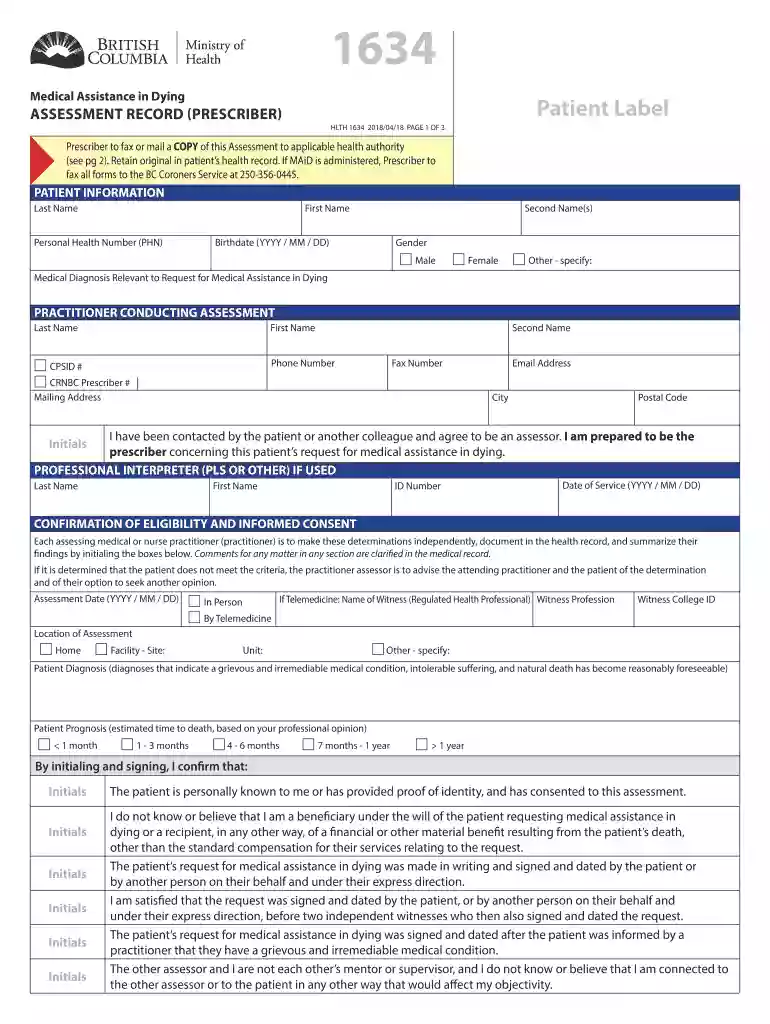
Medical Assistance in Dying Assessment Record (Prescriber) Medical Assistance in Dying Assessment Re 2026

Get Form
Medical Assistance in Dying Assessment Record (Prescriber) Medical Assistance in Dying Assessment Re Preview on Page 1

Here's how it works

01. Edit your form online
Type text, add images, blackout confidential details, add comments, highlights and more.

02. Sign it in a few clicks
Draw your signature, type it, upload its image, or use your mobile device as a signature pad.

03. Share your form with others
Send it via email, link, or fax. You can also download it, export it or print it out.

Definition & Meaning

The "Medical Assistance in Dying Assessment Record (Prescriber)" is a crucial document used in the context of Medical Assistance in Dying (MAiD) within British Columbia. Its primary purpose is to record the detailed assessment performed by a prescriber to determine a patient's eligibility for MAiD. This form captures vital information such as the patient's medical condition, prognosis, and their capability to provide informed consent. The assessment ensures that all legal and ethical criteria are met before proceeding with MAiD.

How to Use the Medical Assistance in Dying Assessment Record

To effectively utilize this assessment record, medical practitioners must thoroughly understand each section of the form. The document serves as a comprehensive checklist that guides the prescriber through the necessary steps for assessing a patient’s eligibility. These include evaluating the patient’s medical history, prognosis, and understanding of MAiD. Additionally, the prescriber must document their discussions with the patient regarding informed consent and any alternative treatments discussed.

  • Patient Information Section: Accurately fill in all required fields with the patient’s personal and medical details.
  • Eligibility Criteria Assessment: Confirm whether the patient meets all specified criteria for MAiD, documenting findings in this section.
  • Informed Consent: Record the process and outcomes of obtaining the patient’s informed consent, noting any questions or concerns raised.

Steps to Complete the Assessment Record

  1. Gather Necessary Information: Before starting the assessment, ensure that all patient medical records and historical data are available for review.
  2. Conduct the Assessment: Follow the structured sections provided in the form to examine the patient’s condition against the legal criteria for MAiD.
  3. Document Findings: Clearly articulate the prescriber’s findings and evaluations in each section of the form, providing comprehensive details.
  4. Informed Consent Discussion: Engage with the patient to discuss the procedure, document the consent, and any alternative options considered.
  5. Finalize the Documentation: Review the completed form to confirm accuracy and completeness before archiving it as part of the patient's records.

Key Elements of the Assessment Record

The form is designed with specific sections, each tailored to capture crucial information needed for a comprehensive assessment:

  • Eligibility Criteria: This includes the patient’s medical condition, the nature of their suffering, and the voluntary nature of their request for MAiD.
  • Informed Consent: Document the prescriber’s explanation of the MAiD process and alternatives, ensuring the patient understands their decision.
  • Decision Communication: Record how and when the assessment results were communicated to the patient and any subsequent steps discussed.

Legal Use of the Assessment Record

Legally, the use of this form is governed by stringent regulations to ensure compliance with ethical and medical standards. It serves as a record that authorities may review to verify that all procedures were followed according to the law. Medical professionals must ensure that the form is completed accurately to avoid any legal repercussions.

Who Typically Uses the Assessment Record

This form is specifically designed for use by licensed prescribers, such as physicians or nurse practitioners, who are authorized to carry out MAiD assessments. It’s a vital tool in ensuring the decision-making process for MAiD is thorough and legally compliant.


decoration image ratings of Dochub

Important Terms Related to the Assessment Record

Understanding the terminology associated with MAiD is crucial for accurately completing the form:

  • Informed Consent: This refers to the patient’s voluntary agreement to the procedure after understanding all implications.
  • Eligibility Criteria: These are the conditions a patient must meet to qualify for MAiD, such as having a grievous and irremediable medical condition.

Versions or Alternatives to the Assessment Record

While the "Medical Assistance in Dying Assessment Record" is specific to British Columbia, there may be variations or alternative forms used in different jurisdictions within Canada. It’s essential for prescribers to use the correct version relevant to their location to comply with local laws.

State-by-State Differences

Although this form is specific to British Columbia, similar forms may vary across provinces in Canada. Each jurisdiction may have different legal requirements and criteria for MAiD, making it essential for prescribers to be familiar with the specific rules in their area.

Eligibility Criteria

A critical component of the assessment form is verifying that the patient meets the established eligibility criteria for MAiD:

  • Medical Condition: The patient must have a serious and incurable illness, disease, or disability.
  • Irremediable Suffering: The patient’s suffering must be intolerable and cannot be relieved under conditions that they find acceptable.
  • Voluntary Request: The decision to pursue MAiD must be made freely and without external pressure.
decoration image

How to Obtain the Medical Assistance in Dying Assessment Record

Prescribers can typically obtain this form through health authorities or directly from medical associations in British Columbia. Being informed about where and how to access this form ensures that prescribers are prepared to undertake MAiD assessments promptly and according to regulatory requirements.

See more Medical Assistance in Dying Assessment Record (Prescriber) Medical Assistance in Dying Assessment Re versions

We've got more versions of the Medical Assistance in Dying Assessment Record (Prescriber) Medical Assistance in Dying Assessment Re form. Select the right Medical Assistance in Dying Assessment Record (Prescriber) Medical Assistance in Dying Assessment Re version from the list and start editing it straight away!
Versions Form popularity Fillable & printable
2021 4.8 Satisfied (130 Votes)
2018 4.2 Satisfied (59 Votes)
be ready to get more

Complete this form in 5 minutes or less

Get form

Got questions?

We have answers to the most popular questions from our customers. If you can't find an answer to your question, please contact us.
Contact us
Intravenous administration is the most reliable and rapid way to accomplish euthanasia. A coma is first induced by intravenous administration of 20 mg/kg sodium thiopental (Nesdonal) in a small volume (10 ml physiological saline).
The Canadian Association of MAiD Assessors and Providers recommends fixed dosing of midazolam (an anxiolytic), 10 mg; propofol (an anesthetic coma-inducing agent), 1000 mg; and rocuronium, 200 mg, or , 40 mg (neuromuscular blockers to stop respiration).
Barbiturates are favored MAiD drugs based on their unique chemistry. , as a base with a pK of 3.4 and good lipid solubility, is immediately absorbed starting in the stomach and acts within minutes.
Voluntary assisted dying A person must meet the eligibility criteria and follow all the legal steps for voluntary assisted dying to happen. This will allow them to take or be given a medication to bring about their death at a time that they choose. Voluntary assisted dying and suicide are different.
Steps in the EOLOA process You request the aid-in-dying drug from your doctor on two separate occasions, at least 48 hours apart. You also make a third request, which you write on a special form. Your doctor begins the process of ensuring that you legally qualify for the EOLOA.

Security and compliance

At DocHub, your data security is our priority. We follow HIPAA, SOC2, GDPR, and other standards, so you can work on your documents with confidence.

Learn more
ccpa2
pci-dss
gdpr-compliance
hipaa
soc-compliance

People also ask

Physician-assisted suicide (oral ingestion) The most common lethal drugs used by clinicians to assist suicide were high doses of barbiturates, frequently either pentobarbital or secobarbital.
While laws differ slightly across states, all require that patients requesting physician-assisted death satisfy three criteria: (1) terminal illness through a prognosis of having 6 months or less to live, (2) competence and intact judgment, and (3) voluntariness.

Related links