







Definition & Meaning
The Provisional Licensed Alcohol and Drug Counselor (PLADC) designation serves as an introductory certification for individuals entering the field of substance abuse counseling. It allows new counselors to practice under supervision as they gain the necessary experience to meet full licensing requirements. This provisional license is crucial for those starting their career in addiction counseling, providing a structured path to develop professional competencies.
How to Use the Provisional Licensed Alcohol and Drug Counselor
Having a PLADC enables individuals to offer counseling services under the guidance of a fully licensed professional. This form of licensure is designed for those who are acquiring supervised practice hours while progressing toward a full license. It legally permits holders to engage in various counseling activities, such as client assessments and individual or group counseling sessions, within a supervised framework to ensure adherence to ethical and professional standards.
How to Obtain the Provisional Licensed Alcohol and Drug Counselor
To obtain a PLADC, applicants must first demonstrate compliance with specific educational and training prerequisites. These include completing coursework in substance abuse counseling and accumulating a designated number of hours in supervised clinical practice. Individuals must also submit a comprehensive application that includes proof of U.S. citizenship or lawful presence and undergo a background check to ensure suitability for working with vulnerable populations.
Steps to Complete the Provisional Licensed Alcohol and Drug Counselor
- Education: Begin by completing required education in addiction counseling through an accredited program.
- Documentation: Gather necessary documents, such as official transcripts and proof of U.S. citizenship or lawful presence.
- Application Submission: Prepare and submit the PLADC application, ensuring all sections are thoroughly completed.
- Background Check: Undergo a criminal history check by submitting fingerprints and other required information.
- Fee Payment: Pay the associated application and processing fees as stipulated by the licensing board.
- Await Approval: After submission, wait for official confirmation of provisional licensure, which will allow you to practice under supervision.
Required Documents
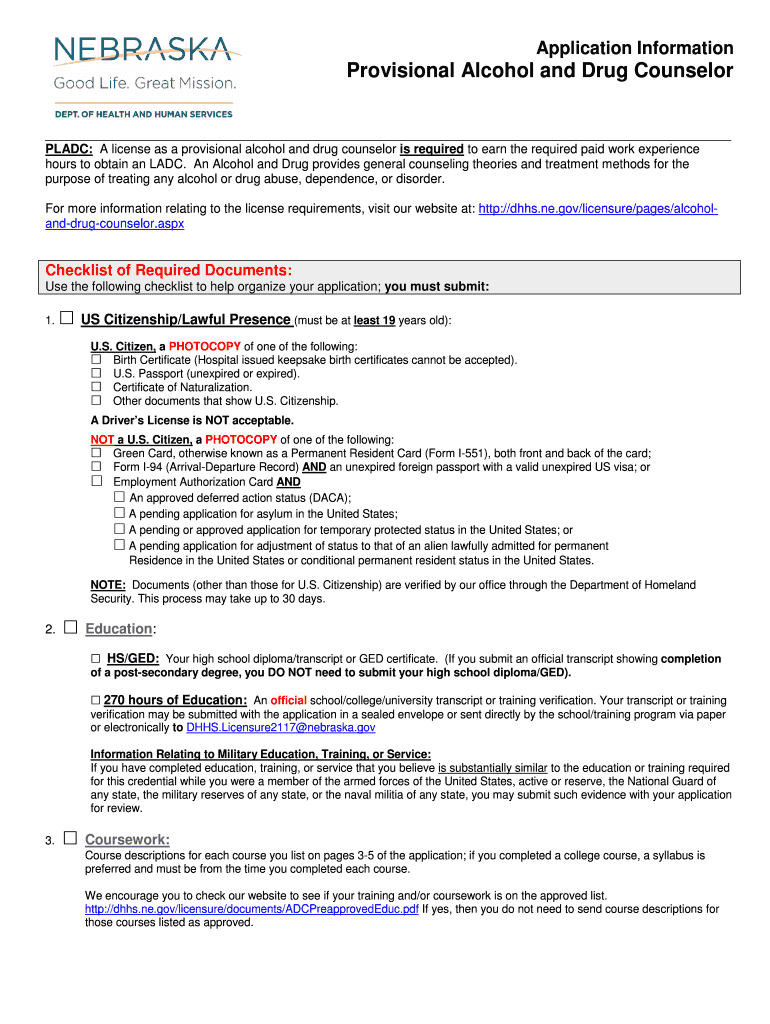
When applying for a PLADC, candidates must provide a detailed set of documents, including:
- Official transcripts from an accredited educational institution.
- Proof of U.S. citizenship or lawful presence, such as a birth certificate or green card.
- Verification of completed supervised practical training hours.
- A completed application form, duly signed and dated.
- Documentation of any relevant professional certifications or licenses.
- Results from a criminal background check.
Eligibility Criteria
Eligibility to apply for the PLADC hinges on several conditions:
- Completion of specified educational programs in alcohol and drug counseling.
- Successful completion of required supervised clinical practice hours.
- Clean legal and disciplinary record, particularly concerning any past licenses.
- U.S. citizenship or lawful presence verification.
- Readiness to practice under supervision to fulfill full licensure requirements.


Key Elements of the Provisional Licensed Alcohol and Drug Counselor
The PLADC comprises several foundational components:
- Scope of Practice: Outlines the activities permissible under supervision, such as client evaluations.
- Supervision Requirements: Details the necessity for oversight by a licensed counselor.
- Renewal and Advancement: Provides guidelines for transitioning from provisional to full licensure.
- Legal Compliance: Ensures alignment with state and federal regulations governing counseling practice.
State-Specific Rules for the Provisional Licensed Alcohol and Drug Counselor
The requirements for a PLADC can vary significantly from one state to another, influenced by local regulatory frameworks. Prospective counselors must familiarize themselves with state-specific educational, practical, and legal requirements. This includes understanding any additional courses mandated by the state and recognizing unique supervision stipulations or ethical codes outlined by the regional licensing board.




