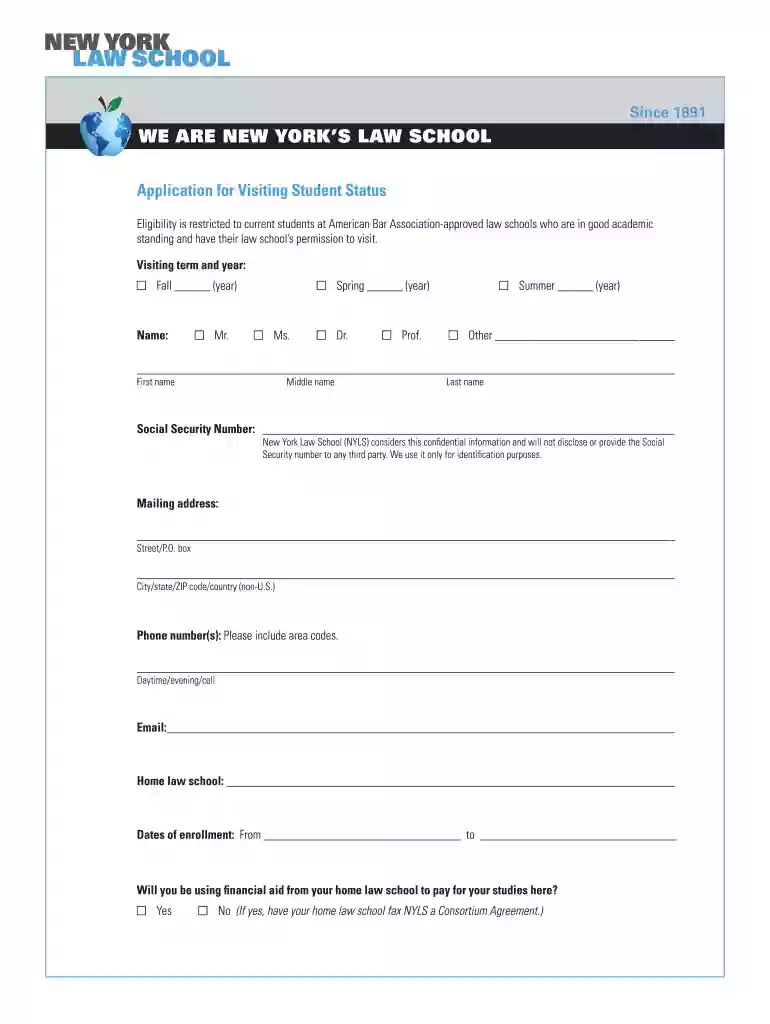
Transfer and Visiting Students - School of Law - University at 2026

Get Form
Transfer and Visiting Students - School of Law - University at Preview on Page 1

Here's how it works

01. Edit your form online
Type text, add images, blackout confidential details, add comments, highlights and more.

02. Sign it in a few clicks
Draw your signature, type it, upload its image, or use your mobile device as a signature pad.

03. Share your form with others
Send it via email, link, or fax. You can also download it, export it or print it out.

Definition & Meaning

"Transfer and Visiting Students - School of Law - University at" pertains to students who wish to transfer to or visit a School of Law within a university. This form is primarily used by law students attending institutions approved by the American Bar Association (ABA) who are considering transferring to another law school or visiting for a semester or more. The application ensures compliance with the host law school’s academic and administrative protocols, playing a crucial role in maintaining academic standards and continuity for the student.

Important Terms Related to the Form

Understanding key terminology is essential when dealing with this form:

  • ABA-Approved Law School: A law school that meets the standards set by the American Bar Association.
  • Letter of Good Standing: A document provided by the current institution confirming the student's academic eligibility.
  • Host School: The institution the student intends to visit or transfer to.
  • Home Institution: The current school where the student is enrolled.

These terms help clarify the requirements and processes involved in transferring or visiting a new law school.

Eligibility Criteria

To qualify as a transfer or visiting student at a school of law, applicants generally need to meet certain requirements:

  • Must be enrolled in an ABA-approved law school.
  • A minimum GPA may be required as stipulated by the host school.
  • Submission of a letter of good standing from the home institution.
  • Compliance with any additional criteria set forth by the host law school, such as language proficiency or prerequisite coursework.

These criteria ensure that students are well-prepared and academically viable for the transition.


decoration image ratings of Dochub

Steps to Complete the Form

Completing the "Transfer and Visiting Students - School of Law - University at" application involves several important stages:

  1. Obtain a Letter of Good Standing: Request this from your current law school’s registrar.
  2. Complete the Application Form: Enter all required personal and academic details accurately.
  3. Submit Required Documents: Attach transcripts, the letter of good standing, and any specific essays or documents requested.
  4. Review Host School Policies: Familiarize yourself with the host school’s rules and expectations for visiting or transfer students.
  5. Submit the Application: Choose an appropriate submission method (online or mail) as specified by the host school’s admissions office.

Following these steps rigorously helps prevent processing delays or rejections.

Required Documents

The application process is document-intensive, ensuring all necessary information is provided:

  • Letter of Good Standing
  • Official Transcripts: Complete records from the home institution.
  • Personal Statement or Essay: Often required to explain the purpose of transfer or visit.
  • Additional School-specific Forms: As dictated by the host law school.

These documents ensure that the host school has a comprehensive view of the student’s academic history and suitability.

Form Submission Methods (Online / Mail / In-Person)

The application can generally be submitted via multiple avenues:

  • Online: The most efficient and preferred method, ensuring quick and trackable submissions.
  • Mail: For those who prefer or are required to submit physical documents.
  • In-Person: Some institutions may allow personal delivery to the admissions office.

The choice depends on the specific processes and allowances of the host institution.

Application Process & Approval Time

The application timeline and approval duration can vary:

  • Application Timeline: Typically, applications should be submitted several months before the intended start date.
  • Approval Time: Varies by institution but generally takes several weeks post-submission.
  • Notification: Applicants are informed through the method specified in their application about acceptance or additional steps.

Planning ahead and adhering to deadlines is vital to ensure a smooth transition.

Digital vs. Paper Version

Choosing between digital and paper submissions depends on several factors:

  • Digital Version: Offers convenience and quick processing, with features like electronic signatures via platforms such as DocHub.
  • Paper Version: May be necessary for hard-copy documentation where required or preferred by certain institutions.

Both methods have their benefits, but a digital submission is often quicker and easier to track.

Penalties for Non-Compliance

Non-compliance with application requirements or deadlines can result in:

  • Delayed Admission: Missing documents or incorrect submissions can push back approval or acceptance.
  • Application Rejection: Failure to meet eligibility criteria can lead to an outright denial.
  • Loss of Application Fee: Many institutions do not refund fees if applications are incomplete or rejected.

Ensuring compliance with all requirements is crucial to avoid these setbacks.

State-Specific Rules

Though the overall process might be similar across states, certain variations exist:

  • Residency Requirements: Different states may have unique stipulations for in-state vs. out-of-state students.
  • Tuition Rates: These may vary based on residency status and the specifics of the visiting arrangement.
  • State Regulations: Additional state-specific laws can influence application approval.

Understanding these variations ensures better preparation and fewer surprises during the application process.

Who Typically Uses the Form

The form is mainly utilized by:

  • Current Law Students: Those seeking educational experiences at different institutions.
  • Prospective Transfers: Students who wish to permanently transfer to another law school.
  • Academic Advisors: To assist students in ensuring applications meet all necessary requirements.

These users rely on the form to facilitate crucial academic transitions, providing academic advancement opportunities and diversified experiences.

decoration image

See more Transfer and Visiting Students - School of Law - University at versions

We've got more versions of the Transfer and Visiting Students - School of Law - University at form. Select the right Transfer and Visiting Students - School of Law - University at version from the list and start editing it straight away!
Versions Form popularity Fillable & printable
2020 4.8 Satisfied (98 Votes)
2019 4.3 Satisfied (24 Votes)
be ready to get more

Complete this form in 5 minutes or less

Get form

Got questions?

We have answers to the most popular questions from our customers. If you can't find an answer to your question, please contact us.
Contact us
It doesnt work that way. According to Quoran and former law professor Alice Baker, law school admission committees normally only consider undergrad GPA and LSAT scores. They normally will totally ignore graduate degrees, work experience, etc. Unlike colleges, law schools normally dont accept transfers.
Visiting students are full or part-time students as defined by their home institution. Visiting students may attend the Law School for no more than two semesters (excluding the summer term). Visiting and special students may not apply as transfer students to the Law School.
If you are looking to transfer, you will need to have earned exceptional grades in your time as an L-1 . Earning stellar grades in your first semester and ranking high in your class may mean that you can transfer after that semester. Some schools will only admit students who are in the very top of their class.
These are the top 25 schools to matriculate the most transfers: Georgetown: 105 transfers in. NYU: 58 transfers in. Arizona State: 50 transfers in. Emory: 42 transfers in. UC Berkeley: 36 transfers in. Columbia: 35 transfers in. Loyola Los Angeles: 34 transfers in. Northwestern: 33 transfers in.
2022 2023 Transfer Admissions Rates RankSchoolTransfer Accept % 1 Northeastern 30.32% 2 Tulane 49.84% 3 Columbia 11.34% 4 UCLA 24.42%16 more rows

Security and compliance

At DocHub, your data security is our priority. We follow HIPAA, SOC2, GDPR, and other standards, so you can work on your documents with confidence.

Learn more
ccpa2
pci-dss
gdpr-compliance
hipaa
soc-compliance
be ready to get more

Complete this form in 5 minutes or less

Get form

People also ask

Generally, students must finish their 1L year to transfer. Admissions committees want to know how you perform in your current law school to see if youll fit in theirs. Most transfer applications open in the spring term right after your first year and close in the early summer.

Related links