Definition and Meaning
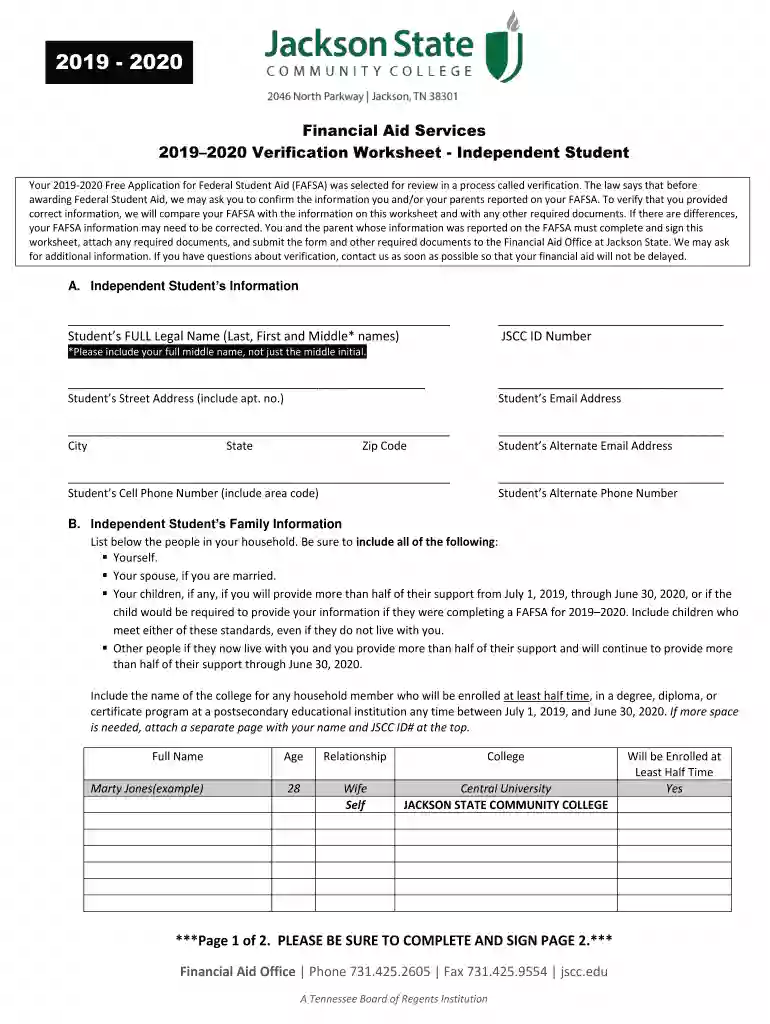
The 2 Independent Verification Worksheet - USCB is a crucial document in the financial aid process for independent students who have applied for Federal Student Aid through the FAFSA. This worksheet is designed to verify the accuracy of the information provided on a student's Free Application for Federal Student Aid (FAFSA). The independent verification is required by many institutions, such as Jackson State Community College, to ensure that the details concerning a student's household and financial situation are correct and up-to-date. Completing this form successfully is essential to prevent delays in processing financial aid packages.
Key Elements of the Worksheet
- Household Information: The form requires listing members of the student's household, including dependents, which helps in calculating the dependency status and financial need.
- Income Details: Students must provide accurate income information, including wages, Social Security benefits, and any other sources of revenue.
- Tax Data: The worksheet may require submitting IRS tax returns or transcripts to verify tax-related information.
Examples: A student living independently with their children will list dependents and document sources of income, including part-time work and any child support received.
How to Use the 2 Independent Verification Worksheet - USCB
Step-by-Step Completion Process
- Acquire the Form: Obtain the worksheet from the USCB financial aid office or their official website.
- Gather Required Documents: Collect necessary documents such as tax returns, W-2 forms, and other income-related documentation.
- Fill Out Personal Information: Enter all relevant details about yourself and your household members.
- Provide Financial Details: Accurately report income, assets, and benefits received.
- Review and Attach Documentation: Ensure all provided information matches with attached documents for consistency.
- Submit the Form: Send the completed worksheet with any additional required documentation to your institution's financial aid office for processing.
Important Reminders
- Review all entries for accuracy to prevent discrepancies.
- Use the IRS Data Retrieval Tool if available, as it can speed up the process and reduce errors.
- Check deadlines to avoid delays in financial aid distribution.
Required Documents
Essential Documentation for Verification
- IRS Tax Transcripts or Tax Returns: Necessary to confirm income and tax information.
- W-2 Forms: Attest to employment income details.
- Supplementary Income Documentation: Proof of any non-taxable income like public assistance or veterans benefits.
- Identity Confirmation: Government-issued ID and social security card copies for verification.
Examples: If the student received work-study wages, the amount reported on the worksheet should align with the W-2 form.

Filing Deadlines and Important Dates
Critical Timeframes
- FAFSA Submission Deadline: Check specific institutional deadlines as they can vary.
- Verification Completion Date: Some schools may set deadlines by which verification must be completed to ensure timely financial aid disbursement.
- IRS Tax Return Filing Deadlines: Tax documents are crucial for verification, aligning tax submissions with FAFSA timelines is beneficial.
Potential Impacts of Missing Deadlines
- Delayed financial aid may result in late payment charges or inability to register for classes.
- Loss of eligibility for certain grants or institutional aid if verification is not completed on time.
How to Obtain the Worksheet
Where to Get the Form
- Institution's Financial Aid Office: Most schools provide the form directly to students who are selected for verification.
- Online via the Institution's Website: Download and print the form for immediate access.
- Direct Mailing: Some students may receive it through postal services if requested or mandated by their institution.
Practical Considerations
- Verify the form version to ensure it is for the correct academic year.
- Check for any electronic submission options to streamline the process.
Who Typically Uses the 2 Independent Verification Worksheet - USCB
Typical Users
- Independent Students: Individuals who meet the criteria set forth by the FAFSA guidelines for independent status. This usually includes being over 24, married, veterans, or having dependents.
- Educational Institutions: Colleges and universities utilize these worksheets to verify data before disbursing financial aid.
Scenarios of Use
- An independent student working full-time who is returning to complete their degree.
- A veteran using GI Bill benefits alongside federal aid to attend college.
Legal Use of the Form
Compliance and Requirements
- Truthful Disclosures: Legal obligations to report truthful and complete information.
- Data Privacy: Protection of personal and financial data under FERPA and other privacy regulations.
- Verification Policies: Compliance with institutional verification requirements to maintain eligibility.
Penalties for Non-Compliance
- Loss of financial aid benefits if found to have submitted false information.
- Possible legal repercussions for fraudulent misrepresentation.
Examples and Case Studies
Real-World Applications
- Case Study 1: A student who is independent due to having children; they use the form to report household size and income for accurate grant calculations.
- Case Study 2: An older student who qualifies based on age, providing necessary documentation under new employment circumstances post-military service.
Impactful Outcomes
- Improved financial aid packages when all elements of income and household size are accurately reported.
- Avoidance of common pitfalls like misreporting spouse income or not updating household size after marital changes.