




01. Edit your form online
Type text, add images, blackout confidential details, add comments, highlights and more.

Type text, add images, blackout confidential details, add comments, highlights and more.

Draw your signature, type it, upload its image, or use your mobile device as a signature pad.

Send it via email, link, or fax. You can also download it, export it or print it out.
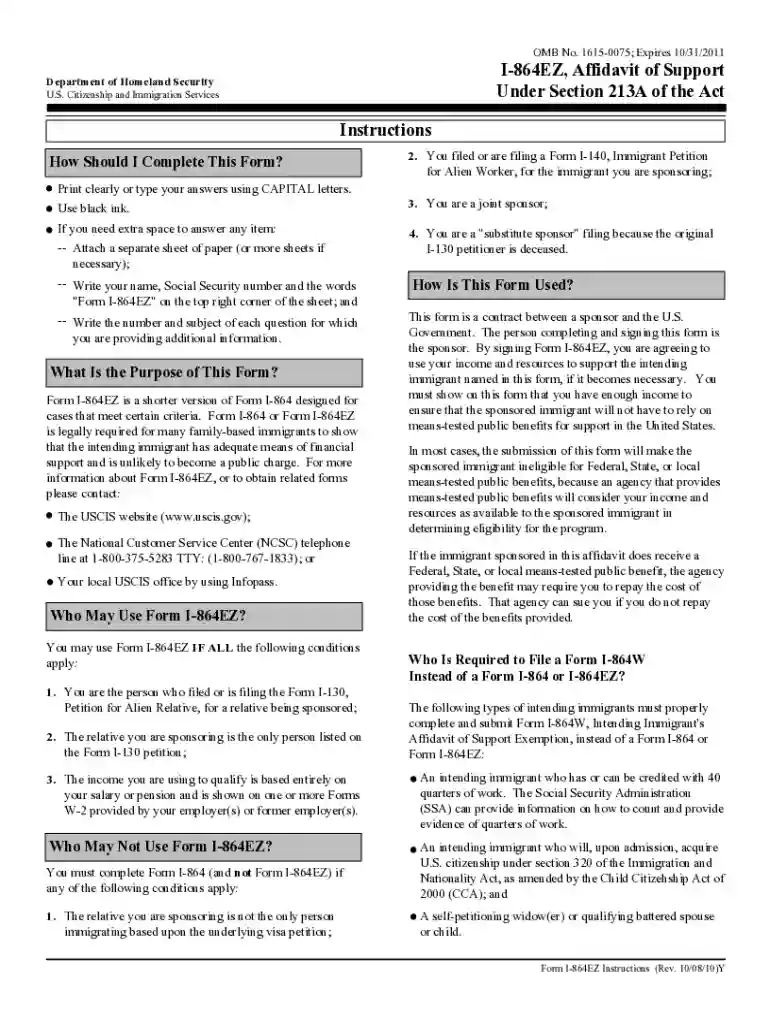
The I-864EZ Affidavit of Support is a simplified version of the Affidavit of Support form required by the U.S. Citizenship and Immigration Services (USCIS) under Section 213A of the Immigration and Nationality Act. This form is a legally binding contract between a sponsor and the U.S. government to ensure that the sponsored immigrant does not become a public charge. Specifically designed for certain family-based immigrants where the sponsor is using only their income to qualify, the I-864EZ aims to streamline financial disclosure for straightforward cases, reducing complexity compared to the standard I-864 form.
Form I-864EZ is applicable to a specific set of conditions. To be eligible, the sponsor must be a U.S. citizen or a lawful permanent resident who is petitioning for a family member. Additionally, the sponsor should be able to demonstrate that their income is sufficient to meet the minimum federal poverty guidelines for their household size. The sponsored immigrant must be the spouse or unmarried child under 21 years of age of the sponsor who is the principal beneficiary of the visa petition filed by the sponsor. Importantly, the form is reserved for cases where the sponsor’s income alone is used to meet the sponsorship requirement, without needing a joint sponsor.


The I-864EZ form encompasses several critical elements:
Completing the I-864EZ involves a systematic process to ensure accuracy and compliance:
The I-864EZ is primarily used by U.S. citizens and lawful permanent residents (green card holders) sponsoring a close family member for immigration purposes. This streamlined affidavit of support is suitable when only the sponsor's income needs to be verified, and no additional family members or co-sponsors are included in meeting the financial requirement. Frequently, sponsors opting for the I-864EZ are those with straightforward financial situations and fewer complexities in their household make-up.

The I-864EZ serves as a legally binding promise by the sponsor to support the immigrant financially. It imposes specific legal obligations on the sponsor, meant to prevent the immigrant from becoming reliant on public benefits. The sponsor agrees to provide for the immigrant until they become a U.S. citizen, accumulate 40 qualifying quarters of work, or leave the U.S. permanently. This legal framework is designed to protect public funds by ensuring that newly arrived immigrants have sufficient financial backing.
Failure to meet the obligations pledged through this form can result in legal action by the government or any agency providing means-tested public benefits to the sponsored immigrant.
When filing the I-864EZ, certain documents must accompany the form to ascertain income, identity, and compliance:
While the I-864EZ does not have a fixed deadline, timing is determined by the immigrant visa or adjustment application submission. Typically, the form should accompany or follow the initial petition for family-based visas to avoid delays in processing. The USCIS may request updated financial documents if processing times extend through multiple tax years, necessitating the resubmission of current year tax returns during adjudication.
Neglecting the responsibilities outlined in the I-864EZ can incur significant penalties for sponsors. Should the immigrant become dependent on means-tested public benefits, the sponsor may be required to reimburse the cost of those benefits to the government. This repayment obligation underscores the serious nature of the affidavit’s commitment.
The I-864EZ can be submitted to the USCIS through traditional mail or electronically, depending on how the petitioner initially filed their immigrant petition. Online submissions allow for faster processing and verification, with instant acknowledgment of form receipt, while mail submissions provide physical documentation tracking.
We've got more versions of the I-864EZ Affidavit of Support Instructions Under Section form. Select the right I-864EZ Affidavit of Support Instructions Under Section version from the list and start editing it straight away!
At DocHub, your data security is our priority. We follow HIPAA, SOC2, GDPR, and other standards, so you can work on your documents with confidence.
Feb 12, 2025 Use this form to show that the applying immigrant has adequate means of financial support and is not likely to rely on the US government for financial support.
You must show on this affidavit that you have enough income and/or assets to maintain the intending immigrants and the rest of your household at 125 percent of


