
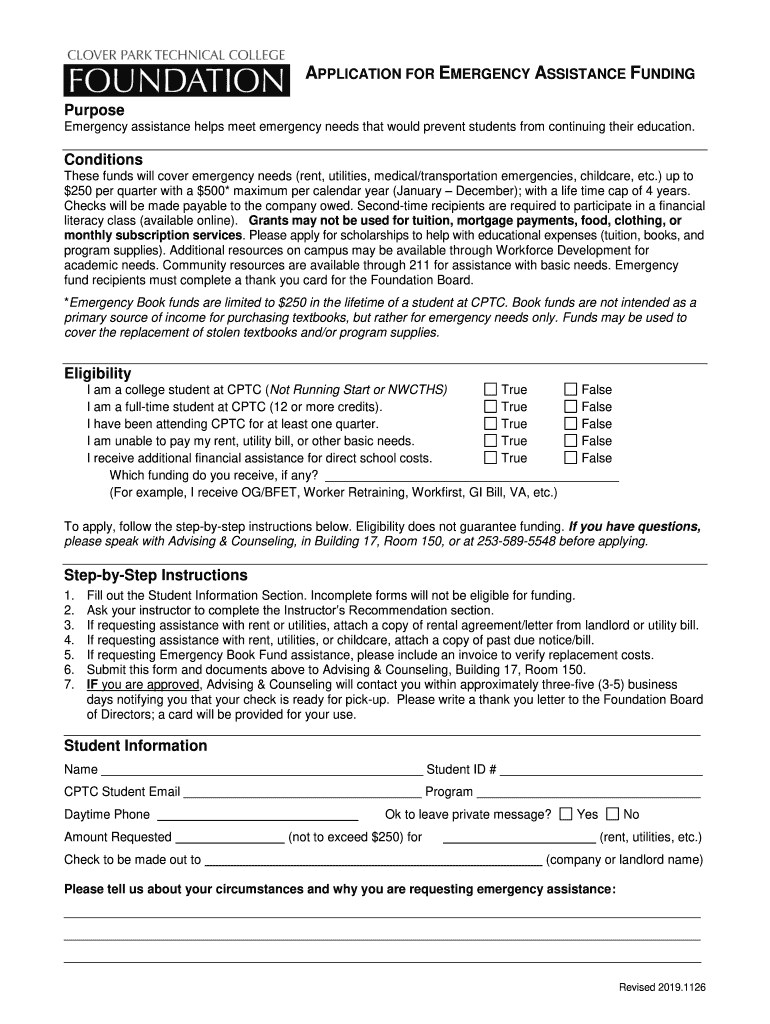







Definition and Purpose of the Application for Emergency Assistance Funding
The "Application for Emergency Assistance Funding" is a formal request submitted by students at educational institutions, such as CPTC, to receive financial support for urgent expenses that could interfere with their educational pursuits. This funding is intended to address unforeseen financial challenges, ensuring that students can maintain their educational progress despite temporary financial setbacks. For instance, funds may cover rent, utilities, and other essential expenses, but not tuition or food.
Eligibility Criteria for Emergency Assistance Funding
When applying for emergency assistance funding, specific eligibility criteria must be met to qualify. Typically, students are required to demonstrate financial need and provide evidence of expenses that align with the funding's intended uses. The program generally outlines limits, such as a cap of $250 per quarter and $500 per year. Students might need to submit documents proving their current enrollment status as part of the application process.


How to Obtain the Application for Emergency Assistance Funding
To access the application form, students often need to visit the student services or financial aid office of their educational institution. Some institutions may offer the form digitally, allowing students to download it from their website. It's crucial to have institutional login credentials if the form is hosted on a university portal. Additionally, students can inquire directly with campus financial advisors to understand the specific dissemination process for the form.
Steps to Complete the Application for Funding
Filling out the application requires careful attention to detail. The following steps outline the process:
- Collect Required Documentation: Gather all necessary documents, such as proof of expenses, enrollment status, and valid identification.
- Complete Personal Information: Fill in personal details accurately, ensuring all contact information is current.
- Explain Financial Situation: Provide a clear and concise explanation of the financial emergency, detailing why the funds are needed.
- Attach Supporting Documents: Attach any documents that substantiate the claim for funding, such as receipts or bills.
- Submit the Application: Follow institutional guidelines for submission, which may include submitting in person, via mail, or through an online portal.
Key Elements of the Application Form
The application form includes several key sections that applicants must carefully fill out to ensure consideration. These elements typically encompass:
- Applicant Information: Name, student ID, and contact details.
- Financial Need Statement: reasons for requesting assistance and description of the emergency.
- Requested Amount: Breakdown of how funds will be utilized.
- Acknowledgement Section: Affirmation that the information provided is accurate, often requiring a signature.
Required Documents for Application
Applicants are expected to provide various documents supporting their application:
- Proof of Expense: Receipts or invoices for the expenses the funding will cover.
- Enrollment Verification: Proof of current enrollment, such as a semester schedule or official enrollment letter.
- Financial Statements: Documents that support the financial need, such as bank statements or financial aid reports.
Application Process and Approval Time
The approval process for emergency funding applications typically includes several stages. Once the application is submitted, it is reviewed by the financial aid office or a designated committee. The timeline from submission to approval can vary, but applicants usually receive a decision within two to four weeks. In some cases, follow-up interviews may be conducted to clarify aspects of the application.
Legal Use of Emergency Assistance Funding
Funds received through emergency assistance applications must be used strictly for the purposes outlined in the approval. Misappropriation of these funds can lead to revocation of funds, academic disciplinary actions, and possible legal repercussions. Institutions may conduct audits to ensure compliance with funding agreements.
Examples of Using Emergency Assistance Funding
Here are some scenarios illustrating the appropriate use of emergency assistance funding:
- Unexpected Medical Expenses: A student incurs medical charges not covered by insurance.
- Emergency Travel Costs: Immediate travel is required due to a family crisis.
- Loss of Employment: A student loses their part-time job and needs assistance with rent.
These examples highlight common situations where emergency funds can play a crucial role in maintaining students' educational journeys.




