




01. Edit your form online
Type text, add images, blackout confidential details, add comments, highlights and more.

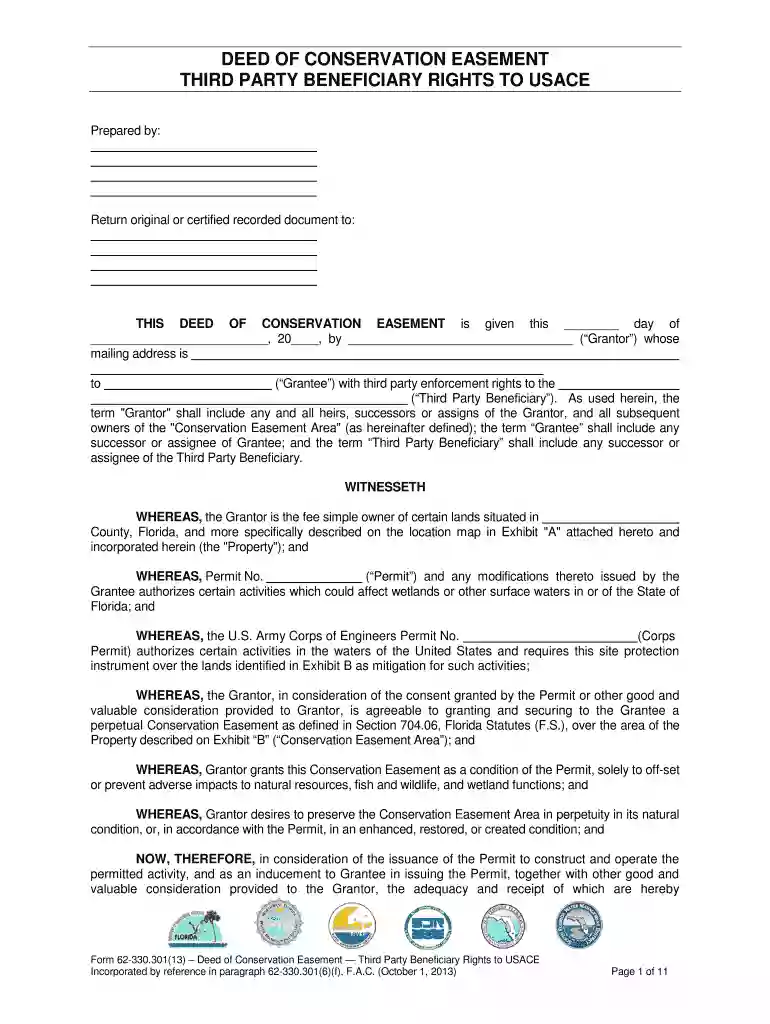
Type text, add images, blackout confidential details, add comments, highlights and more.

Draw your signature, type it, upload its image, or use your mobile device as a signature pad.

Send it via email, link, or fax. You can also download it, export it or print it out.
"Third Party Beneficiary Rights to USACE" refers to the legal entitlements granted to a third party, specifically the U.S. Army Corps of Engineers (USACE), within the framework of a conservation easement. Essentially, it establishes the rights and responsibilities of the USACE regarding the preservation and protection of natural resources, wetlands, and wildlife habitats. Within such agreements, the third party beneficiary holds the authority to ensure compliance with the easement terms, which typically include prohibitions on activities harmful to the environment.
These rights allow USACE to intervene and enforce the terms of the conservation easement, ensuring the property is managed according to agreed-upon environmental and preservation standards.
Understanding these terms aids in interpreting the rights and responsibilities outlined in the deed of conservation easement involving a third party beneficiary.
USACE, as a third party beneficiary, has distinct legal rights to enforce compliance. This might involve:
The rights need to be explicitly stated in the easement documentation, highlighting the scope and limitations of USACE's control and intervention capacity.
Understanding the key elements helps in comprehending the comprehensive nature of the rights and responsibilities associated with these conservation easements.
Different states may have unique regulations regarding conservation easements and third party beneficiary rights. Notable differences can include:
Being aware of state-specific rules is crucial for effective implementation and compliance with conservation easement agreements.
Examples might include challenges USACE encounters, such as disputes over property boundaries or differing interpretations of environmental regulations.
Drafting the Easement: Collaborate with legal experts to develop a clear and detailed easement.
Agreement between Parties: Secure consensus between the grantor, grantee, and USACE on the rights and responsibilities.
These steps provide a structured approach to completing and implementing a conservation easement with USACE as a third party beneficiary.
Understanding the business types that benefit from these rights helps in identifying potential stakeholders and enhancing cooperative engagements.
We've got more versions of the THIRD PARTY BENEFICIARY RIGHTS TO USACE form. Select the right THIRD PARTY BENEFICIARY RIGHTS TO USACE version from the list and start editing it straight away!
At DocHub, your data security is our priority. We follow HIPAA, SOC2, GDPR, and other standards, so you can work on your documents with confidence.
This historic event opens a new chapter for U.S. energy trade, with the U.S. expected to become one of the top three global LNG suppliers by 2020; and for
by MW Huston 2022 Cited by 2 Supreme Court denied the plaintiffs third-party beneficiary status where granting it would have conflicted with a statutory scheme that gave the government
9. Third Party Beneficiarys Enforcement Rights. The Third Party Beneficiary of this Conservation Easement shall have all the rights of the Grantee under this


