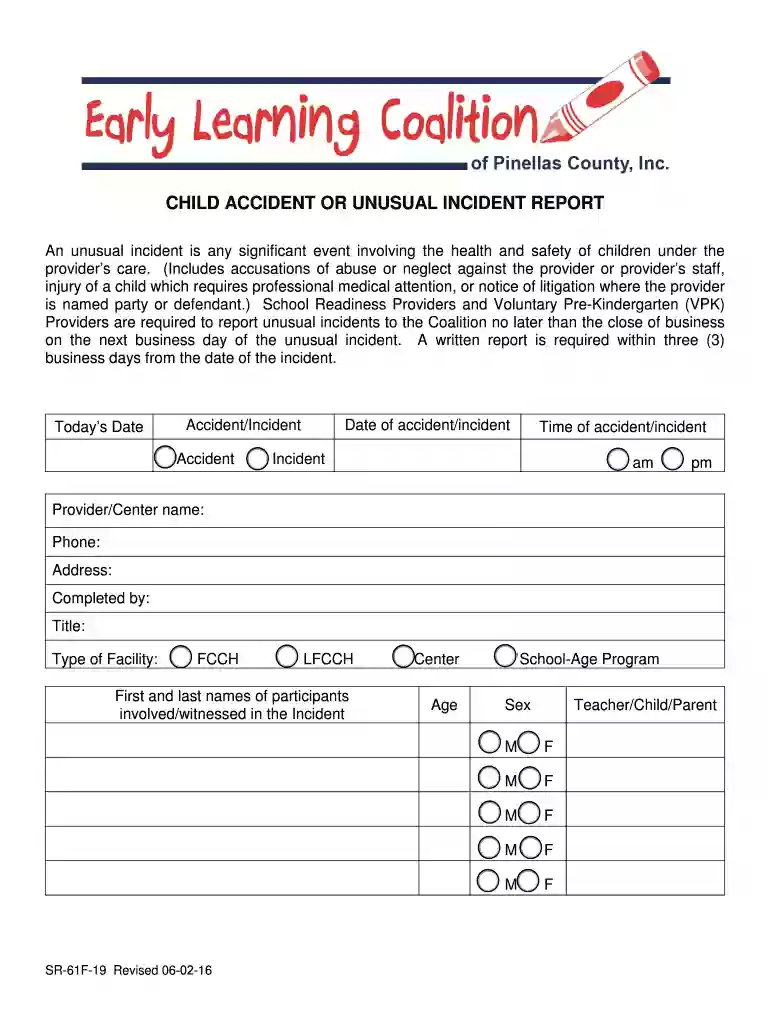
CHILD ACCIDENT OR UNUSUAL 2026

Get Form
CHILD ACCIDENT OR UNUSUAL Preview on Page 1

Here's how it works

01. Edit your form online
Type text, add images, blackout confidential details, add comments, highlights and more.

02. Sign it in a few clicks
Draw your signature, type it, upload its image, or use your mobile device as a signature pad.

03. Share your form with others
Send it via email, link, or fax. You can also download it, export it or print it out.

Definition & Meaning

The "CHILD ACCIDENT OR UNUSUAL" form is a crucial document used primarily for reporting incidents involving children that are out of the ordinary or unexpected. This might include accidents, serious injuries, or even incidents that may result in allegations of abuse. These events must be documented meticulously to ensure all parties are properly informed and any necessary follow-up actions can be taken. Providers responsible for the care of children utilize this form to make official reports to regulatory bodies, like the Coalition, and to ensure that any required legal procedures are adhered to.

Steps to Complete the CHILD ACCIDENT OR UNUSUAL Form

Completing the "CHILD ACCIDENT OR UNUSUAL" form involves a series of important steps designed to capture comprehensive details about the incident.

  1. Gather Information: Start by collecting all relevant information about the incident. This includes the specific details of what occurred, when it happened, and who was involved.
  2. Fill Out Personal Details: Enter the child's personal information, such as name, age, and contact details, into the appropriate sections of the form.
  3. Describe the Incident: Provide a detailed description of the event, including the sequence of actions leading to it and any contributing factors.
  4. Medical Services: If medical attention was required, outline the type of medical services provided and any treatments that were administered.
  5. Witness Statements: Collect and include statements from witnesses, if available, to provide additional perspectives on the incident.
  6. Submit the Form: The completed form must be submitted to the appropriate agency by the next business day, followed by a written report within three days.

Key Elements of the CHILD ACCIDENT OR UNUSUAL Form

The form comprises several sections, each aimed at gathering comprehensive data about the incident.

  • Incident Description: A detailed account of what transpired, focusing on the facts without subjective interpretation.
  • Medical Action Taken: This section requires information on any medical intervention that was undertaken, specifying the nature and urgency of the required care.
  • Preventive Measures: A critical part of the form that asks for suggestions or plans to mitigate similar future incidents.
  • Legal and Follow-up Actions: Details any legal steps taken, such as notifying law enforcement, and outlines any follow-up required.

Required Documents

To accompany the "CHILD ACCIDENT OR UNUSUAL" form, several documents may be necessary to provide a complete account:

  • Medical Reports: Any medical records or statements from healthcare providers who attended to the child.
  • Witness Statements: Written reports from any witnesses to the incident, offering more insight into the event’s context.
  • Photographic Evidence: Images or videos, if available, that visually document the aftermath or specifics of the incident.

Legal Use of the CHILD ACCIDENT OR UNUSUAL Form

This form plays a vital legal role as it helps to create an official record of the incident. Reporting is not only crucial for accountability but also supports follow-up investigations if required. Legal use also includes adhering to mandatory notification timelines to avoid any compliance issues. Failure to complete or submit the form within the stipulated time frame can lead to penalties or other legal repercussions.

Penalties for Non-Compliance

Non-compliance with the mandatory reporting process can result in serious consequences. Penalties may include fines, sanctions, or revocation of licenses for the facility responsible for the child's care. These penalties underscore the importance of timely and accurate reporting to ensure all necessary legal obligations are met.

Examples of Using the CHILD ACCIDENT OR UNUSUAL Form

Various scenarios showcase the need for this form:

  • Accidental Injury: If a child falls and sustains a significant injury, the form records the incident and any measures taken to address it.
  • Allegation of Abuse: Should there be a suspicion or allegation of abuse in a care setting, the form serves to document the initial claim and any immediate action.
  • Unanticipated Health Events: In the case of an unexpected health crisis, such as a severe allergic reaction, completing the form helps in detailing the response and medical aid provided.

State-Specific Rules for the CHILD ACCIDENT OR UNUSUAL Form

Different states may have varied requirements or additional sections mandated for completion on this form. Understanding regional regulations is essential for compliance. Certain states might have extra requirements for documentation and reporting, while others could stipulate specific timelines to be followed. Adapting the general form to meet these unique state standards is critical for ensuring adherence to all legal requirements.

See more CHILD ACCIDENT OR UNUSUAL versions

We've got more versions of the CHILD ACCIDENT OR UNUSUAL form. Select the right CHILD ACCIDENT OR UNUSUAL version from the list and start editing it straight away!
Versions Form popularity Fillable & printable
2020 4.8 Satisfied (55 Votes)
2016 4 Satisfied (58 Votes)
be ready to get more

Complete this form in 5 minutes or less

Get form

Got questions?

We have answers to the most popular questions from our customers. If you can't find an answer to your question, please contact us.
Contact us
According to Californias family purpose doctrine, parents may be held vicariously liable for damages caused by their minor children while operating a family car with permission. This includes situations where the parent knows or should know that the teen is not fit to drive safely.
Call an ambulance if your child: is unconscious or seems unaware of whats going on. has a cut that will not stop bleeding or is gaping open. will not wake up. has a fit for the first time, even if they seem to recover.
Falls are by far the most common causes of accidents in the home; they account for 44 per cent of all childrens accidents. Most falls involve tripping over on the same level. However, the most serious consequences result from falls between two levels, such as falling out of a pram or highchair or falling from a bed.
Adding them as drivers when theyre minors is for personal protection. Because if they are driving another vehicle not covered on your policy, you can be personally sued for any injuries or damages, since parents can be sued for acts by their minor children.
Insurance follows the car: In California, your policy usually applies even if someone else was driving, though terms vary by insurer. Both driver and owner can share liability: Owners may be responsible if they allow an unlicensed or negligent driver to use their car.

Security and compliance

At DocHub, your data security is our priority. We follow HIPAA, SOC2, GDPR, and other standards, so you can work on your documents with confidence.

Learn more
ccpa2
pci-dss
gdpr-compliance
hipaa
soc-compliance

People also ask

Select State Parental Liability Statutes Arizona. Parents in Arizona are liable for their childrens intentional acts that injure others or damage their property. California. Colorado. Florida. Hawaii. Illinois. Kansas. Massachusetts.
Child Accidents . Accidents that occur during the school day or during the Extended Learning Program that require the child to go home or seek medical attention.

Related links