Medicare Compensation Recovery Third party authority (MO021) 2026

Get Form
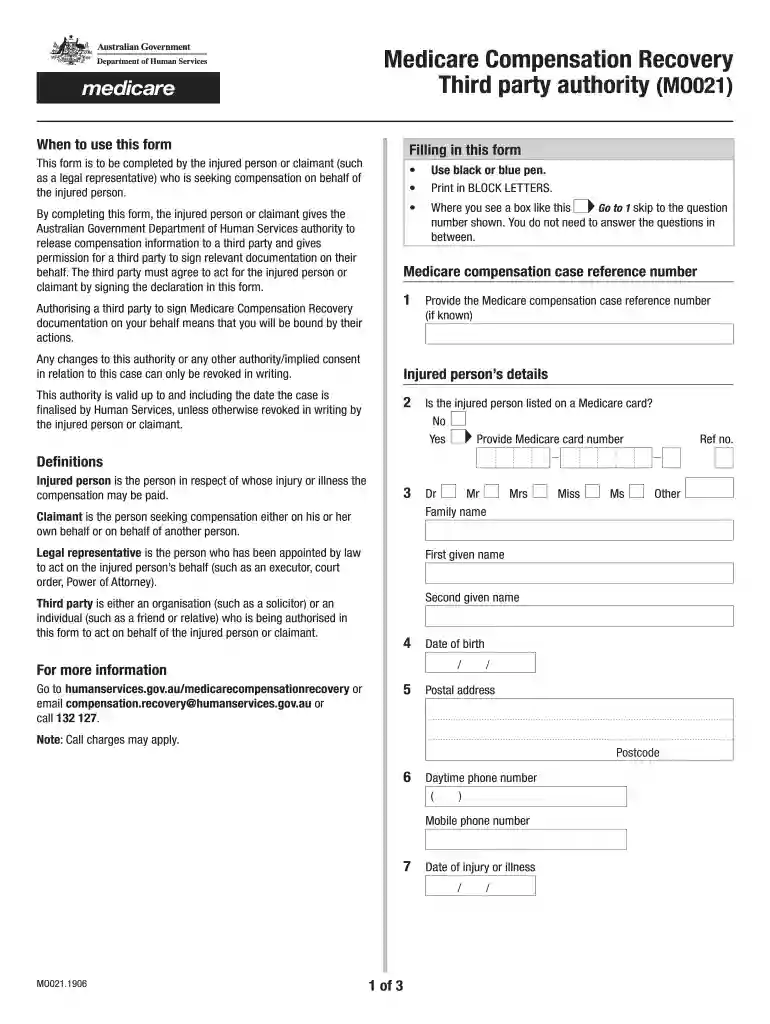
medicare mo021 Preview on Page 1

Here's how it works

01. Edit your medicare mo021 online
Type text, add images, blackout confidential details, add comments, highlights and more.

02. Sign it in a few clicks
Draw your signature, type it, upload its image, or use your mobile device as a signature pad.

03. Share your form with others
Send it via email, link, or fax. You can also download it, export it or print it out.

Definition and Purpose of the Medicare Compensation Recovery Third Party Authority (MO021)

The "Medicare Compensation Recovery Third Party Authority (MO021)" is a standardized form used to authorize a third party to act on behalf of an individual, specifically in the context of Medicare compensation recovery. This authorization is crucial when an injured person or claimant requires assistance in managing Medicare-related claims, ensuring that a designated third party can access and manage personal and sensitive information related to their healthcare compensation.

  • Purpose: This form is primarily utilized to facilitate the recovery process of Medicare compensation when a third party is involved. Whether it's a legal representative, family member, or healthcare manager, the MO021 form grants them the legal authority to handle the necessary documents and interactions with Medicare officials.
  • Usage Context: Typically used in personal injury cases, legal disputes, or situations where an individual cannot manage their Medicare affairs independently due to incapacity or administrative complexity.

Steps to Complete the Medicare Compensation Recovery Third Party Authority (MO021)

Completing the MO021 form involves a structured process that ensures all necessary authorizations are properly documented. Here is a breakdown of the key steps:

  1. Gather Personal Details: Start by collecting all relevant personal details of the injured person or claimant. This includes full legal names, Medicare numbers, contact information, and any related identification numbers.

  2. Identify the Third Party: Clearly specify the third party being authorized. Include their full name, relationship to the claimant, and contact information. If applicable, mention any legal or professional credentials that justify their role.

  3. Detail the Scope of Authority: Describe the specific actions the third party is authorized to undertake. This may include accessing medical records, negotiating settlements, or interacting with Medicare officials on the claimant’s behalf.

  4. Review Privacy Considerations: Highlight privacy considerations related to the handling of personal medical information. Ensure consent is clearly documented.

  5. Sign and Date the Form: Both the injured person and the authorized third party must sign and date the form to validate the authorization. Witnesses may be required depending on state-specific rules.

Who Typically Uses the Medicare Compensation Recovery Third Party Authority (MO021)

The MO021 form is commonly used by various parties when dealing with Medicare compensation claims:


  • Legal Representatives: Attorneys handling personal injury or compensation cases need this form to gain access to a client’s Medicare information.
  • Healthcare Managers: In some circumstances, healthcare administrators may be designated to manage medical billing or insurance claims.
  • Family Members: If an individual is incapacitated or unable to manage their affairs, a family member might use the MO021 to assist in managing Medicare-related claims.
  • Trustees or Conservators: Individuals acting in a fiduciary capacity on behalf of the injured person may also need to complete this form.
decoration image ratings of Dochub

Key Elements of the Medicare Compensation Recovery Third Party Authority (MO021)

The MO021 form contains several critical elements that ensure clarity and legal compliance:

  • Claimant Information: Accurate identification details including name, address, and Medicare number.
  • Third Party Details: Complete contact information and, if necessary, documentation supporting their involvement.
  • Scope of Authority: Clear outline of the responsibilities and limitations of the third party’s role.
  • Effective Date and Expiry: Specify when the authorization comes into effect and any expiration dates, if applicable.
  • Signatures: Official signatures from both the injured person and the third party, ensuring the authorization is legally binding.

Legal Use and Compliance for the Medicare Compensation Recovery Third Party Authority (MO021)

Proper legal use of the MO021 form is critical to ensure all parties act within the permitted scope of authority. Here are important compliance considerations:

  • State Regulations: While the form is standardized, some states may have additional requirements or variations. It is essential to review local laws.
  • Data Protection Laws: Compliance with data protection regulations, including HIPAA, is mandatory when handling personal medical information. Unauthorized disclosure or misuse can result in significant penalties.
  • Validity and Revocation: The claimant may revoke this authorization at any time. Legal steps to formally revoke the third party’s authority should be followed to avoid unauthorized actions.

Examples of Using the Medicare Compensation Recovery Third Party Authority (MO021)

Real-world scenarios illustrate the utility of the MO021 form:

  • Case 1: Personal Injury Claims: A legal representative uses the MO021 to access a claimant’s Medicare information needed for calculating settlement amounts in a case involving an accident.
  • Case 2: Medical Billing Management: A family member authorized by the MO021 communicates with Medicare to resolve billing discrepancies after their relative receives treatment.
  • Case 3: Long-term Care Management: A healthcare manager utilizes the form to coordinate ongoing care and necessary Medicare claims for an incapacitated patient.

Important Terms Related to the Medicare Compensation Recovery Third Party Authority (MO021)

Understanding the relevant terminology is essential:

  • Claimant: The injured person entitled to Medicare compensation.
  • Third Party Authority: Legal power granted to another individual to act on the claimant's behalf.
  • Medicare Compensation Recovery: Process of reclaiming payments made by Medicare when another entity is liable for medical expenses.

Eligibility Criteria for Using the Medicare Compensation Recovery Third Party Authority (MO021)

Eligibility for utilizing the MO021 form depends on several factors:

  • Authorization by the Claimant: The claimant must voluntarily agree to authorize the third party.
  • Legal Capacity: The third party must have the legal capacity to act on behalf of the claimant, often requiring proof of competency or fiduciary responsibility.
  • Relevant Circumstances: Typical triggers include personal injury, medical incapacity, or situations requiring complex mediation with Medicare officials.

These comprehensive sections provide a detailed examination of the Medicare Compensation Recovery Third Party Authority (MO021), ensuring all potential users have a clear understanding of the form's purpose, application, and compliance considerations.

decoration image

See more Medicare Compensation Recovery Third party authority (MO021) versions

We've got more versions of the Medicare Compensation Recovery Third party authority (MO021) form. Select the right Medicare Compensation Recovery Third party authority (MO021) version from the list and start editing it straight away!
Versions Form popularity Fillable & printable
2020 4.8 Satisfied (120 Votes)
2019 4.3 Satisfied (59 Votes)
be ready to get more

Complete this form in 5 minutes or less

Get form

Got questions?

We have answers to the most popular questions from our customers. If you can't find an answer to your question, please contact us.
Contact us
Examples of Third-Party Payers They offer various health insurance plans to individuals, families, and employers, providing coverage for a wide range of healthcare services. 2. Government Programs: Government programs like Medicare and Medicaid are also considered third-party payers.
What Does It Mean to Reassign Your Benefits? Reassigning your Medicare benefits allows an eligible organization/group to submit claims and receive payment for Medicare Part B services that you have provided as a member of the organization/group.
The Third Party Liability and Recovery Division (TPLRD) ensures that the Medi-Cal program is the payer of last resort by identifying, cost avoiding, and recovering from liable third parties.
When your provider accepts assignment, Medicare pays its share and you pay your share of that amount. as full payment for a covered service. This is called accepting assignment. If a provider accepts assignment, its for all Medicare-covered Part A and Part B services.
Reassigning Medicare benefits allows an eligible individual or entity to submit claims on behalf of and receive payment for Medicare Part B services that the performing practitioner provides for the eligible billing individual or entity.

Security and compliance

At DocHub, your data security is our priority. We follow HIPAA, SOC2, GDPR, and other standards, so you can work on your documents with confidence.

Learn more
ccpa2
pci-dss
gdpr-compliance
hipaa
soc-compliance
be ready to get more

Complete this form in 5 minutes or less

Get form