
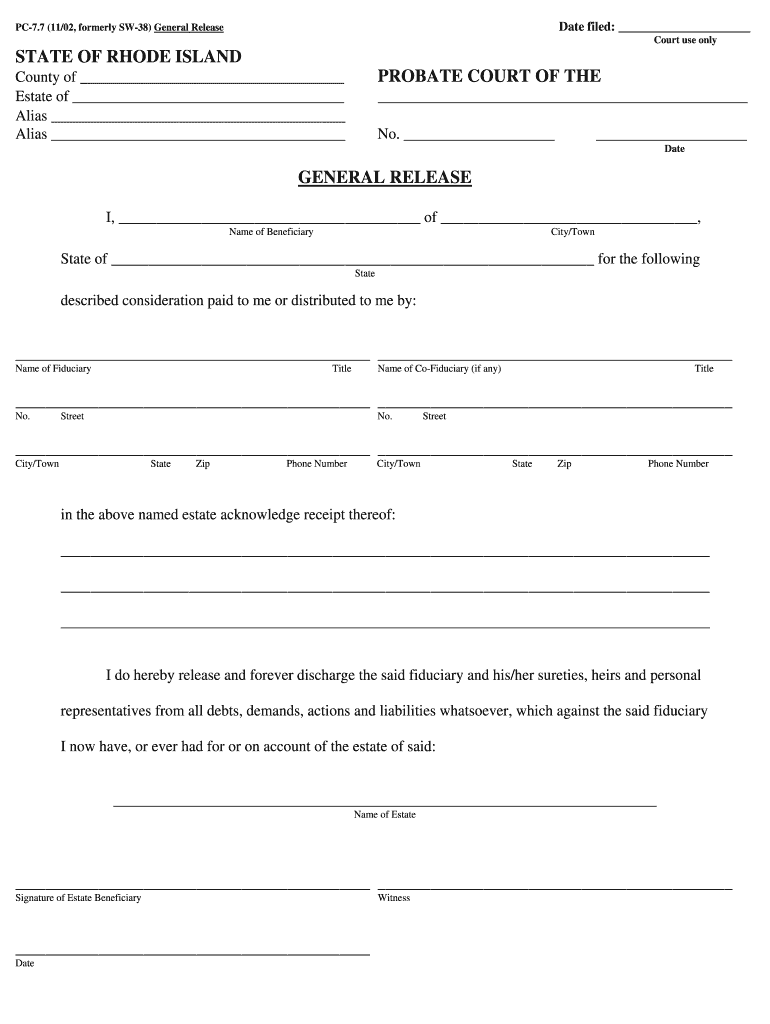







Definition and Purpose of the PC-7 7 General Release
The PC-7 7 General Release is a legal document utilized within the Probate Court of Rhode Island. This form serves a critical function by allowing a beneficiary to formally acknowledge receipt of all due considerations from a fiduciary pertaining to an estate. Through this acknowledgment, the beneficiary relinquishes the right to pursue any future claims or liabilities against the fiduciary and their representatives concerning the estate.
Legal Context and Importance
- Probate Proceedings: In probate, the PC-7 7 General Release is an essential document that helps facilitate the smooth distribution of estate assets, ensuring all parties involved settle their interests and claims effectively.
- Mutual Protection: By signing this release, beneficiaries protect themselves from inadvertently waiving their rights, while fiduciaries gain security against future claims, promoting trust and compliance with legal requirements.
Obtaining the PC-7 7 General Release
Acquiring the PC-7 7 General Release form involves several straightforward steps, ensuring that the necessary legal standards are met and maintained through the process.
Step-by-Step Acquisition Process
- Contact Probate Court: Initiate proceedings by reaching out to the Rhode Island Probate Court, which provides the necessary forms and guidance on how to proceed effectively.
- Online Access: While some jurisdictions may offer digital versions of forms, it's crucial to check if the PC-7 7 General Release is available for download from official state or court websites.
- Legal Consultation: Consider consulting with a legal professional to ensure all local and court-specific nuances regarding the form’s procurement and completion are adequately addressed.
Completing the PC-7 7 General Release
Filling out the PC-7 7 General Release requires precise adherence to specific steps, ensuring the form is completed both legally and efficiently.
Detailed Completion Steps
- Identify the Parties Involved: Clearly list the beneficiary and fiduciary with appropriate identification details.
- Detail the Considerations Received: Provide a comprehensive account of the considerations or assets the beneficiary has received from the estate.
- Include Dates and Signatures: Ensure that all parties, including witnesses if required, sign and date the document where necessary.
- Review for Accuracy: Double-check all entries for accuracy and completeness before submission to avoid legal discrepancies later.
Legal Use and Relevance
Proper legal use of the PC-7 7 General Release ensures compliance with Rhode Island state laws regarding probate proceedings.
Application and Enforcement
- Court Approval: After completing the form, submission to the Probate Court for approval may be required, ensuring all conditions of the estate distribution are legally satisfied.
- Binding Agreement: Once executed, the release serves as a legally binding agreement, indicating the beneficiary's waiver of further claims.
Key Elements to Consider
Several core elements make up the structure of the PC-7 7 General Release, integral for its legal and functional application.
Essential Components
- Consideration Clause: Specifies what the beneficiary has received from the estate, forming the crux of the release.
- Release of Claims: Explicitly outlines the rights and claims the beneficiary relinquishes upon signing the document.
Examples and Real-World Applications
Understanding the practical implementations of the PC-7 7 General Release can illuminate its relevance and utility.
Application Scenarios
- Estate Settlements: Often used in settling estate matters where a clear, mutual understanding between beneficiaries and fiduciaries is essential.
- Avoiding Litigation: By eliminating ambiguity over asset distribution, this form reduces potential familial or legal conflicts post-probate.
State-Specific Regulations and Differences
Rhode Island, like many states, has particular rules pertaining to the use and requirements of probate forms such as the PC-7 7 General Release.
Localized Legal Variations
- Jurisdictional Requirements: Specific district courts within Rhode Island may have additional guidelines or prerequisites for accepting the PC-7 7.
- State Law Compliance: Familiarity with both state and local probate law ensures the form’s execution adheres to required legal standards.
Variations and Alternatives
While the PC-7 7 General Release is a standard probate form in Rhode Island, knowing about alternative forms or methods might be beneficial.
Other Relevant Probate Forms
- Different Probate Forms: Depending on the complexity of the estate, other specialized forms may complement or be used in place of the PC-7 7, requiring careful legal consideration.
- Digital Alternatives: Exploring if electronic versions or alternatives are recognized can streamline the process. However, always verify with legal counsel or the court regarding their admissibility and procedural ramifications.




