







Definition & Meaning
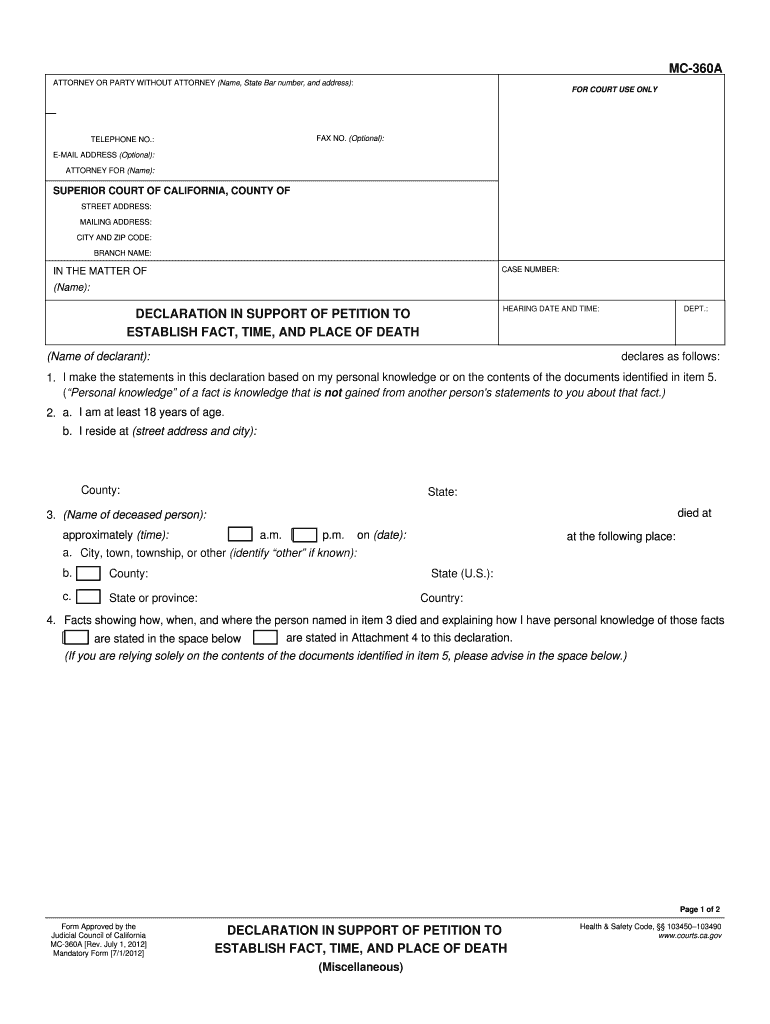
The MC-360A Declaration in Support of Petition is a legal document used within the California Superior Court system. It serves as a formal statement detailing essential facts surrounding a person's death, including the time, place, and circumstances. This form is crucial when the declarant has firsthand knowledge of the deceased's details, often supporting ongoing court cases related to the death. It ensures precision in recording the circumstances and time of death, supplementing other evidence such as police or coroner's reports.
How to Use the MC-360A Declaration
To effectively use the MC-360A form, individuals must ensure that they provide comprehensive and accurate information based on their personal knowledge. This involves:
- Carefully reading the form’s instructions.
- Filling out each section with precise data about the date, time, place, and circumstances of the death.
- Attaching any supporting documents, like police reports.
- Reviewing the completed form to ensure accuracy before submission.
Ensuring all provided information is accurate is critical to mitigate any potential legal issues or misunderstandings within legal proceedings.
How to Obtain the MC-360A Form
Acquiring the MC-360A form can be done through several methods:
- Online Download: The official California Courts website offers the option to download the form directly, ensuring you have the most current version.
- Court Clerk’s Office: Forms can also be obtained in person at the clerk’s office of the California Superior Court.
- Legal Representation: Consulting with a legal adviser can also yield the necessary documentation, especially if additional clarification is required regarding the form's content.
Steps to Complete the Form
Filling out the MC-360A form requires a step-by-step approach to ensure its accuracy:
- Read Instructions Carefully: Begin by reading all instructions provided with the form.
- Enter Personal Details: Start by providing the declarant's personal information.
- Provide Death Details: Document the deceased's name, time, place, and circumstances of death.
- Attach Supporting Documents: Include any documents that support the declaration, such as coroner's reports.
- Review and Submit: Carefully review all entered data for correctness before submitting it to the appropriate court.
Who Typically Uses the MC-360A Form
This form is primarily utilized by individuals who have firsthand information regarding a deceased person’s circumstances. Typical users include:
- Next of Kin: Family members who were present or involved at the time of death.
- Witnesses: Individuals who witnessed the circumstances surrounding the death.
- Law Enforcement Officers: Officers involved in the case who possess personal knowledge of the incident.


Key Elements of the Form
The MC-360A form comprises several pivotal sections:
- Personal Information: Details of the declarant, including contact information and relation to the deceased.
- Circumstantial Details: A narrative section where the declarant details the death’s circumstances.
- Supporting Documents: An area to list and include relevant supporting documents.
Ensuring each section is completed with precise detail is vital for the declaration to be considered valid in court.
Legal Use of the MC-360A Form
The MC-360A's primary legal function is to provide supporting evidence in court cases about the decedent’s circumstances. It often accompanies petitions or motions concerning inheritance disputes, insurance claims, or wrongful death cases. The accuracy and completeness of the information provided in the MC-360A form help strengthen the legal process by corroborating facts with personal knowledge.
State-Specific Rules
California mandates specific guidelines for using the MC-360A form:
- Jurisdiction: The form is valid only within California courts; it cannot be used in other states.
- Regulations Compliance: Users must comply with all state-specific procedures and deadlines for submission.
- Legal Precedent: The form usage is bound by California's legal proceedings requirements.
Adhering to these rules ensures the form's acceptability and legal standing within California's judicial system.
Penalties for Non-Compliance
Failure to accurately complete or file the MC-360A can result in significant penalties:
- Delayed Proceedings: Incorrect information can lead to delays in court proceedings or dismissals.
- Legal Repercussions: Providing false statements may result in legal consequences, including perjury charges.
- Rejection of Claims: Incomplete forms can lead to the rejection of associated legal claims, impacting inheritance or insurance processes.




