




01. Edit your telephone bills fcc online
Type text, add images, blackout confidential details, add comments, highlights and more.

Type text, add images, blackout confidential details, add comments, highlights and more.

Draw your signature, type it, upload its image, or use your mobile device as a signature pad.

Send bills transition fcc online via email, link, or fax. You can also download it, export it or print it out.
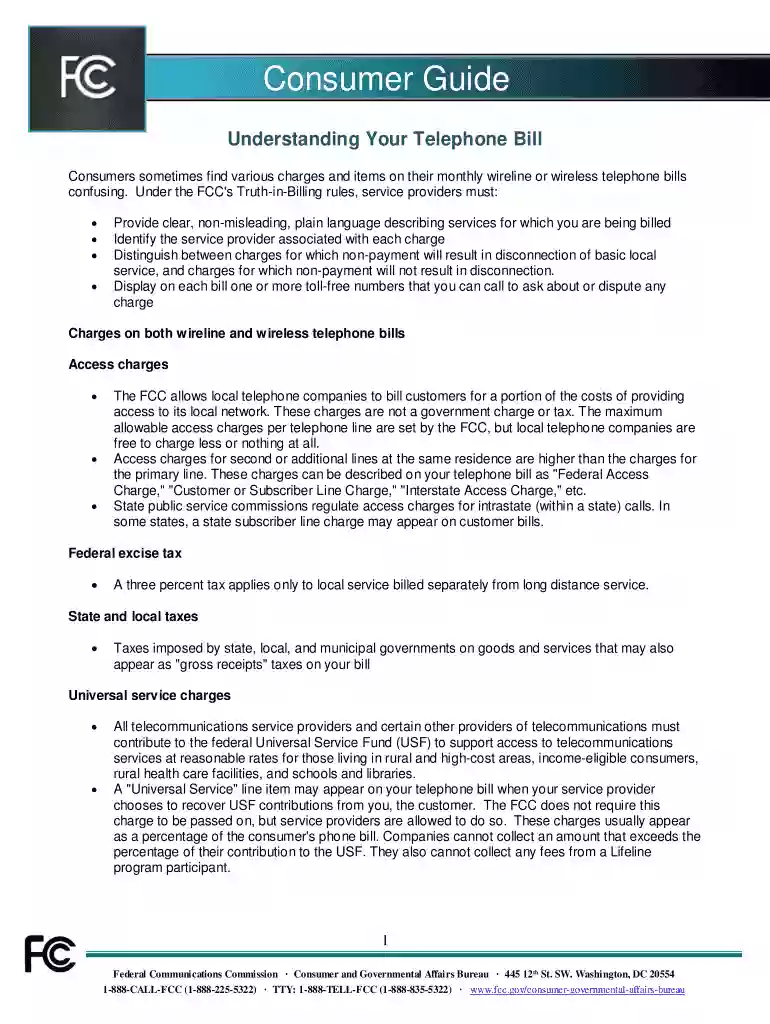
The "bills transition fcc online" is a digital process facilitated by the Federal Communications Commission (FCC) to streamline the understanding and management of telephone bills. It aims to provide consumers with clear insights into the composition of their bills, including charges like access fees, taxes, and other wireline and wireless service charges. This initiative aligns with the FCC's Truth-in-Billing rules which mandate service providers to furnish transparent and accurate billing information, ensuring consumers can easily identify and, if necessary, dispute unfamiliar charges.
Utilizing the bills transition FCC online process involves understanding the detailed breakdown of your telephone bills. Consumers can access explanatory guides provided by the FCC, which helps demystify various bill components. These guides include information on recognizing different charges, understanding the context behind them, and learning how to challenge any discrepancies. You can also access these resources through the FCC's website, where interactive tools may assist you in navigating and interpreting bill statements.
Successfully completing the bills transition process involves a few structured steps. Firstly, gather all necessary billing documents and any previous correspondences with your service provider. Secondly, use the FCC's guides to annotate and mark any unfamiliar or questionable charges on the bill. Thirdly, consult the dispute resolution procedures recommended by the FCC for guidance on initiating disputes. Lastly, maintain records of all communications and actions taken for future reference.
The primary reason for using the bills transition FCC online is to ensure transparency in billing practices. The process empowers consumers by providing clarity on their telephone bills, which in turn increases trust in service providers. Additionally, this system assists consumers in avoiding overbilling and helps in recovering funds from erroneous charges. It's also crucial for maintaining organized and accurate records for personal and business financial planning.
Understanding the essential components involved in this process helps in effectively navigating the billing information. Key elements include:
The legal utility of the bills transition FCC online primarily revolves around its alignment with Truth-in-Billing regulations. These regulations require service providers to ensure that their billing statements are truthful, clear, and explicit. Utilizing this process helps users safeguard against fraud and aids in the legal resolution of billing issues both informally and formally through consumer protection services.
Consider a scenario where a consumer notices unfamiliar charges on their bill. By engaging with the FCC's transition process, the consumer can use the provided guides to accurately decode these charges. They may follow these steps:
When engaging with the bills transition FCC online, familiarity with certain terminology enhances comprehension and effectiveness. These include:
Understanding these terms helps in navigating through the intricacies of telephone billing and taking appropriate actions concerning billing concerns.
We've got more versions of the telephone bills fcc form. Select the right telephone bills fcc version from the list and start editing it straight away!
At DocHub, your data security is our priority. We follow HIPAA, SOC2, GDPR, and other standards, so you can work on your documents with confidence.
Mar 3, 2017 An opinion piece by Whartons Kevin Werbach looks at how the FCC will be impacted by the Trump administration and what that means for internet
The program would be administered by the FCC, with appropriations going to the FCC and processed through FCC and USAC. The FCC would be responsible for


