




01. Edit your form online
Type text, add images, blackout confidential details, add comments, highlights and more.

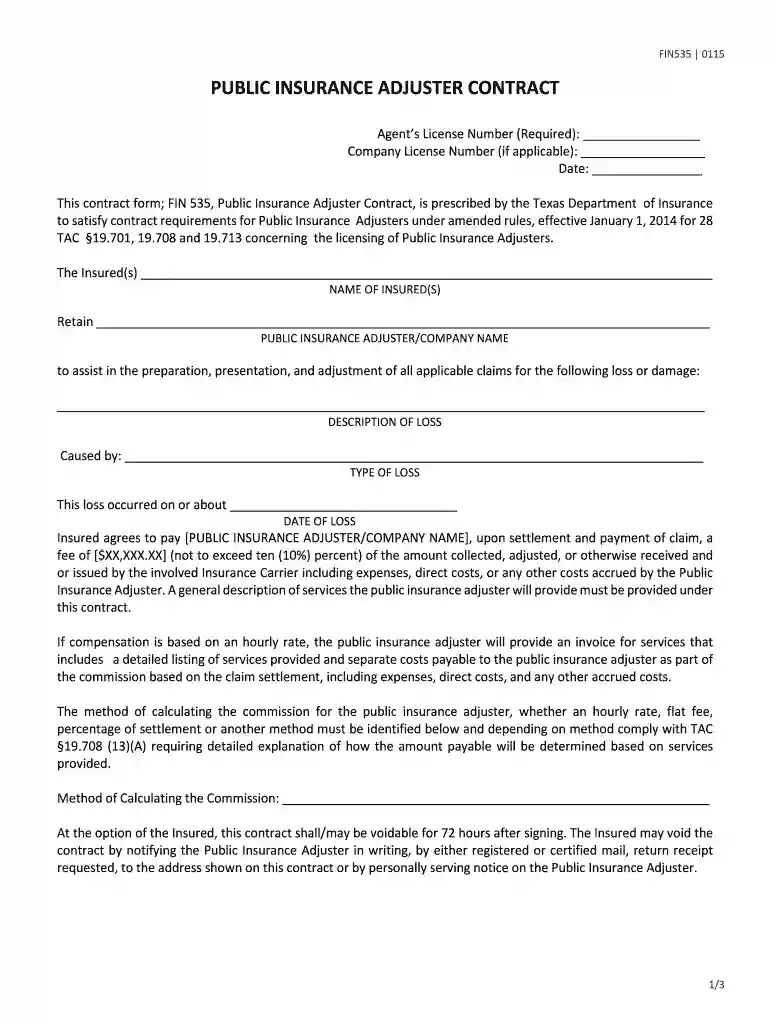
Type text, add images, blackout confidential details, add comments, highlights and more.

Draw your signature, type it, upload its image, or use your mobile device as a signature pad.

Send it via email, link, or fax. You can also download it, export it or print it out.
A Public Insurance Adjuster Contract is an official agreement between a policyholder and a public insurance adjuster, typically outlined by state insurance departments like the Texas Department of Insurance. This contract delineates the responsibilities and services provided by the adjuster, who is an independent professional appointed to assist the insured in managing and negotiating insurance claims. Public insurance adjusters assess damage, prepare necessary documentation, and strive to secure optimal settlement amounts on behalf of the policyholder. They work solely for the insurance claimant, not the insurance company, ensuring impartial advocacy for the insured.
The contract is a comprehensive document containing several critical components essential for both parties to understand and agree upon:
Engaging with a Public Insurance Adjuster Contract involves several steps to ensure its proper execution and adherence:
The Public Insurance Adjuster Contract adheres to various legal requirements to ensure its enforceability and compliance with state laws:
Different states have unique rules regarding the use and formulation of Public Insurance Adjuster Contracts. For instance:
Completing a Public Insurance Adjuster Contract involves a structured approach to ensure all parties understand their roles and responsibilities:
The Public Insurance Adjuster Contract is predominantly utilized by:


To efficiently execute a Public Insurance Adjuster Contract, several documents may be required to support the claims process:
We've got more versions of the PUBLIC INSURANCE ADJUSTER CONTRACT form. Select the right PUBLIC INSURANCE ADJUSTER CONTRACT version from the list and start editing it straight away!
At DocHub, your data security is our priority. We follow HIPAA, SOC2, GDPR, and other standards, so you can work on your documents with confidence.
Easily search for Member details, including eligibility status, covered benefits and missed services information. Create, submit, correct and void claims;
(b) A public insurance adjusters written contract with an insured must contain: (1) the name, address, and license number of the public insurance adjuster
Insured: By signing this CONTRACT, you request and authorize your insurer to add the Public Adjuster as an additional payee on all drafts or checks pertaining


