





Definition & Meaning
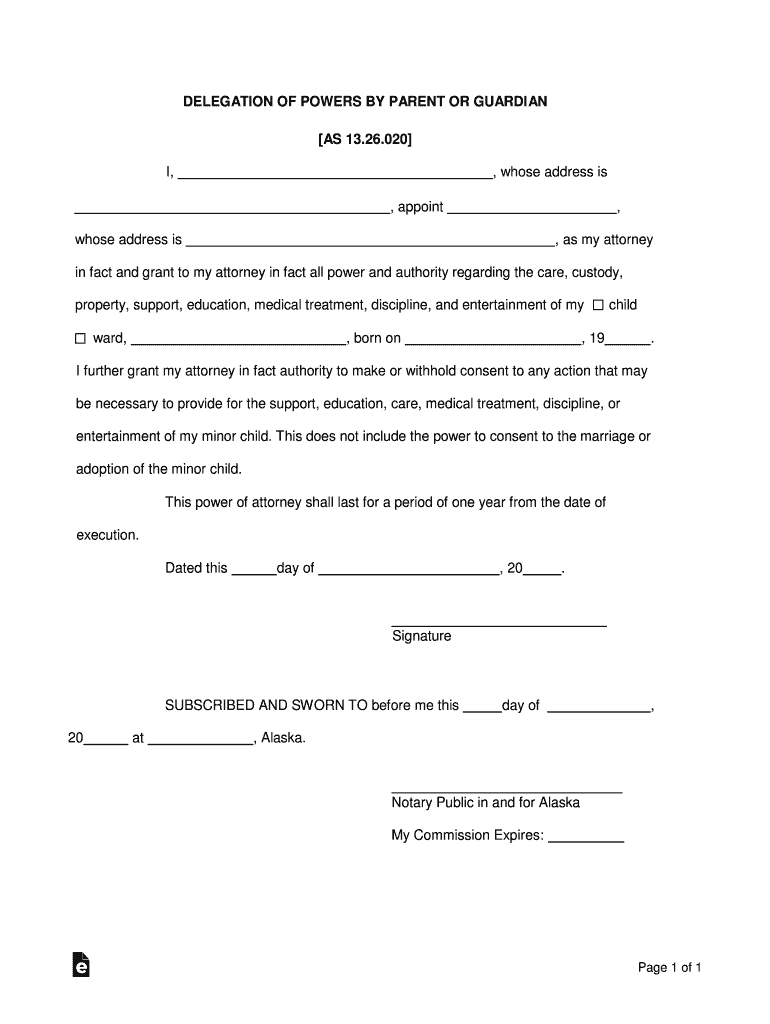
The Alaska Minor Children Power of Attorney Form is a legal document used for delegating parental responsibilities to an attorney-in-fact for a minor child. This form is primarily designed to allow a parent or guardian to appoint another individual to make decisions regarding the child's care, education, and medical treatment. It is a temporary arrangement with a typical duration of one year, excluding authority over marriage or adoption.
The form is crucial for parents who may be temporarily unavailable due to travel, medical issues, or other reasons, ensuring the child’s needs are met adequately during their absence. By clearly defining the powers granted, the form helps in avoiding potential conflicts or misunderstandings concerning the child's welfare.
How to Use the Alaska Minor Children Power of Attorney Form
- Identify the Powers Granted: Clearly outline which responsibilities the attorney-in-fact will have, such as medical decisions, educational enrollment, or other caregiving tasks.
- Specify Duration: Define the time period the power of attorney will be effective. Generally, it is limited to one year but can be terminated earlier if necessary.
- Provide Contact Information: Include detailed contact information for both the parent or guardian and the attorney-in-fact to ensure clear communication.
- Clarify Exclusions: Understand and note that the form does not allow decisions on marriage or adoption.
This form can be used by parents in various scenarios, such as military deployment, extended travel, or hospitalization, ensuring the continuity of care for their children.
Steps to Complete the Alaska Minor Children Power of Attorney Form
- Obtain the Form: Acquire the form from a reputable source. Ensure it is the latest version compliant with Alaska state laws.
- Fill Out the Details: Provide the child's information, including name and date of birth, along with details of both the parent or guardian and the appointed attorney-in-fact.
- Define the Scope and Duration: Clearly state which parental powers are delegated and for how long.
- Sign and Notarize: Both the parent or guardian and the attorney-in-fact must sign the document. A notary public must witness these signatures for the form to be legally binding.
- Distribute Copies: Provide copies of the completed form to relevant parties, including schools and healthcare providers, to inform them of the temporary change in authority.
Completing this process ensures the attorney-in-fact can legally act in the child's best interests as specified.
Why Use the Alaska Minor Children Power of Attorney Form
The Alaska Minor Children Power of Attorney Form provides several benefits:
- Legal Clarity: Establishes a clear, legal framework for decision-making on behalf of the child during the parent's absence.
- Temporary Arrangement: Offers a flexible solution for temporary situations without altering parental rights permanently.
- Peace of Mind: Ensures parents can delegate authority knowing their children will be properly cared for in unexpected situations.
This form is an essential tool for parents who need to temporarily delegate the care of their children to another trusted individual.
Key Elements of the Alaska Minor Children Power of Attorney Form
- Child’s Information: Critical identifying details about the minor child.
- Parent/Guardian Details: Information about the parent granting the power of attorney.
- Attorney-in-Fact's Details: Contact and identifying information for the appointed caretaker.
- Scope of Powers: Specific authorities the attorney-in-fact will have.
- Time Frame: Detailed period during which the form is effective.
These components ensure the form effectively communicates all necessary information to implement the delegated powers appropriately.
State-Specific Rules for the Alaska Minor Children Power of Attorney Form
- Jurisdictional Compliance: The form must comply with Alaskan laws and may differ significantly from forms in other states.
- Time Limitation: Typically restricted to one year, following state guidelines.
- Notary Requirement: Must be notarized in Alaska to be legally recognized.
Awareness of these rules ensures the form is valid and enforceable within the state.
Legal Use of the Alaska Minor Children Power of Attorney Form
- Care Decisions: Authority to make healthcare decisions, enroll in school, and similar responsibilities.
- Exempted Powers: Specifically precludes decisions regarding adoption or marriage.
- Emergency Situations: Especially useful in emergencies where the parent cannot be reached.
This legal tool helps maintain stability in the child’s life when parents are unable to fulfill their roles temporarily.
Examples of Using the Alaska Minor Children Power of Attorney Form
- Military Deployment: Parents serving in the military can ensure their children’s needs are met during deployment with this form.
- Extended Travel: Parents taking long-term or international trips can designate a trusted individual to handle parental duties.
- Health Crises: Families facing medical emergencies can use the form to delegate care responsibilities to a relative or friend.
These scenarios highlight the form's practicality for various unpredictable situations where temporary parental delegation is required.
Required Documents for Completing the Alaska Minor Children Power of Attorney Form
- Identification: Valid ID for both the parent/guardian and the attorney-in-fact.
- Child’s Birth Certificate: To verify the child's identity.
- Notary Services: Access to a notary public to complete the legal requirements.
Gathering these documents beforehand ensures a smooth completion process.