




01. Edit your form online
Type text, add images, blackout confidential details, add comments, highlights and more.

Type text, add images, blackout confidential details, add comments, highlights and more.

Draw your signature, type it, upload its image, or use your mobile device as a signature pad.

Send it via email, link, or fax. You can also download it, export it or print it out.
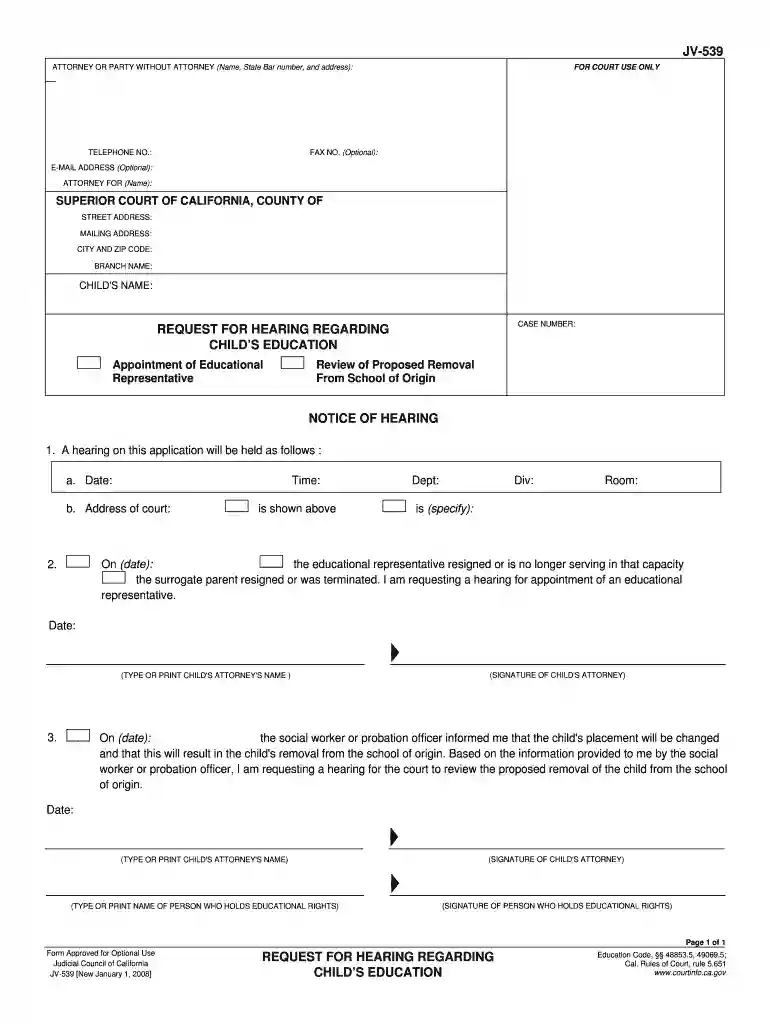
The JV-539 form is a legal document utilized primarily in the Superior Court of California. It serves to request a hearing concerning a child's educational matters, especially regarding the appointment of an educational representative and decisions related to removing a child from their school of origin. This form plays a crucial role in ensuring the child's educational rights are upheld during legal procedures that might affect their schooling.
Acquiring the JV-539 form involves several straightforward methods. Individuals can visit official court websites related to the Superior Court of California to download the form directly. Alternatively, legal offices or court clerks often provide these forms in person upon request. Ensuring the form is the correct version, namely the 2008 iteration, is essential for accurate filing and legal compliance.
Gather Required Information: Collect all necessary details such as the child's current educational status, legal guardian information, and pertinent court case numbers.
Fill in Personal and Court Details: Enter the attorney's information, court case details, and specific requests concerning the child's education.
Specify Educational Concerns: Clearly articulate the reasoning for the requested hearing, addressing issues like removing the child from their school and appointing an educational representative.
Review and Sign the Document: Ensure all sections are completed accurately before obtaining signatures from all relevant parties involved in the child's educational rights.
Submit the Form: File the completed form with the appropriate California Superior Court.
This form is legally utilized to initiate processes involving changes to a child's educational arrangements in the context of legal proceedings. Filing a JV-539 form requests court intervention to address potential alterations in the child's schooling environment. This is typically required when a child's continued education might be impacted by family law proceedings or when there is a dispute over educational decisions.
The JV-539 can be submitted using several methods, adapting to the filer’s preferences and circumstances:
The primary users of the JV-539 form are legal guardians, attorneys representing minors, and parties involved in family law cases where a child's educational future requires legal intervention or clarification. This includes cases of custody where education-related decisions might affect the child's welfare.


Failing to file the JV-539 when necessary can result in a delay or denial in appointing an educational representative or blocking the proposed changes to a child's school placement. Non-compliance could also hinder legal processes surrounding the child's best educational interests, potentially impacting the resolution of disputes regarding the child's schooling arrangements.
We've got more versions of the how do i file a jv 539 2008 form form. Select the right how do i file a jv 539 2008 form version from the list and start editing it straight away!
At DocHub, your data security is our priority. We follow HIPAA, SOC2, GDPR, and other standards, so you can work on your documents with confidence.
See form info Download JV-539. Request for Hearing Regarding Childs Access to Services. Effective: January 1, 2014. espaol See form info Download JV-540
It must use court form JV-536 to tell the court, the childs attorney, and the childs social worker or probation officer about appointments and changes. CRC
Nov 5, 2020 Indicate by check mark whether the registrant (1) has filed all reports required to be filed by Section 13 or 15(d) of the Securities Exchange


