




01. Edit your form online
Type text, add images, blackout confidential details, add comments, highlights and more.

Type text, add images, blackout confidential details, add comments, highlights and more.

Draw your signature, type it, upload its image, or use your mobile device as a signature pad.

Send it via email, link, or fax. You can also download it, export it or print it out.
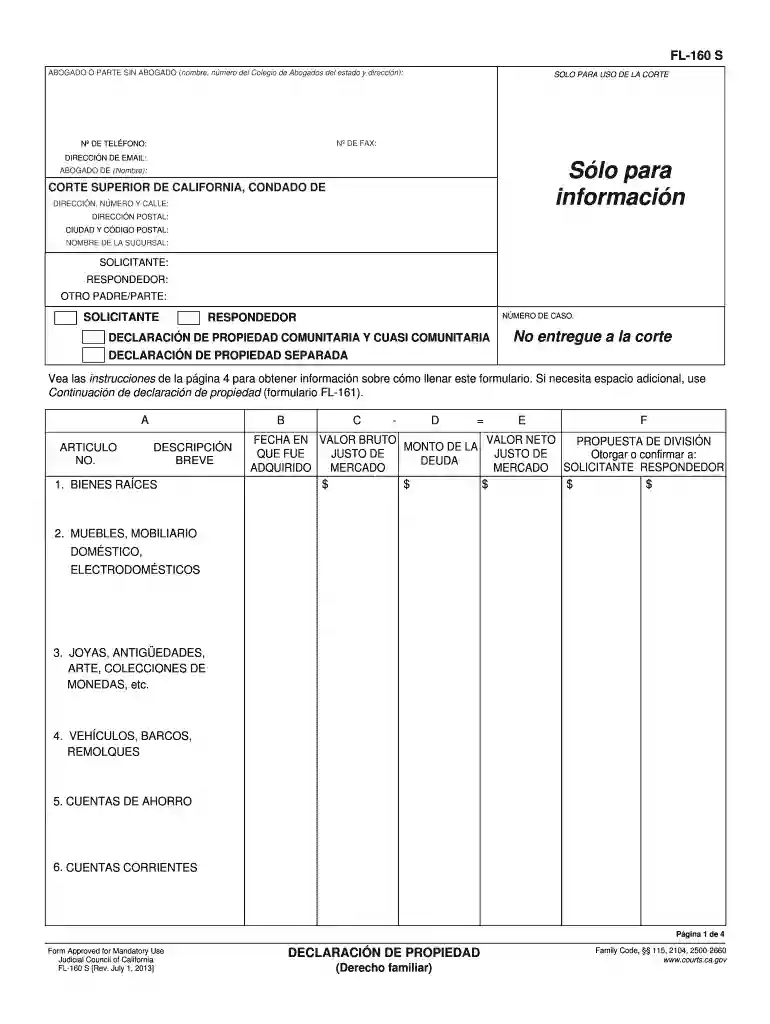
The 2013 CA FL-160 S is a legal form used in California family law proceedings. It is designed to declare the division of community, quasi-community, and separate property, as well as debts, during divorce or legal separation. This document is vital for transparent asset division, helping ensure a fair distribution process. It specifies various assets and liabilities, such as real estate, vehicles, retirement accounts, and debts, offering insight into how these are proposed to be divided between parties.
Understanding the core elements of the 2013 CA FL-160 S is essential for properly completing the form. It includes sections to list assets and liabilities, categorize them as community or separate, and specify their value. Key sections involve:
The 2013 CA FL-160 S can be acquired from several sources. The most straightforward method is downloading the form from the California Courts website. It is also available at local family law court's clerk office. When obtaining the form, ensure it is the correct version relevant to the case's jurisdiction and requirements.
Completing the 2013 CA FL-160 S involves several methodical steps:
In legal contexts, the 2013 CA FL-160 S plays a critical role in divorce and legal separation proceedings. It is a formal declaration of couples’ financial landscape, helping inform the court about how to equitably divide property and debt. Adhering to its instructions protects parties' rights during legal proceedings, potentially minimizing disputes.
Understanding terms related to the 2013 CA FL-160 S is crucial for accurate completion:
Different states have varying laws regarding asset division in divorce, making California’s approach significant. California is a community property state, meaning assets and debts are generally split 50/50 unless legally adjusted by mutual agreement of the parties. Comprehending these rules ensures legal compliance and a fair division.
Submitting the 2013 CA FL-160 S within specified timeframes is critical. Deadlines typically align with court schedules and proceedings related to divorce or legal separation cases. Missing these deadlines can lead to complications or delays in the proceedings, emphasizing the importance of timely submission.
The 2013 CA FL-160 S can be submitted in various ways, offering flexibility based on individual preference or urgency:
We've got more versions of the 2013 CA FL-160 S form. Select the right 2013 CA FL-160 S version from the list and start editing it straight away!
At DocHub, your data security is our priority. We follow HIPAA, SOC2, GDPR, and other standards, so you can work on your documents with confidence.
by DM Smith In the major portion of the Article, I analyze and critique three rationaleseither stated or impliedfor private termination actions: to enable a new parent to
Jul 1, 2016 Check Community and Quasi-Community Property Declaration on page 1 to use Property Declaration (form FL-160) to provide a combined list of


