




01. Edit your form online
Type text, add images, blackout confidential details, add comments, highlights and more.

Type text, add images, blackout confidential details, add comments, highlights and more.

Draw your signature, type it, upload its image, or use your mobile device as a signature pad.

Send it via email, link, or fax. You can also download it, export it or print it out.
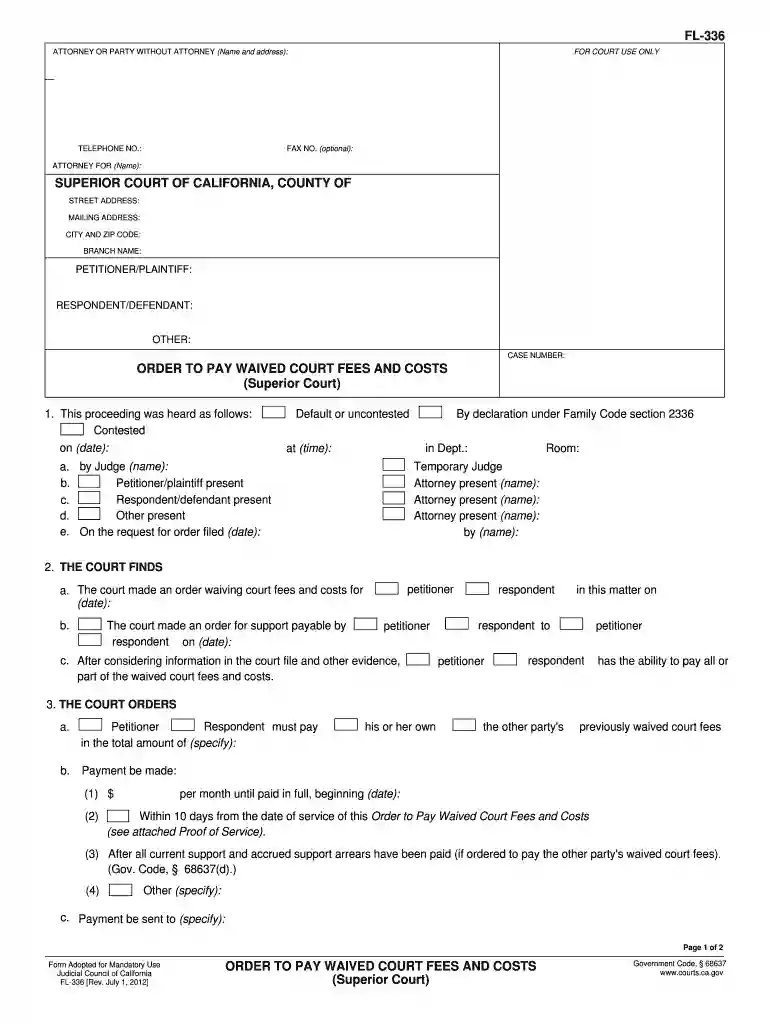
The FL-336 form is an official document from the Superior Court of California used to mandate the payment of previously waived court fees and costs. This court order is issued when the court finds that one party, typically the respondent, must reimburse another party, often the petitioner, for fees that were initially waived during legal proceedings. The form details the amount to be paid, deadlines for payment, and outlines the procedures for contesting the order through a hearing if necessary. The form also provides guidance on potential collection actions should the ordered payments remain unpaid.
Once you receive the FL-336 form, follow these steps to ensure compliance:
To get the FL-336 form, you may need to visit the local Superior Court of California where the case is being handled. It may be sent to you directly by the court when the order is issued. Alternatively, the form can often be accessed and downloaded from the California Courts website, ensuring easy recordkeeping and reference.
Filling out the FL-336 form requires careful attention to detail:
This form includes several critical elements:
The FL-336 form is commonly used by parties involved in legal proceedings under the jurisdiction of the Superior Court of California. This includes:


The FL-336 form functions as a legally binding court order that parties must comply with. It is essential to adhere to its terms to avoid additional legal consequences, such as enforced collection actions or further legal penalties.
Consider these examples of how the FL-336 form might apply:
Several key terms are crucial when dealing with the FL-336 form:
Utilizing and understanding the FL-336 form is critical for ensuring that court-ordered payments are made compliantly and in a timely manner, maintaining the integrity of legal proceedings.
We've got more versions of the FL-336 ORDER TO PAY WAIVED COURT FEES AND COSTS Judicial Council forms - courts ca form. Select the right FL-336 ORDER TO PAY WAIVED COURT FEES AND COSTS Judicial Council forms - courts ca version from the list and start editing it straight away!
At DocHub, your data security is our priority. We follow HIPAA, SOC2, GDPR, and other standards, so you can work on your documents with confidence.
Also explains how to ask the court to continue to waive those fees. Get form FL-336. Effective: July 1, 2016.
The Prison Litigation Reform Act (PLRA) changes various parts of the United States Code that address civil rights litigation and in forma pauperis (IFP)
Feb 12, 2015 Petitioner challenges, and alternatively asks this Court to issue a writ prohibiting, this proposed rule: Carbon Pollution Emission Guidelines


