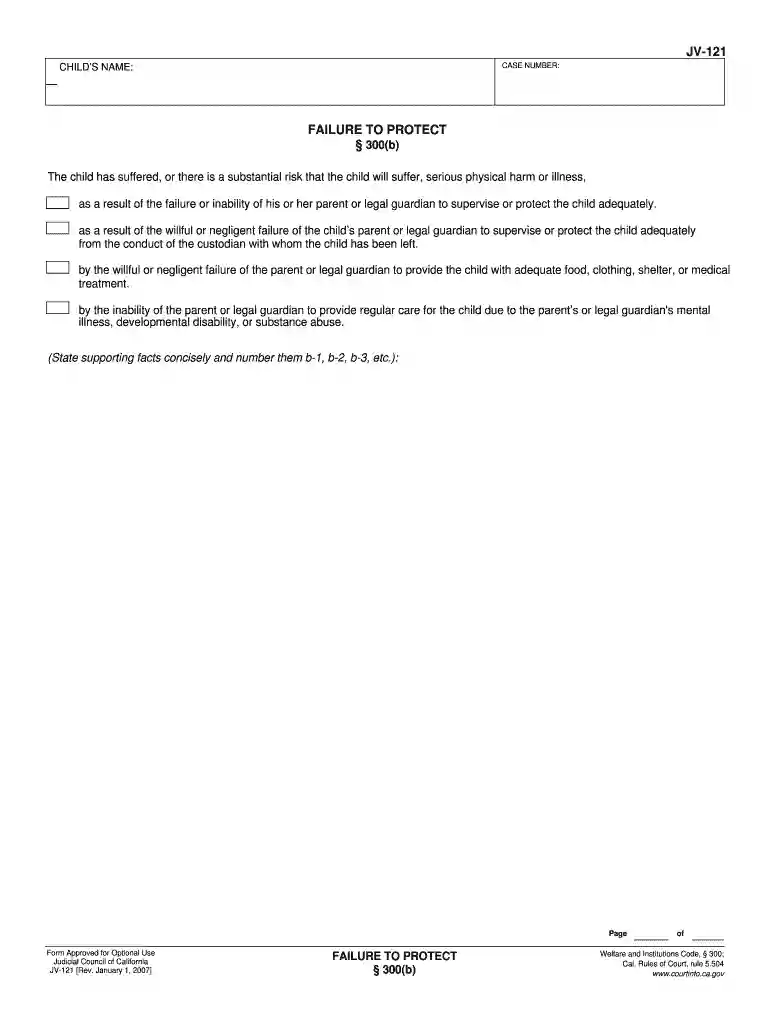
JV-121 Failure to Protect Judicial Council forms - courts ca 2026

Get Form
JV-121 Failure to Protect Judicial Council forms - courts ca Preview on Page 1

Here's how it works

01. Edit your form online
Type text, add images, blackout confidential details, add comments, highlights and more.

02. Sign it in a few clicks
Draw your signature, type it, upload its image, or use your mobile device as a signature pad.

03. Share your form with others
Send it via email, link, or fax. You can also download it, export it or print it out.

Definition & Meaning

The "JV-121 Failure to Protect Judicial Council forms - courts ca" refers to a specific legal document used within the California court system. It relates to circumstances where a child may face serious danger due to neglect or inadequate care from a parent or guardian. This form is integral in initiating legal processes to ensure the welfare of the child, aligning with § 300(b) of the Welfare and Institutions Code, which outlines conditions under which a child might need protection by legal authorities.

How to Use the JV-121 Form

To use the JV-121 form, individuals, often in conjunction with legal counsel, must accurately fill out the document to detail the circumstances that imply a failure to protect a child. The form serves as part of a legal submission, providing evidence or statements that support claims of neglect or harm. Careful completion is crucial, as any errors or omissions can impact the proceedings. Users should ensure that they adhere to privacy guidelines and clear the form after submission to protect sensitive information.

Steps to Complete the JV-121 Form

  1. Gather Required Information: Collect all necessary data, including details about the child, the parent or guardian, and the alleged circumstances of neglect or harm.
  2. Fill in Personal Details: Enter the personal and contact information required at the beginning of the form.
  3. Describe the Situation: Clearly outline the specifics of the situation, adhering to the guidelines for thoroughness and accuracy provided in § 300(b).
  4. Provide Evidence: Attach any supporting documents or evidence that corroborate the claims made in the form.
  5. Review and Verify: Double-check all information for accuracy and completeness.
  6. Sign and Date the Form: Provide signature and date to validate the document.
  7. Submit: Follow the appropriate submission method—whether online, by mail, or in person.

Who Typically Uses the JV-121 Form

The JV-121 form is primarily used by family members, social workers, attorneys, or other legal professionals involved in child welfare cases within California. It may also be used by guardians or caretakers seeking to rectify situations that may place a child in jeopardy. The form provides a mechanism for concerned parties to initiate protective legal action for the child involved.


decoration image ratings of Dochub

Key Elements of the JV-121 Form

  • Identifying Information: Relevant details about the child and the involved parties.
  • Incident Description: A factual recount of the situation necessitating intervention.
  • Supporting Evidence: Documentation to reinforce claims, such as medical records or witness statements.
  • Privacy and Confidentiality Notices: Instructions on handling and clearing the form post-submission to maintain data integrity and confidentiality.

Legal Use of the JV-121 Form

Legal utilization of the JV-121 form ensures adherence to California's child protection statutes. This form initiates official investigations or interventions and is recognized in legal settings as a formal document that can influence court judgments regarding child welfare. Its proper use directly contributes to legal proceedings aimed at safeguarding vulnerable individuals.

Filing Deadlines / Important Dates

The JV-121 form must be filed within timeframes specified by the court, contingent on the urgency and specifics of the case. Missing these deadlines can delay proceedings and potentially endanger the child's well-being. It's essential for users to consult with legal professionals or court clerks to confirm exact deadlines for submission.

State-Specific Rules for the JV-121 Form

California's regulations govern the JV-121 form, designed to align with its legislative framework surrounding child protection. Users must comply with state-specific requirements and ensure that all procedures, filings, and legal actions reflect California's standards and practices in child welfare cases.

Examples of Using the JV-121 Form

  • Case Example 1: A social worker uses the JV-121 form to report a situation where a child is frequently left unattended, leading to significant risk of harm.
  • Case Example 2: An aunt applies the form to seek intervention for her niece who is subjected to neglect, providing evidence within the document to initiate legal action.
  • Case Example 3: Legal counsel advises a parent in a custody battle to use the JV-121 to highlight failures of the opposing party in ensuring the child's safety.

Each example illustrates the critical role of the JV-121 form in commencing proceedings that safeguard children at risk of neglect or harm.

See more JV-121 Failure to Protect Judicial Council forms - courts ca versions

We've got more versions of the JV-121 Failure to Protect Judicial Council forms - courts ca form. Select the right JV-121 Failure to Protect Judicial Council forms - courts ca version from the list and start editing it straight away!
Versions Form popularity Fillable & printable
2023 4.6 Satisfied (45 Votes)
2016 4.8 Satisfied (43 Votes)
2007 4.4 Satisfied (248 Votes)
be ready to get more

Complete this form in 5 minutes or less

Get form

Got questions?

We have answers to the most popular questions from our customers. If you can't find an answer to your question, please contact us.
Contact us
Californias Tarasoff duty, or Duty to Protect, applies when a patient makes a threat to a psychotherapist of serious violence against a reasonably identifiable victim or victims.
A complex case is an action that requires exceptional judicial management to avoid placing unnecessary burdens on the court or the litigants and to expedite the case, keep costs reasonable, and promote effective decision making by the court, the parties, and counsel.
Parents or caretakers may be charged with a form of criminal or civil penalty called failure to protect when they do not prevent another person from abusing the children in their care. Although couched in gender-neutral terms, defendants charged with failure to protect are almost exclusively female.
Legal Implications in California In California, failure to protect is a docHub factor in juvenile dependency cases and can lead to: Removal from Home: The child may be removed from the home and placed in foster care or with another guardian.
You have different options: Contact the local police department and ask them to enforce. Make sure you have a copy of the current order to give them. Contact the district attorney in your county. File a contempt of court. Get an updated order.

Security and compliance

At DocHub, your data security is our priority. We follow HIPAA, SOC2, GDPR, and other standards, so you can work on your documents with confidence.

Learn more
ccpa2
pci-dss
gdpr-compliance
hipaa
soc-compliance
be ready to get more

Complete this form in 5 minutes or less

Get form

People also ask

In California, neglect is usually charged as a misdemeanor. Failure to protect charges can lead to life sentences for parents in six states Oklahoma, Missouri, Nebraska, Nevada, South Carolina and West Virginia. In Texas, the maximum penalty is 99 years.
Under Government Code section 68511, the council may prescribe certain forms. Use of those forms is mandatory. The council may also approve forms. Use of an approved form is not mandatory, but the form must be accepted by all courts in appropriate cases (rule 1.35).

Related links