




01. Edit your vexatious litigant online
Type text, add images, blackout confidential details, add comments, highlights and more.

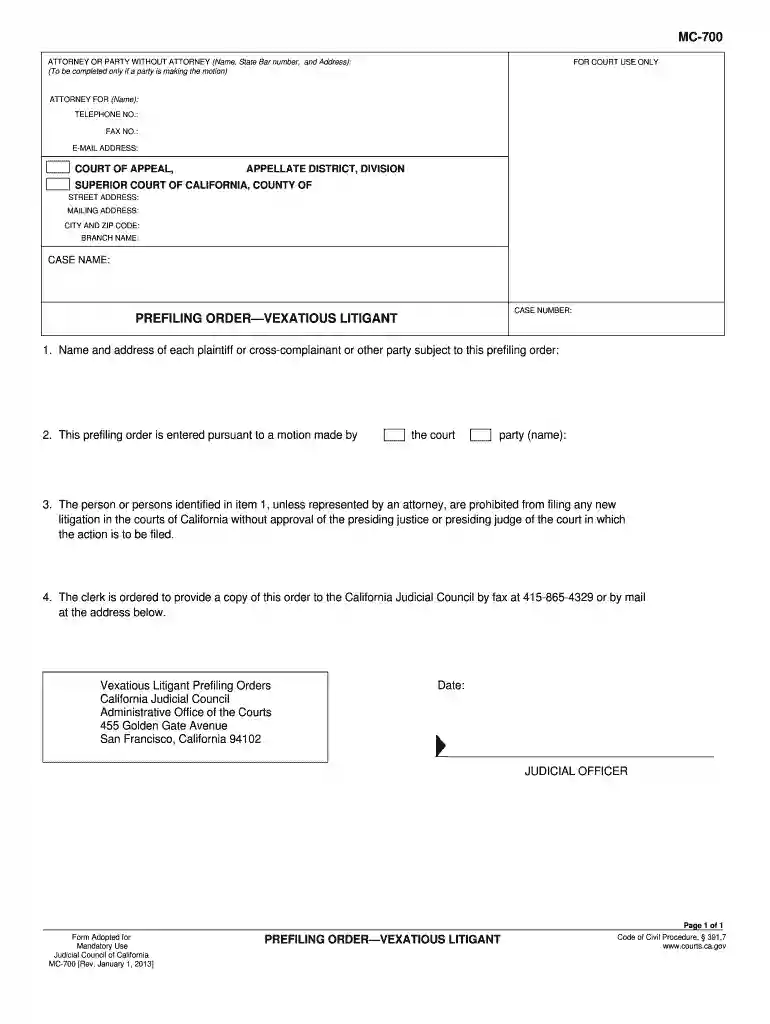
Type text, add images, blackout confidential details, add comments, highlights and more.

Draw your signature, type it, upload its image, or use your mobile device as a signature pad.

Send la county court vexatious litigant form via email, link, or fax. You can also download it, export it or print it out.
A vexatious litigant is an individual who consistently files frivolous lawsuits, primarily to harass or burden an opponent. The label "vexatious litigant" is often applied to litigants who misuse the legal system's processes without valid grounds, resulting in unnecessary legal proceedings and costs. In many jurisdictions, courts can officially designate a person as a vexatious litigant, imposing restrictions such as requiring court approval before any new litigation is filed. This measure aims to curb abuse and preserve judicial resources for legitimate claims.
The vexatious litigant form typically outlines the restrictions and permissions required for filing new litigation. When identified as a vexatious litigant, the individual must complete this form to seek prior court approval before pursuing further legal action. The form ensures the court assesses whether the proposed litigation has merit before it proceeds. This process helps prevent misuse of court resources and protects other parties from undue legal burdens.
Individuals can obtain the vexatious litigant form from the issuing court's website or the court clerk's office. In some instances, a lawyer may assist in acquiring and completing the form. It is essential to ensure the correct version of the form is used, as different jurisdictions may have varying requirements. For example, forms from California may be different from those in Texas, and using the correct form ensures compliance with local legal standards.
Basic Information: Include your personal details, such as name and contact information.
Case Details: Provide specifics of the proposed litigation, including the parties involved and the claim's nature.
Previous Litigations: Detail any past legal actions you have initiated. This section aids in assessing the legitimacy of repeated claims.
Approval Request: Formally request permission for the court to review and approve the potential filing.
Supporting Documents: Attach any relevant documentation, such as previous judgments or pertinent evidence supporting the proposed litigation.
Submission: Submit the completed form per the court's specified method, typically online, by mail, or in-person, along with any applicable fees.
Frivolous Litigation: Legal proceedings with no substantial legal merit, often intended to harass the defendant.
Court Approval: The mandatory process that vexatious litigants must undergo before filing new litigation, ensuring that the proposed claim has a valid basis.
Judicial Resources: The time, personnel, and financial resources a court allocates to handle legal proceedings, which vexatious litigation aims to protect.
Legally, the vexatious litigant form serves as a tool for courts to manage and prevent the exploitation of judicial processes. It acts as a gatekeeper, requiring individuals labeled as vexatious litigants to present credible evidence and arguments for why their case should be allowed to proceed. This safeguard is crucial in maintaining the balance between an individual's right to access legal remedies and the broader public interest in a fair and efficient judicial system.
The application of vexatious litigant status and the associated forms can vary significantly across states. For instance, California has stringent rules requiring vexatious litigants to seek permission for any new action, while other states might have different procedures or thresholds. It is essential for vexatious litigants to understand and adhere to the specific rules of the state where they intend to file litigation. Knowing these nuances ensures compliance and prevents further legal complications.
Scenario 1: An individual repeatedly files baseless lawsuits against a neighbor, all dismissed for lack of evidence. The court designates this person as a vexatious litigant, requiring them to complete the form for future filings.
Scenario 2: A business faces repeated lawsuits from a competitor aimed at hindering operations. The court intervenes, labeling the competitor a vexatious litigant and requiring them to use the form for new legal actions.
Failure to comply with the vexatious litigant requirements can lead to severe penalties. These may include dismissal of the proposed litigation, sanctions, or even a holding of contempt. The aim is to enforce the restrictions and deter misuse by holding individuals accountable if they attempt to circumvent the court's ruling. Compliance is mandatory to avoid further legal ramifications and to pursue any legitimate claims.
We've got more versions of the vexatious litigant form. Select the right vexatious litigant version from the list and start editing it straight away!
At DocHub, your data security is our priority. We follow HIPAA, SOC2, GDPR, and other standards, so you can work on your documents with confidence.
Vexatious litigation is a legal proceeding that starts with malice and without good cause. Vexatious litigation is meant to bother, embarrass, or cause legal
Under Code of Civil Procedure section 391(b), a vexatious litigant is a person who does any of the following: In the immediately preceding seven-year period


