







Definition & Meaning
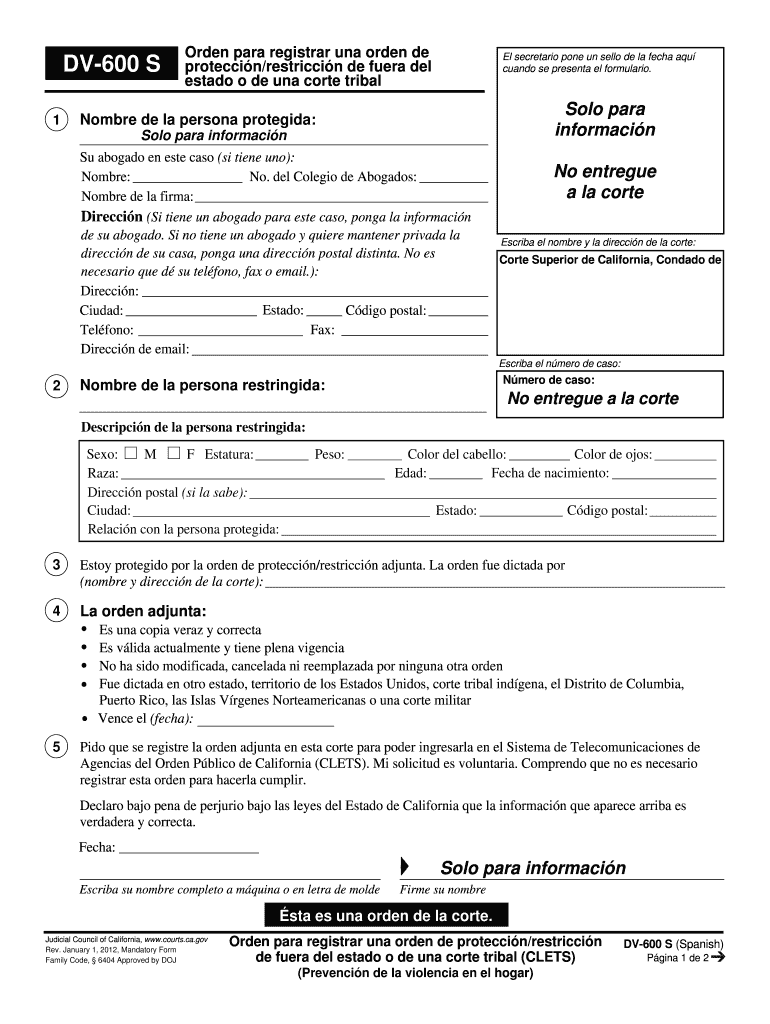
The DV-600 Order to Register Out-of-State or Tribal Court Protective Restraining Order (Spanish) Judicia is a legal form used in California to officially record a protective or restraining order that was issued by a court outside of California or by a tribal court. This registration ensures that the protective order is recognized and enforceable within the state, providing continued legal protection to the individual it was designed to safeguard.
How to Use the DV-600 Order to Register Out-of-State or Tribal Court Protective Restraining Order
To effectively use the DV-600 form, you must submit it to a California court, typically in the county where enforcement of the order is desired. This process does not require a court hearing, simplifying registration. Registrants need to provide specific details about the original protective order, including names of the protected and restrained individuals, alongside any additional documentation requested by the court. Once registered, the form allows local law enforcement to enforce the order.
Steps to Complete the DV-600 Form
- Gather Required Information: Prepare all details related to the original protective order, such as case numbers and court information.
- Fill Out the Form: Complete the DV-600 form, ensuring accuracy in personal information and order specifics.
- Attach Necessary Documents: Attach a copy of the original out-of-state or tribal court order.
- Submit the Form: Deliver the completed form to the appropriate California court. This may be done in person, by mail, or electronically if the court offers such services.
- Follow Up: Confirm the registration with the court and verify enforcement readiness with local law enforcement where protection is needed.
Who Typically Uses the DV-600 Form
This form is primarily used by individuals who have received protective or restraining orders from courts outside of California or from tribal courts and are now residing or located within California. It is particularly relevant for those needing their order to be recognized and enforced by California authorities.


Important Terms Related to the DV-600 Form
- Protected Person: The individual for whom the restraining order was issued.
- Restrained Person: The individual the restraining order is against.
- Enforceability: The ability of California law enforcement to uphold the conditions of an out-of-state or tribal order after registration.
Legal Use of the DV-600 Form
The DV-600 form serves as a bridge between jurisdictions, enabling the legal enforcement of protective orders issued by courts outside California or tribal courts. By registering such orders, individuals ensure that these legal protections are recognized under California law, maintaining their safety without needing to initiate a new court proceeding.
Key Elements of the DV-600 Form
- Personal Information: Accurate and complete details of both the protected and restrained individuals.
- Order Details: Specific information from the original out-of-state or tribal court order such as the date of issue, expiration, and any unique terms.
- Supporting Documents: Attachments that provide context and verification of the original protection order's legitimacy and current status.
State-Specific Rules for the DV-600 Form
California law provides the framework for registering out-of-state and tribal court protective orders. While this form facilitates the recognition of such orders, registrants should be aware of any county-specific requirements or additional documentation that might be requested to complete the registration process effectively.
Examples of Using the DV-600 Form
Consider a case where an individual was granted a protective order by a tribal court due to domestic issues, and they move to California for work. Upon registering the order using the DV-600 form, they ensure their continued protection across state lines. Another scenario might involve someone who obtained a restraining order in another state and now needs it recognized in California for protection against an ex-partner.
Required Documents
When submitting the DV-600 form, you'll typically need a certified copy of the original out-of-state or tribal court protective order. Additional documents might include identification to verify the protected person's identity and any further court-specific forms as required by the California jurisdiction where the registration occurs.
Form Submission Methods (Online / Mail / In-Person)
The DV-600 form can be submitted through various methods, depending on the facilities provided by the specific California court:
- Online: Some courts may allow electronic submission through an official court website.
- Mail: Applicants can send the completed form and necessary documentation via postal mail.
- In-Person: Direct submission at the courthouse provides immediate confirmation and assistance if clarifications are needed.
By following these guidelines and processes, individuals ensure their protective orders remain effective and enforceable within California, aligning with state legal requirements and personal protection needs.




