DV-150 Supervised Visitation and Exchange Order - California Courts - courts ca 2026

Get Form
DV-150 Supervised Visitation and Exchange Order - California Courts - courts ca Preview on Page 1

Here's how it works

01. Edit your form online
Type text, add images, blackout confidential details, add comments, highlights and more.

02. Sign it in a few clicks
Draw your signature, type it, upload its image, or use your mobile device as a signature pad.

03. Share your form with others
Send it via email, link, or fax. You can also download it, export it or print it out.

Definition and Meaning

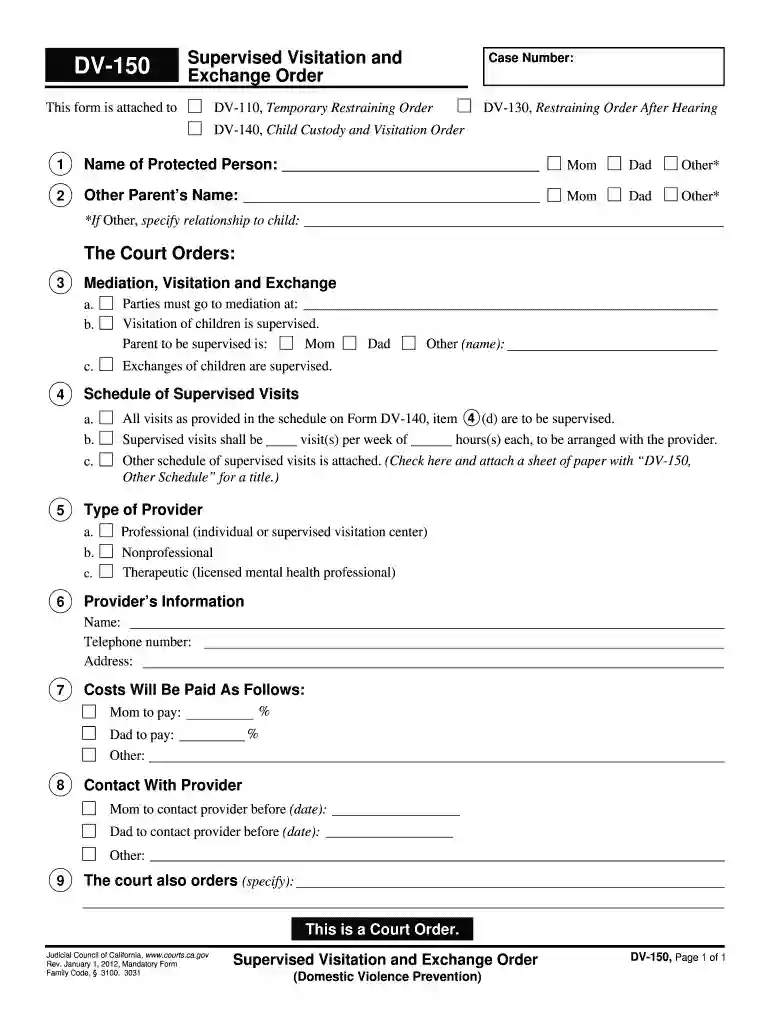
The DV-150 Supervised Visitation and Exchange Order, used by the California Courts, is a crucial legal document for families involved in domestic violence cases. It ensures that visitation between parents and their children occurs under supervision, safeguarding the child's welfare. This order lays out specific requirements, such as visitation schedules, the type of supervision required, and how costs should be shared among the parties. The document heavily intertwines with other legal aspects like restraining orders or child custody arrangements, making it an essential tool to maintain a structured and safe environment for minors during parental visits.

How to Use the DV-150 Supervised Visitation and Exchange Order

Utilizing the DV-150 involves both understanding its structure and adhering to the specified conditions. First, identify who the supervised individual is and the type of supervision mandated, whether through an agency or an agreed-upon third party. Parents should carefully review the document to stick to the agreed visitation times and locations. Compliance with the document’s stipulations not only ensures legal adherence but also promotes the child’s safety and comfort during visitations.

Key Usage Considerations:

  • Supervision Type: Identify whether professional supervision is required or if a neutral party can oversee exchanges.
  • Visitation Schedule: Follow the specified dates and times to avoid any legal complications.
  • Documentation: Keep records of each visitation to provide evidence of compliance if needed.

Steps to Complete the DV-150 Supervised Visitation and Exchange Order

Filling out the DV-150 involves several critical steps to ensure accuracy and compliance:

  1. Basic Information: Enter pertinent details about both parents and the child involved.
  2. Schedule Specification: Provide clear dates, times, and locations for visits, aligning with any court-mandated arrangements.
  3. Supervision Details: Identify the supervising party, clarifying their role and any related responsibilities.
  4. Cost Sharing: Outline financial arrangements for supervision, ensuring fair distribution of costs.
  5. Final Review: Examine the form for errors or omissions before submission to the court clerk.

This order needs careful and precise completion to avoid misunderstandings and legal setbacks.

Important Terms Related to the DV-150 Order

Understanding the terminology within the DV-150 form is important for proper compliance:

  • "Supervised Visitation": Refers to parental visits overseen by a designated supervisor.
  • "Exchange Order": Pertains to safe, structured exchanges of the child between parents.
  • "Restraining Order": A legal instrument restricting contact between individuals, often used concurrently with DV-150.
  • "Provider": The individual or agency responsible for supervising visits.

Each term and concept must be understood to maintain compliance with the form's directives.

Legal Use of the DV-150 Supervised Visitation and Exchange Order

The DV-150 order serves a legal function by structuring and monitoring interactions in sensitive situations involving domestic violence. It legally binds parties to adhere to outlined visitations, providing courts with a tool to mitigate potential risks to the child's welfare. Adhering to this order ensures that legal safeguards protect all parties, particularly minors, during familial exchanges.

Legal Considerations:

  • Compliance Monitoring: Courts may require proof of compliance with the order to protect the child's well-being.
  • Violation Consequences: Breaching the set terms can lead to legal penalties, including loss of visitation rights.

Key Elements of the DV-150 Supervised Visitation and Exchange Order

The DV-150 form integrates several key elements critical to its execution:

  • Detailed Schedules: Specifies times, locations, and frequencies of visits.
  • Type of Supervision: Outlines whether visits need professional oversight or can be supervised by a neutral party.
  • Financial Responsibilities: Details cost allocations for services required under the order.

Understanding these components helps maintain order and ensures compliance with legal standards.

State-Specific Rules for the DV-150 Form

California has specific guidelines governing DV-150 use, reflecting its statutes on family law and domestic violence. These state-specific rules ensure that all supervised visitation and exchange orders align with California’s strict regulations, enforcing protective measures tailored to this jurisdiction.

Considerations Specific to California:

  • Legal Framework: The California Family Code provides the legal foundation for the DV-150.
  • Court Procedures: Familiarize with specific court filing procedures within California jurisdictions for proper submission and validation of the form.

Examples of Using the DV-150 Supervised Visitation and Exchange Order

Real-life applications of the DV-150 showcase its importance in ensuring safety and compliance:

  • Case Example 1: A mother seeks the order during custody arrangements involving a history of domestic violence. The DV-150 facilitates secure, supervised visits, fostering peace of mind.
  • Case Example 2: Parents mutually agree to use the DV-150 to establish clear communication pathways, reducing potential conflict.

Through such examples, the tangible benefits and protective mechanisms of the DV-150 become evident.

See more DV-150 Supervised Visitation and Exchange Order - California Courts - courts ca versions

We've got more versions of the DV-150 Supervised Visitation and Exchange Order - California Courts - courts ca form. Select the right DV-150 Supervised Visitation and Exchange Order - California Courts - courts ca version from the list and start editing it straight away!
Versions Form popularity Fillable & printable
2016 4.8 Satisfied (124 Votes)
2012 4.2 Satisfied (42 Votes)
be ready to get more

Complete this form in 5 minutes or less

Get form

Got questions?

We have answers to the most popular questions from our customers. If you can't find an answer to your question, please contact us.
Contact us
Transitioning from supervised to unsupervised visitation requires parents to: Show substantial progress and a cooperative attitude towards the custodial parent and the court. Actively participate in the childs life. Seek assistance or therapy if needed. Sever ties with any negative influences.
Youll need to file a motion for modification of the visitation schedule in order to request the change from supervised visits to non-supervised visits. However if the supervised visitation has just started, keep in mind that the judge may not be inclined to grant a modification at this time.
Penalties for contempt of family court include imprisonment, community service, fines, and/or payment of the outstanding debt for financial obligations. California civil code dictates that sentencing must result in fines of up to $1,000 per act of contempt and/or as many as five days in jail.
Engage in negativity: Gossip or criticism of the other parent in front of your child harms their relationship with both parents and may violate a court order. Use drugs or alcohol before or during a visit: Never show up for visits under the influence of drugs or alcohol.
A supervised visitation order does not have any sort of usual duration. If it is successful, it can move to unsupervised visitation after six months or so. If it is unsuccessful, as it seems to be here, the court can change the order after about the same amount of time.

Security and compliance

At DocHub, your data security is our priority. We follow HIPAA, SOC2, GDPR, and other standards, so you can work on your documents with confidence.

Learn more
ccpa2
pci-dss
gdpr-compliance
hipaa
soc-compliance