




01. Edit your form online
Type text, add images, blackout confidential details, add comments, highlights and more.

Type text, add images, blackout confidential details, add comments, highlights and more.

Draw your signature, type it, upload its image, or use your mobile device as a signature pad.

Send it via email, link, or fax. You can also download it, export it or print it out.
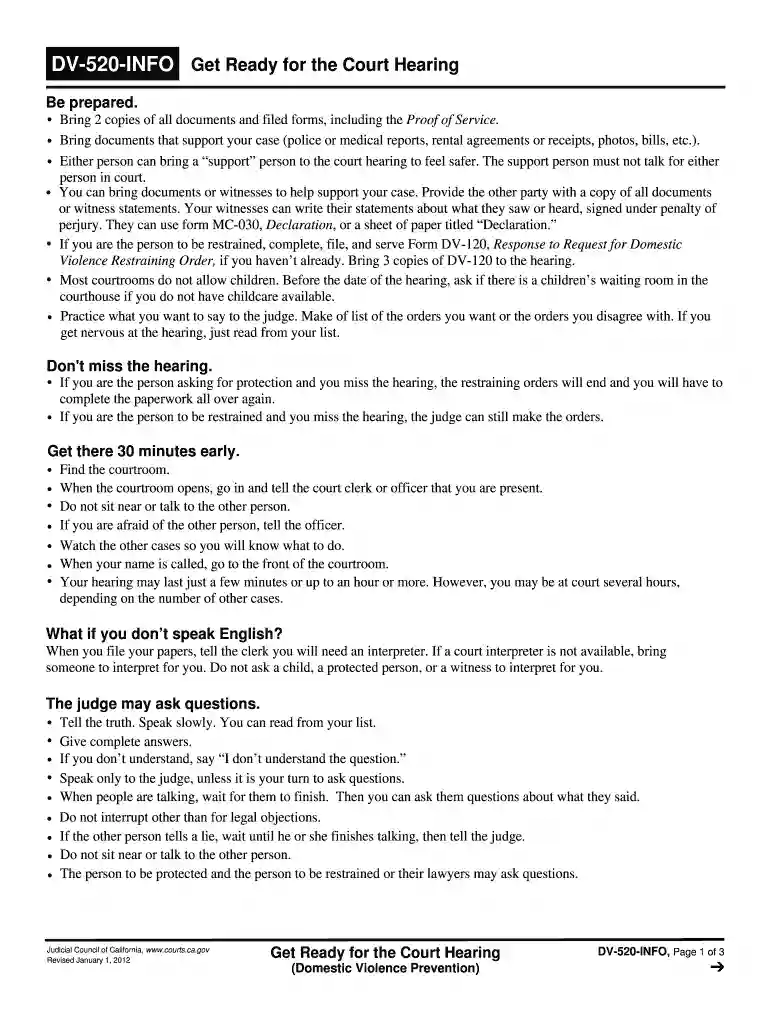
The DV-520-INFO form, also known as "Get Ready for the Court Hearing Judicial Council forms," is an essential guide for individuals preparing for court hearings related to domestic violence restraining orders in California. This informational document provides crucial guidelines on preparing for the hearing, ensuring individuals understand the process and what is required of them. It outlines necessary steps such as gathering relevant documents, understanding the role of support persons, and what to expect during and after the hearing.
To effectively use the DV-520-INFO, individuals should focus on the detailed instructions provided within the form. The document should be read thoroughly to understand the expectations and preparations required for the court hearing. Users are advised to highlight sections relating to document preparation, courtroom procedures, and post-hearing actions to ensure they are fully aware of their responsibilities and any legal obligations.
Although the DV-520-INFO itself is more of an informational tool rather than a form that requires filling, several steps are necessary to ensure readiness for the hearing:
There are several critical elements in the DV-520-INFO that users should pay attention to:
The use of the DV-520-INFO is integral to maintaining the legal process associated with domestic violence cases. It ensures that individuals understand their rights and responsibilities, helping to streamline court proceedings and improve the efficacy of legal processes. Misunderstanding or failing to comply with the guidelines could impact the outcome of the hearing and any subsequent orders.
Before attending the court hearing, individuals are instructed to bring essential documents, including:
An example of effectively using the DV-520-INFO includes using it as a guide to ensure comprehensive preparation for court hearings. For instance, Jane Doe, facing a domestic violence hearing, carefully reviews the form to understand the necessary documents she must bring and ensures she knows how to respond to potential questions from the judge. This preparation facilitates a smoother process, leading to a more informed and confident presentation in court.
While the DV-520-INFO form is specifically designed for California, it is crucial to comply with any additional state-specific guidelines if applicable. Individuals outside of California must verify if similar forms or guidelines exist in their jurisdiction and ensure alignment with their state's legal requirements.
This form emphasizes California's legal standards and practices, making awareness of regional differences imperative for those seeking judicial advice or representation outside of the state.
We've got more versions of the DV-520-INFO Get Ready for the Court Hearing Judicial Council forms - courts ca form. Select the right DV-520-INFO Get Ready for the Court Hearing Judicial Council forms - courts ca version from the list and start editing it straight away!
At DocHub, your data security is our priority. We follow HIPAA, SOC2, GDPR, and other standards, so you can work on your documents with confidence.
For more information, read form DV-520-INFO, Get Ready for the Restraining Order. Court Hearing. If you need more time to prepare your case, you may ask for
(Civil Code section 54.8.) Bring evidence or witnesses to your court hearing. If you have evidence or witnesses, read the information.
For more information, read form. DV-520-INFO, Get Ready for the Restraining Order. Court Hearing. If you need more time to prepare your case, you may ask the


