




01. Edit your form online
Type text, add images, blackout confidential details, add comments, highlights and more.

Type text, add images, blackout confidential details, add comments, highlights and more.

Draw your signature, type it, upload its image, or use your mobile device as a signature pad.

Send it via email, link, or fax. You can also download it, export it or print it out.
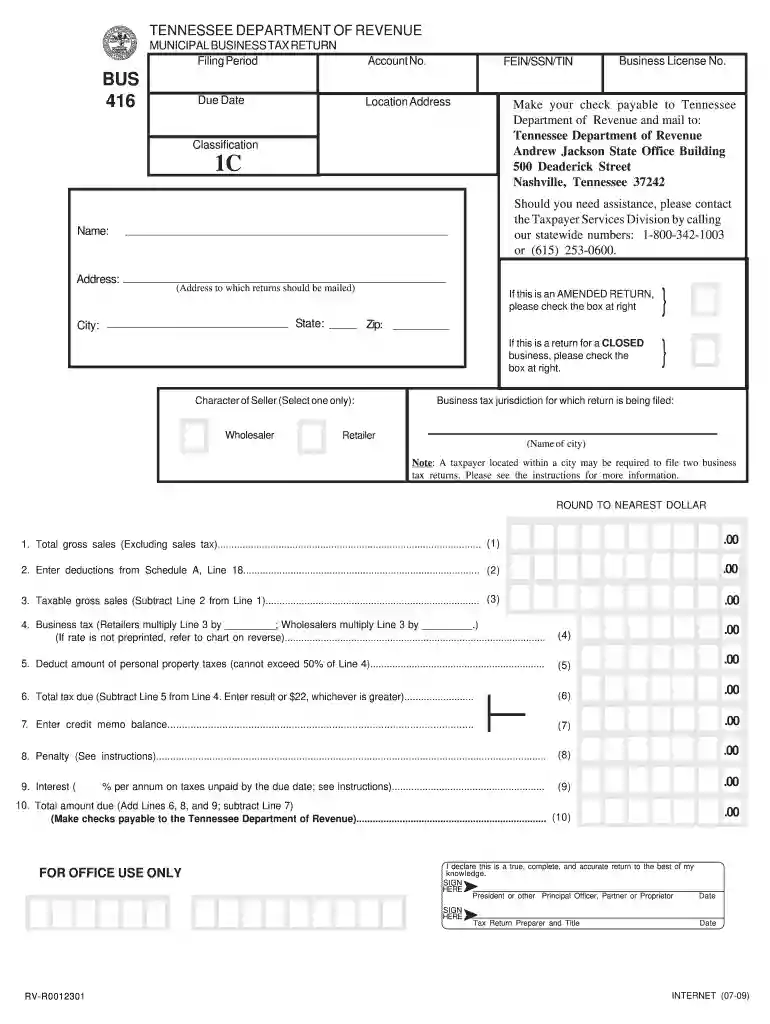
The "Municipal Business Tax Return Classification 1C - Tennessee" is an essential document for businesses operating within Tennessee. It is utilized for declaring and reporting business taxes to the Tennessee Department of Revenue. This form is specifically designed to capture details such as gross sales, deductions, and tax liabilities for businesses categorized under Classification 1C, which covers certain retail and wholesale operations. Understanding the nuances of this form is crucial for accurate tax compliance and to avoid potential penalties or interest for misreporting.
Gather Necessary Information: Before completing the form, collect essential business financial data, including gross sales figures, allowable deductions, and previous tax payments. Having comprehensive records ensures accuracy in reporting.
Download the Form: The Municipal Business Tax Return form can be acquired directly from the Tennessee Department of Revenue's official website. Ensure you have the most recent version of the form to avoid discrepancies.
Fill Out Business Details: Begin by entering your business name, address, and federal tax identification number. Verify that all details are correct to ensure proper processing.
Report Gross Sales: Input the total gross sales for the reporting period in the designated section. Ensure that this figure is accurate as it forms the basis for tax calculations.
Calculate Deductions and Adjustments: Identify and document any applicable deductions or adjustments that your business qualifies for. This could include exemptions for certain transactions or credits.
Determine Tax Due: Using the provided formula or guidelines on the form, calculate the total tax due after accounting for any deductions or credits.
Review and Sign: Double-check all entries for accuracy before signing the document. The signature validates that the information provided is truthful and complete.
Submit the Form: The completed form can be submitted online, via mail, or in person. Ensure compliance with the submission deadline to avoid late penalties.
The Municipal Business Tax Return is typically due on the 15th day of the fourth month following the close of your fiscal year. For businesses using the calendar year as their fiscal year, this would mean a deadline of April 15. It is imperative to adhere to these deadlines to prevent penalties. Keep track of any state-specific holidays that might affect submission dates.
Preparing your Municipal Business Tax Return necessitates various documents, including:
Having these documents readily available facilitates the completion and accuracy of the tax return.
Failure to file the Municipal Business Tax Return Classification 1C accurately or on time may result in significant penalties. Common penalties include a percentage of the unpaid tax plus interest on outstanding amounts. Additionally, businesses run the risk of being flagged for an audit, which could lead to further scrutiny and potential fines.
Businesses classified under LLCs (Limited Liability Companies), corporations, partnerships, and sole proprietorships are all potentially required to file the Municipal Business Tax Return Classification 1C. Each entity type may have different tax liabilities and requirements, so it's important to understand how these distinctions affect your filing.
Tennessee imposes specific rules regarding who must file a Municipal Business Tax Return. The requirement typically applies to businesses conducting taxable activities within the state. Certain exemptions, such as for small businesses with limited sales, may apply, but these require careful examination of state stipulations to determine eligibility.
Consider a small retail store in Nashville that needs to file its tax return. The business must report its annual sales, deduct allowable expenses like cost of goods sold, and calculate its net tax liability using Classification 1C guidelines. Accurate filing ensures compliance with state laws, and timely submissions can prevent penalties. Moreover, if the business undergoes an expansion or modifies its structure (e.g., from sole proprietor to LLC), the tax obligations may change, necessitating an updated approach to tax filing.
We've got more versions of the Minicipal Business Tax Return Classification 1C - tennessee form. Select the right Minicipal Business Tax Return Classification 1C - tennessee version from the list and start editing it straight away!
At DocHub, your data security is our priority. We follow HIPAA, SOC2, GDPR, and other standards, so you can work on your documents with confidence.
Class 1C. Businesses in the 1C classification are selling farm, nursery and related products including: ◾ Bulbs. ◾ Feed. ◾ Fertilizer. ◾ Grain. ◾ Hay.
Apr 1, 2019 POSITION TAKEN OR EXPECTED TO BE TAKEN IN A TAX RETURN IS REQUIRED TO MEET. BEFORE BEING RECOGNIZED IN THE FINANCIAL STATEMENTS. IT ALSO


